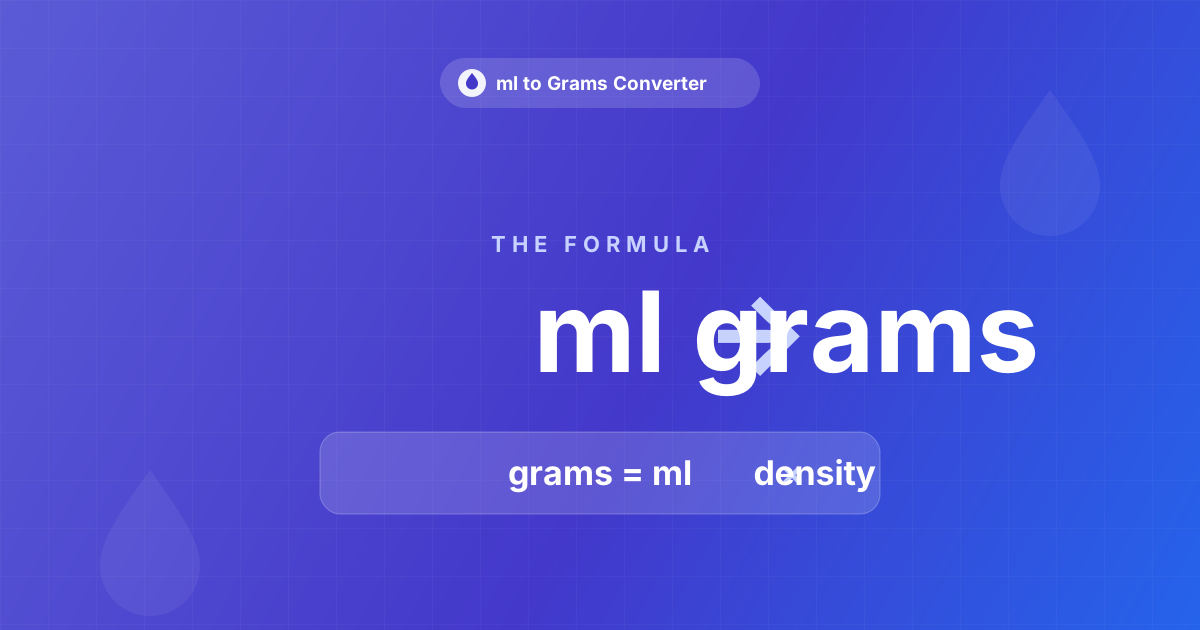
Here’s the whole trick to converting ml to grams: multiply the milliliters by the ingredient’s density in g/ml. That’s it. grams = ml × density. Water is the freebie, because its density is 1, so 200 ml of water weighs 200 g on the nose. Everything else, you’ll need its density first, and I’ll show you where to grab it. If you’d rather not do sums at all, the ml to Grams Converter handles it.
People get stuck here because ml measures space and grams measure weight, and those don’t line up on their own. Density is the bridge. Water just happens to make that bridge invisible, which is why so many recipes assume 1 ml is 1 g and then go sideways. More on that in is 1 ml the same as 1 gram.
How to convert ml to grams in three steps
There’s really not much to it. Three moves, and only one needs any effort:
- Grab your volume in milliliters.
- Find the ingredient’s density in g/ml.
- Multiply the two. That number is your weight in grams.
Quick one to prove it: you’ve got 180 ml of milk. Milk’s about 1.03 g/ml, so 180 × 1.03 = 185.4 g. That’s the whole job.
Where do you get the density?
Step two is where everyone stalls, so here are your choices, quickest first.
Easiest is a converter that already stores the densities, so you just pick the ingredient. Next easiest is the chart a bit further down, which covers the usual kitchen suspects. And if you’re working with something odd, type the product name and “density” into a search and look for a g/ml figure (g/cm³ is the same thing).
Fair warning, though: density isn’t carved in stone. Warm a liquid and it loosens up slightly; pack flour tighter and it gets heavier. So whatever you calculate is a solid estimate, not a lab reading.
Try it: the ml to Grams Converter already knows the density for dozens of ingredients. Pick one, read the grams, move on.
Some worked examples
Watching the formula run on a few things makes it stick. Every one is just grams = ml × density.
Water, 300 ml. 300 × 1.00 = 300 g. Density’s 1, so the numbers are twins. Water’s the only ingredient you can honestly eyeball.
Flour, 250 ml. 250 × 0.53 = 132.5 g. Flour’s feather-light, so the gram figure sits way below the millilitre one. This is the conversion people botch most.
Olive oil, 150 ml. 150 × 0.91 = 136.5 g. Oil’s a shade lighter than water, so it slips just under.
Honey, 200 ml. 200 × 1.42 = 284 g. Honey’s heavy, so the weight leaps past the volume. If you ever doubt that density matters, this is the example to remember.
Conversion chart: ml to grams
Use the middle column for the density, or read straight across for the amounts recipes actually call for.
| Ingredient | Density (g/ml) | 100 ml | 250 ml | 500 ml |
|---|---|---|---|---|
| Water | ~1.00 | 100 g | 250 g | 500 g |
| Whole milk | ~1.03 | 103 g | 258 g | 515 g |
| Granulated sugar | ~0.85 | 85 g | 213 g | 425 g |
| All-purpose flour | ~0.53 | 53 g | 133 g | 265 g |
| Vegetable / olive oil | ~0.92 | 92 g | 230 g | 460 g |
| Honey | ~1.42 | 142 g | 355 g | 710 g |
Something not on the list? Scale the 100 ml number. 400 ml of sugar is 85 × 4 = 340 g.
Cups and spoons count too
Half the recipes out there use teaspoons or cups instead of millilitres. No problem, just switch the measure to ml first:
- 1 teaspoon = 5 ml
- 1 tablespoon = 15 ml
- 1 US cup = 240 ml
A cup of flour, then, is 240 × 0.53 = about 127 g. A tablespoon of honey is 15 × 1.42 = about 21 g. Once it’s in millilitres, the maths is identical.
Estimating in your head
You won’t always have a calculator handy, and you don’t need one for a rough figure. Just round each density to something you can do on the fly:
- Water and milk: don’t bother changing it (×1).
- Oil: shave off about 10% (×0.9).
- Sugar: drop roughly 15% (×0.85).
- Flour: cut it in half (×0.5).
- Honey: add around 40% (×1.4).
So 200 ml of flour is “about half,” near 100 g, and 200 ml of honey is “40% more,” near 280 g. These are counter-top ballparks, not final weights, but they’ll catch a big blunder before it hits the bowl.
Where it goes wrong
Multiplying by 1 out of habit. Works for water. Nothing else. Look up the real density every time.
Muddling g/ml with kg/L. They’re the same number (1 g/ml = 1 kg/L), so you don’t convert between them, but don’t accidentally plug in grams per litre either.
Rounding the density too early. Do the multiply first, round the answer last. On a big batch, early rounding drifts.
Scooping dry ingredients. Packed flour outweighs spooned flour for the same cup. When it really matters, weigh it.
Why it’s an estimate, not gospel
The formula’s exact. The density you feed it isn’t. A warm liquid reads a little lighter, a cold one a little heavier, and scooped flour can run 20% over spooned flour in the same measure.
That doesn’t break anything. It just means your result is close and dependable, which is all a recipe asks for. When a bake genuinely hinges on precision, weighing in grams takes the guesswork out.
Frequently asked questions
What is the ml to grams formula? grams = ml × density (g/ml). Multiply the volume by the ingredient’s density. Water is ×1, which is why 200 ml of water comes to 200 g.
How do I convert ml to grams for flour? Multiply by about 0.53. So 250 ml of all-purpose flour is around 132.5 g. Packed flour weighs more, so weigh it if you can.
Does the same trick work for kilograms and litres? Yep. The kg/L density is the same figure as g/ml, so a litre of milk at 1.03 is 1.03 kg, or 1,030 g. Just keep the units paired.
Is 100 ml always 100 grams? Only for water. 100 ml of milk is about 103 g, flour about 53 g, honey about 142 g.
Going the other way
That covers turning volume into weight. Flip the problem, and start with a weight instead, and the same density just divides instead of multiplies. Converting grams to ml walks through that. Or let the ml to Grams Converter handle either direction. If you want the plain science behind it, Wikipedia’s density page is a clean read.