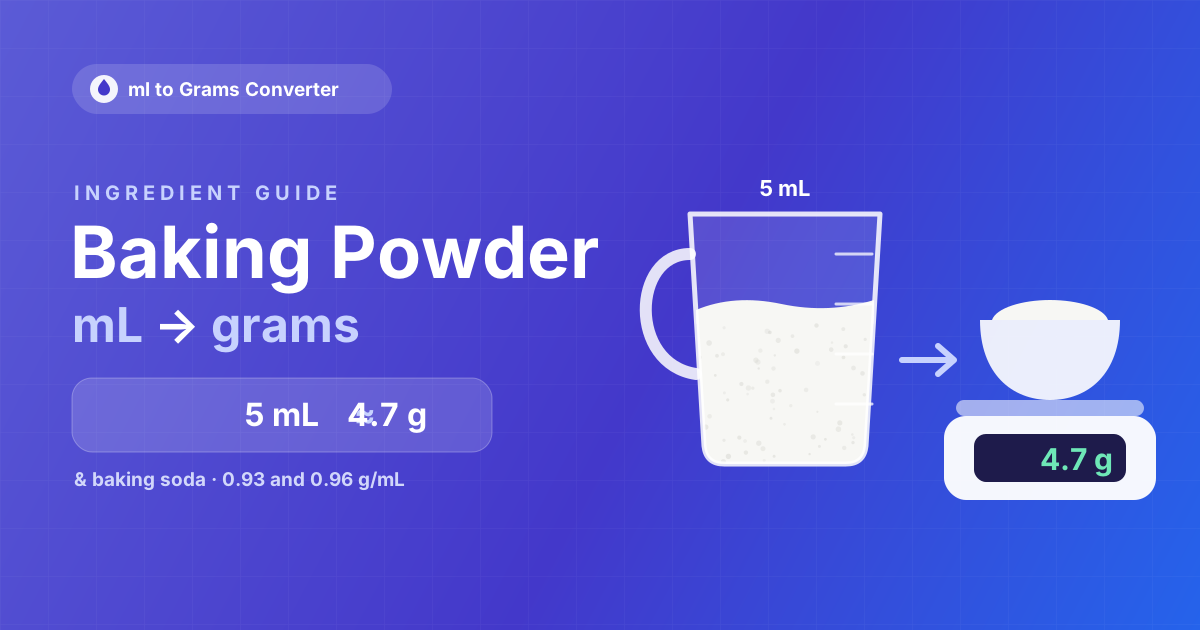
A level teaspoon (5 mL) of baking powder weighs about 4.7 g, and a level teaspoon of baking soda weighs about 4.8 g. Those figures use 0.93 g/mL for baking powder and 0.96 g/mL for baking soda, both spooned and leveled, which are the exact values in the site’s converter. The two powders weigh almost the same per spoon, but they do different jobs in a recipe, so each one gets its own chart.
Because recipes use these leaveners by the quarter teaspoon, the charts start small and stop at 60 mL. Small amounts are where the precision matters.
Baking powder mL to grams
These weights assume baking powder stirred loose in its tin, spooned into the measure and leveled, at 0.93 g/mL.
| Volume (mL) | Baking powder (g) |
|---|---|
| 1.25 mL | 1.2 g |
| 2.5 mL | 2.3 g |
| 3.75 mL | 3.5 g |
| 5 mL | 4.7 g |
| 7.5 mL | 7 g |
| 10 mL | 9.3 g |
| 12.5 mL | 11.6 g |
| 15 mL | 14 g |
| 20 mL | 18.6 g |
| 25 mL | 23 g |
| 30 mL | 28 g |
| 45 mL | 42 g |
| 60 mL | 56 g |
The first four rows match the quarter-teaspoon steps recipes usually use: 1/4, 1/2, 3/4 and 1 teaspoon. Weights are shown to one decimal below 20 g because at this scale a tenth of a gram is a real share of the total.
Baking soda mL to grams
Baking soda is slightly denser, at 0.96 g/mL for a spooned and leveled measure. The UK name is bicarbonate of soda; it is the same product, and these numbers apply to it.
| Volume (mL) | Baking soda (g) |
|---|---|
| 1.25 mL | 1.2 g |
| 2.5 mL | 2.4 g |
| 3.75 mL | 3.6 g |
| 5 mL | 4.8 g |
| 7.5 mL | 7.2 g |
| 10 mL | 9.6 g |
| 12.5 mL | 12 g |
| 15 mL | 14.4 g |
| 20 mL | 19.2 g |
| 25 mL | 24 g |
| 30 mL | 29 g |
| 45 mL | 43 g |
| 60 mL | 58 g |
At a quarter teaspoon the two powders round to the same 1.2 g. By a tablespoon, soda comes out a little heavier. The gap never gets large, which is exactly why people are tempted to treat the two as the same thing. They are not, and the section on swapping below explains why in two paragraphs.
What the two densities assume
Both values describe dry powder that has been stirred to break up any settling, dipped or spooned into a measuring spoon, and leveled flat with a knife. The spoon was not tapped or pressed. Packed powder will weigh more than these tables show, and a heaped spoon more again.
The 0.93 g/mL and 0.96 g/mL figures are the same ones the converter uses for its Baking Powder and Baking Soda options, so any number you calculate there will match this page.
Teaspoons and tablespoons, side by side
Most recipes list leaveners in spoons, so here are both powders on one table. The spoons are metric: 5 mL for a teaspoon and 15 mL for a tablespoon.
| Measure | Baking powder (g) | Baking soda (g) |
|---|---|---|
| 1/4 teaspoon (1.25 mL) | 1.2 g | 1.2 g |
| 1/2 teaspoon (2.5 mL) | 2.3 g | 2.4 g |
| 3/4 teaspoon (3.75 mL) | 3.5 g | 3.6 g |
| 1 teaspoon (5 mL) | 4.7 g | 4.8 g |
| 1 1/2 teaspoons (7.5 mL) | 7 g | 7.2 g |
| 2 teaspoons (10 mL) | 9.3 g | 9.6 g |
| 1 tablespoon (15 mL) | 14 g | 14.4 g |
A US measuring teaspoon holds 4.93 mL rather than a round 5 mL. The tables use 5 mL, and the difference is far smaller than the variation you get from how the spoon is filled, so you can use the table with either set of spoons.
Why published weights disagree by a gram or two
Look up “grams in a teaspoon of baking powder” in three places and you may get three answers. That is normal. Here is what the main references give for one level teaspoon, exactly as published.
| Source | Baking powder | Baking soda |
|---|---|---|
| USDA FoodData Central | 4.6 g | 4.6 g |
| King Arthur Baking | 4 g | 6 g |
| Common US brand labels (1/8 tsp = 0.6 g) | about 4.8 g | about 4.8 g |
USDA’s figure for baking powder is almost exactly what 0.93 g/mL predicts, and you can check it in USDA FoodData Central. King Arthur Baking lists baking powder lighter, at 4 g per teaspoon, and baking soda heavier: it gives 3 g for a half teaspoon, which is 6 g per teaspoon. Brand labels print 0.6 g for a 1/8 teaspoon serving of either powder, which scales to about 4.8 g per teaspoon.
Three things explain the spread. First, these are fine powders, and their weight per spoon depends on packing: a light dip and a firm scoop fill the same spoon differently. Second, both powders clump, and a hidden lump in the spoon adds weight. Third, humidity plays a part, because it changes how the powder settles and clumps. On top of that, label grams for servings this tiny are rounded, so a label figure is a close estimate rather than a measurement.
The values used here sit inside the published range and match the calculator. If a recipe comes from a writer who gives their own gram weights, use theirs, because those numbers reflect how they actually filled the spoon.
Why one gram matters at this scale
With flour or sugar, a gram or two either way disappears into the batter. Leaveners are different. In a small cake, an extra 1 g of leavening can be 20% more than the recipe intended. That is a much bigger proportional error than a gram of flour could ever cause.
This is the one place where an ordinary kitchen scale is not the best tool. Most kitchen scales read in whole grams, which is too coarse when the target is 2.3 g or 3.6 g. A pocket or jewelry scale that reads to 0.1 g is more accurate for these amounts. If you don’t have one, a set of level measuring spoons is more reliable than guessing at a kitchen scale’s display.
Weighing the bigger ingredients helps as well. Leavening is balanced against the flour, so a heavy hand with the flour cup throws the ratio off even when the baking powder is perfect. The flour mL to grams chart covers that side of the recipe.
Converting any amount
The formula is the same for both powders; only the density changes:
- Baking powder:
grams = mL × 0.93 - Baking soda:
grams = mL × 0.96
For example, 20 mL × 0.93 g/mL = 18.6 g of baking powder, while 20 mL × 0.96 g/mL = 19.2 g of baking soda. To go from grams back to volume, divide by the same density.
Because these densities are close to 1 g/mL, the gram and mL figures are similar, but they are not the same: mL measures volume and grams measure mass, and the two only match one for one at a density of 1 g/mL. For other volumes, enter the amount and select Baking Powder or Baking Soda in the mL to Grams Converter to calculate another amount.
Worked examples
Baking powder in a basic cake
A recipe calls for 2 teaspoons of baking powder, which is 10 mL.
10 mL × 0.93 g/mL = 9.3 g
On a 0.1 g scale, stop at 9.3 g. On a whole-gram kitchen scale, the reading could be a gram off in either direction, so measuring spoons are the safer choice here.
Baking soda in a buttermilk batter
A buttermilk pancake or quick bread recipe asks for 1/2 teaspoon of baking soda, or 2.5 mL.
2.5 mL × 0.96 g/mL = 2.4 g
That is a small quantity, and a slightly heaped half teaspoon can easily carry a good deal more. Level it carefully.
A recipe that uses both
Many recipes use a little of each. Say the list reads 1 1/2 teaspoons of baking powder and 1/4 teaspoon of baking soda.
- Baking powder:
7.5 mL × 0.93 g/mL = 6.975 g, which rounds to about 7 g. - Baking soda:
1.25 mL × 0.96 g/mL = 1.2 g.
Measure them separately with level spoons rather than eyeballing both into one heaped spoon. On a 0.1 g scale, the soda target is small enough that a single stray lump would push it well over.
A tablespoon of baking powder
Larger batches sometimes call for a full tablespoon, which is 15 mL.
15 mL × 0.93 g/mL = 13.95 g, or about 14 g.
A level tablespoon of baking soda, by comparison, is about 14.4 g. At this size a whole-gram kitchen scale is accurate enough, so tablespoon quantities are the easiest leavening amounts to weigh.
Grams to mL for baking powder and baking soda
Recipes written by weight are easy to follow with a precise scale. Without one, divide the grams by the density and measure the volume with spoons. The formulas are mL = grams ÷ 0.93 for baking powder and mL = grams ÷ 0.96 for baking soda.
| Weight (g) | Baking powder (mL) | Baking soda (mL) |
|---|---|---|
| 1 g | 1.1 mL | 1 mL |
| 2 g | 2.2 mL | 2.1 mL |
| 3 g | 3.2 mL | 3.1 mL |
| 4 g | 4.3 mL | 4.2 mL |
| 5 g | 5.4 mL | 5.2 mL |
| 6 g | 6.5 mL | 6.3 mL |
| 8 g | 8.6 mL | 8.3 mL |
| 10 g | 10.8 mL | 10.4 mL |
| 12 g | 12.9 mL | 12.5 mL |
| 15 g | 16.1 mL | 15.6 mL |
| 20 g | 22 mL | 21 mL |
Two common cases:
- A recipe asks for 5 g of baking powder.
5 g ÷ 0.93 g/mL = 5.38 mL, about 5.4 mL. That is a level teaspoon (5 mL) plus a small pinch. - A recipe asks for 3 g of baking soda.
3 g ÷ 0.96 g/mL = 3.13 mL, about 3.1 mL. That sits between a 1/2 teaspoon (2.5 mL) and a 3/4 teaspoon (3.75 mL), so fill a half teaspoon and add a little more rather than rounding up to the larger spoon.
Building gram amounts from your spoon set
Gram amounts rarely land on a single spoon, so combine spoons to get close. Say a recipe lists 6 g of baking powder: 6 g ÷ 0.93 g/mL = 6.45 mL, about 6.5 mL. One teaspoon plus a 1/4 teaspoon is 6.25 mL, which holds about 5.8 g, close enough for any home bake. Reaching for 1 1/2 teaspoons instead would overshoot to about 7 g.
Halving and doubling a recipe
Scaling is where leavening amounts turn awkward. Flour and sugar halve neatly, but half of 3/4 teaspoon is not a spoon most people own. The simplest method is to scale the volume first, then read the weight from the charts:
- Halving 1 1/2 teaspoons of baking powder gives 3/4 teaspoon, about 3.5 g.
- Doubling 1 1/2 teaspoons of baking powder gives 3 teaspoons, exactly 1 tablespoon, about 14 g.
- Doubling 2 teaspoons of baking powder gives 20 mL, about 18.6 g.
- Tripling 1/2 teaspoon of baking soda gives 1 1/2 teaspoons, about 7.2 g.
Scale every ingredient by the same factor, including the acidic ones that baking soda relies on, such as buttermilk, yogurt or cocoa. In a chocolate recipe, the cocoa powder mL to grams chart converts the cocoa side in the same way.
Measuring 1/8 teaspoon
Halving a 1/4 teaspoon leaves you needing an eighth, which holds 0.625 mL:
- Baking powder:
0.625 mL × 0.93 g/mL = 0.58 g, about 0.6 g. - Baking soda:
0.625 mL × 0.96 g/mL = 0.6 g.
That matches the 0.6 g brand labels print for a 1/8 teaspoon serving. If your set has no 1/8 teaspoon, fill and level a 1/4 teaspoon, then push half of it back into the tin with the tip of a knife. Half of 3/4 teaspoon is 3/8, so measure a 1/4 teaspoon plus an 1/8 teaspoon: about 1.7 g of baking powder or 1.8 g of baking soda. At these sizes, careful leveling does more for accuracy than any kitchen scale.
Can you swap one for the other?
Not spoon for spoon. Baking soda is pure sodium bicarbonate, which needs an acid in the recipe to work: buttermilk, yogurt, brown sugar, cocoa or lemon juice are the usual ones. Baking powder is baking soda already mixed with a dry acid and a starch filler, usually cornstarch, so it brings its own acid along. (For the filler itself, see the cornstarch mL to grams chart.)
Baking soda is roughly three to four times stronger in leavening power, so a small spoonful of it does a lot of work. Swapping by volume goes wrong in both directions: too much soda leaves a soapy or metallic taste, and too little leavening power gives a flat bake. If you are out of one, look for a recipe written for the one you have.
Measuring tips for leaveners
- Stir before you measure. Both powders settle and clump in the container. A quick stir with a dry spoon breaks this up.
- Dip, then level. Dip the measuring spoon into the loosened powder and sweep across the top with the flat back of a knife. Do not tap the spoon or press the powder in.
- Use true measuring spoons. Check that your set is marked 5 mL and 15 mL. Cutlery teaspoons are not measuring tools.
- Crush any lumps. A lump in the spoon is extra weight you didn’t intend. Press lumps out against the side of the tin before you level.
- Use a 0.1 g scale if you weigh. For quantities under a tablespoon, a pocket scale is more accurate than a kitchen scale that reads in whole grams.
- Test old baking powder. Baking powder loses strength over time once opened. Stir a little into hot water: if it fizzes, it is still good; if it barely reacts, replace it. No weight conversion can make up for a tin that has gone flat.
- Keep the labels straight. Bicarbonate of soda in a UK recipe is baking soda, so use the soda column, not the baking powder one.
For any other amount, the mL to Grams Converter has both powders listed separately, so pick the right one before you type the volume.
Frequently asked questions
How many grams is 1 teaspoon of baking powder?
A level 5 mL teaspoon of baking powder weighs about 4.7 g at 0.93 g/mL. Published figures range from about 4 g to about 4.8 g, depending on how the spoon is filled.
How many grams is 1 tablespoon of baking soda?
A level 15 mL tablespoon of baking soda weighs about 14.4 g at 0.96 g/mL. A heaped or packed tablespoon will weigh more.
How many teaspoons is 5 g of baking powder?
Five grams of baking powder is about 5.4 mL, which is a level teaspoon plus a small pinch. A 0.1 g scale is the most accurate way to measure it.
Can I use baking powder instead of baking soda?
Not one for one. Baking soda is roughly three to four times stronger and needs an acid in the recipe, while baking powder contains its own acid, so swapping by volume can leave a bake flat or give it a soapy, metallic taste.
Is bicarbonate of soda the same as baking soda?
Yes. Bicarbonate of soda is the UK name for baking soda, so the baking soda chart on this page applies to it.