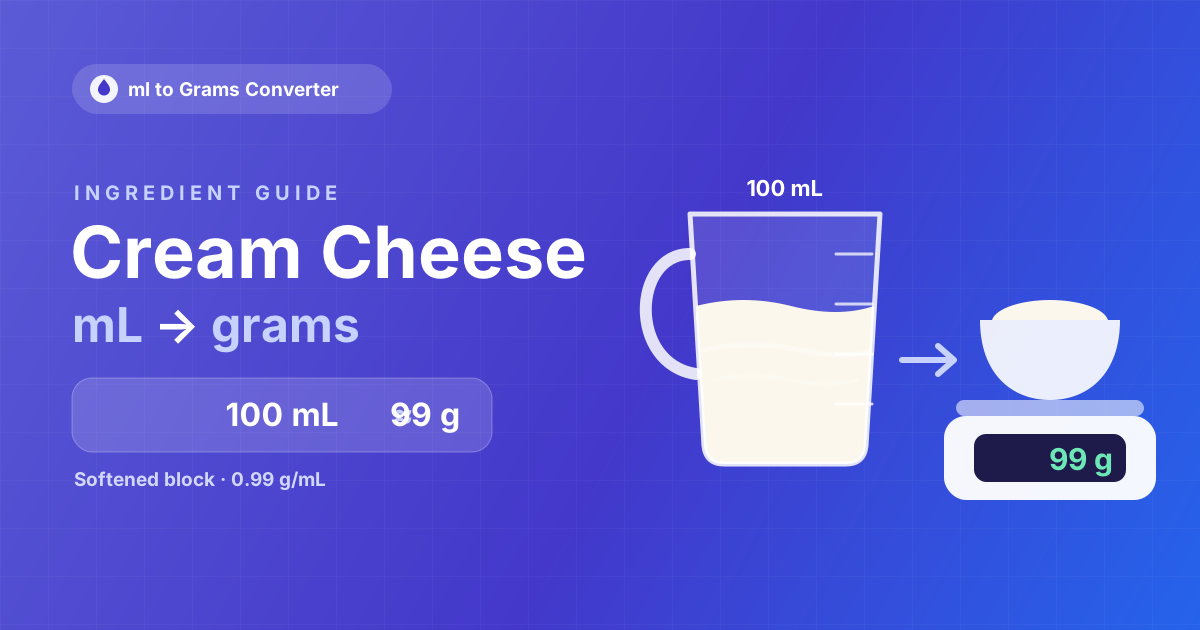
Softened block cream cheese weighs almost the same as water, volume for volume. At 0.99 g/mL, 100 mL of block cream cheese weighs about 99 g, and a US cup (240 mL) weighs about 238 g. That figure applies to block (brick) cream cheese only: tub cream cheese is heavier per spoon, at about 1.05 g/mL, and whipped cream cheese is much lighter, at about 0.74 g/mL.
So check the package before you convert. The first chart covers block cream cheese, which is the value the site’s converter uses; the second puts all three styles side by side.
Block cream cheese mL to grams
| Volume (mL) | Block cream cheese (g) |
|---|---|
| 5 mL | 5 g |
| 10 mL | 9.9 g |
| 15 mL | 14.9 g |
| 30 mL | 30 g |
| 45 mL | 45 g |
| 50 mL | 50 g |
| 60 mL | 59 g |
| 75 mL | 74 g |
| 80 mL | 79 g |
| 100 mL | 99 g |
| 120 mL | 119 g |
| 125 mL | 124 g |
| 150 mL | 149 g |
| 200 mL | 198 g |
| 225 mL | 223 g |
| 240 mL | 238 g |
| 250 mL | 248 g |
| 300 mL | 297 g |
| 500 mL | 495 g |
These values use 0.99 g/mL, the same density as the “Cream Cheese” option in the converter, so the chart and the calculator agree. The figure assumes block cream cheese that has been softened and pressed into the measure with no air gaps, then leveled. Cold cheese straight from the fridge leaves gaps and will usually weigh less than the chart shows. Amounts under 20 g are given to one decimal place and larger ones to the nearest gram.
Block, tub or whipped: the same spoon, three weights
Cream cheese comes in three common styles, and they are not interchangeable by volume. This table fills the same measure with each one.
| Volume (mL) | Block, 0.99 (g) | Tub/spreadable, about 1.05 (g) | Whipped, about 0.74 (g) |
|---|---|---|---|
| 15 mL | 14.9 g | 15.8 g | 11.1 g |
| 30 mL | 30 g | 32 g | 22 g |
| 60 mL | 59 g | 63 g | 44 g |
| 120 mL | 119 g | 126 g | 89 g |
| 240 mL | 238 g | 252 g | 178 g |
| 250 mL | 248 g | 263 g | 185 g |
The tub and whipped figures come from package labels. Philadelphia’s original tub spread lists a serving of 2 tablespoons as 31 g, which works out to about 1.05 g/mL. The whipped version lists 2 tablespoons as 22 g, about 0.74 g/mL. The original brick label, by contrast, gives its serving as 1 oz (28 g) with no tablespoon measure at all, because a brick is meant to be sliced or weighed rather than spooned.
Block and tub cream cheese land within about 6% of each other. For a bagel spread, a dip or a sauce, you can treat them as the same by volume and nobody will taste the difference.
Whipped cream cheese is another matter. It has air beaten into it, so a spoonful weighs roughly a quarter less than the same spoon of block. USDA data puts whipped cream cheese lighter still, at 10 g per tablespoon (about 0.68 g/mL), so treat 0.74 as a working figure and expect some whipped products to come in under it. The practical rule: never swap whipped for block by volume in a cheesecake. Fill the same cups with whipped cheese and the filling ends up short on cheese. Go by weight instead.
Light cream cheese behaves like regular block for measuring. USDA lists low-fat cream cheese at 240 g per cup, about 1.01 g/mL, so the block chart works for reduced-fat and Neufchâtel-style cheeses too.
Why the converter uses 0.99 g/mL
Published figures for regular cream cheese cluster tightly. USDA FoodData Central lists 1 tablespoon at 14.5 g and 1 cup at 232 g, about 0.98 g/mL, along with a 3 oz package at 85 g. The USDA’s survey database (FNDDS) uses 240 g per cup, about 1.01 g/mL. King Arthur’s ingredient chart gives 1 cup as 227 g, which follows the common convention that one 8 oz package equals a cup.
The converter’s 0.99 sits in the middle of that range, which makes it a sound value for softened block cream cheese. The spread between sources has less to do with the cheese than with how firmly each cup was packed, which the packing section below explains.
How to convert cream cheese mL to grams
Multiply the volume by the density for the style you have:
grams = mL × density
- Block:
100 mL × 0.99 g/mL = 99 g - Tub:
100 mL × 1.05 g/mL = 105 g - Whipped:
100 mL × 0.74 g/mL = 74 g
Block cream cheese is one of the few ingredients where 1 mL comes close to 1 g, and that is only because its density happens to be about 1 g/mL. The shortcut does not carry over to whipped cream cheese, where 100 mL is about 74 g.
Enter your exact volume and select Cream Cheese in the mL to Grams Converter to calculate another amount. The Cream Cheese option uses the block value. For tub cream cheese, choose Other (Custom) and enter 1.05 as the density; for whipped cream cheese, enter 0.74.
Cold vs softened: how packing changes the weight
Cream cheese is a soft solid, and its measured weight depends heavily on how it goes into the cup. Cold, firm cheese breaks into lumps that leave air gaps between them. Those gaps take up volume but add no weight, so a cup of cold cream cheese weighs less than the chart predicts. Softened cheese flows into the corners and packs fully, which is the condition the 0.99 figure describes.
To measure block cream cheese by volume:
- Let it soften until a spoon pushes into it easily.
- Spoon it into a dry measuring cup or measuring spoon in a few portions, pressing each one down with a spatula to squeeze out air.
- Level the top with a straight edge.
- Scrape the measure clean with a flexible spatula, since cream cheese clings to the sides.
If you need a volume from cold block cheese and don’t want to soften it, water displacement works. Fill a liquid measuring jug with cold water to a clear mark, add pieces of firm block cheese until the level rises by the amount you need, then pour off the water and lift out the cheese. It is accurate because the cheese is fully surrounded by water, with no air gaps.
Both methods are more work than a scale, though. Set the bowl on the scale, tare it, and add cream cheese until you reach the weight from the chart. Nothing to soften first, nothing to scrape out of a cup.
Cream cheese by the spoon and cup
The table below uses 15 mL for a tablespoon, 240 mL for a US cup and 250 mL for a metric cup, with softened block cream cheese.
| Measure | Block cream cheese (g) |
|---|---|
| 1 tablespoon (15 mL) | 14.9 g |
| 2 tablespoons (30 mL) | 30 g |
| 1/4 cup (60 mL) | 59 g |
| 1/3 cup (80 mL) | 79 g |
| 1/2 cup (120 mL) | 119 g |
| 2/3 cup (160 mL) | 158 g |
| 3/4 cup (180 mL) | 178 g |
| 1 US cup (240 mL) | 238 g |
| 1 metric cup (250 mL) | 248 g |
A level tablespoon of block cream cheese at about 14.9 g is close to the 14.5 g per tablespoon that USDA lists. For tub or whipped cream cheese, use the comparison table above: 1 tablespoon (15 mL) of tub spread is about 15.8 g, while the same spoon of whipped cream cheese is about 11.1 g.
Package sizes and recipe amounts
Cream cheese is sold by weight. In the US the standard brick is 8 oz (226 to 227 g), with a smaller 3 oz (85 g) brick also common. In many other countries it comes in tubs of 150 g, 180 g, 200 g or 300 g.
An 8 oz brick (227 g) fills about 229 mL at the converter density, a little under a US cup (240 mL). That is why many recipes treat one brick as “about 1 cup.” A 3 oz brick (85 g) is about 86 mL, and two 8 oz bricks together (454 g) come to about 459 mL.
Soft tub cream cheese takes up a little less space per gram because it is denser. A 200 g tub is about 190 mL at 1.05 g/mL, a 150 g tub about 143 mL, and a 300 g tub about 286 mL.
Using part of a brick
Dips, sauces and small batches of frosting often need only part of a package. Rather than packing a measuring cup and scraping it out, cut the brick and weigh the piece. Half of an 8 oz brick is about 113 g, which fills about 114 mL, a shade under 1/2 cup. The smaller 3 oz brick works as a ready-measured 1/3 cup: the recipe needs about 79 g, and the brick holds 85 g, so one brick covers it with a few grams to spare.
Before you wrap the leftover piece, weigh it and write the figure on the wrapping. The next time a recipe asks for 1/4 cup, you will know at a glance whether the 59 g you need is there, without unwrapping and guessing.
Cheesecake and frosting amounts
Recipes for cheesecake and cream cheese frosting are usually written in packages or grams, and it pays to follow them that way. A large cheesecake that calls for 900 g of block cream cheese is working with about 909 mL of cheese, and trying to measure that in cups invites every packing error described above. Volume conversions are most useful for the small amounts: a spoonful stirred into a sauce, a quarter cup in a dip, a spread for toast.
Frosting usually pairs cream cheese with butter, and the butter mL to grams guide covers that side of the recipe. If a no-bake filling or frosting also calls for whipping cream, the cream mL to grams guide has those figures.
Worked examples
Cream cheese frosting from a cup measure. A cupcake frosting asks for 1/2 cup (120 mL) of softened block cream cheese.
120 mL × 0.99 g/mL = 118.8 g, so weigh about 119 g.
A cheesecake written in cups. An older cheesecake recipe asks for 2 cups of cream cheese. Taken literally, that is two 240 mL US cups of softened block cheese:
480 mL × 0.99 g/mL = 475.2 g, about 475 g.
Two 8 oz bricks weigh 454 g, so a strict conversion says two bricks plus about 21 g, a little over a tablespoon. Before you open a third brick, consider how the recipe was written. Many US recipes treat one 8 oz brick as “1 cup”, the same convention behind King Arthur’s 227 g per cup, so a filling described as 2 cups was most likely developed with two bricks. Use 454 g. By the same logic, 3 cups means three bricks, about 680 g, which takes up roughly 687 mL of block cheese. If the recipe gives grams as well as cups, the grams settle the question.
A dip made with tub cream cheese. A party dip calls for 250 mL of spreadable cream cheese from a tub.
250 mL × 1.05 g/mL = 262.5 g, so about 263 g.
Many cream cheese dips also use sour cream; the sour cream mL to grams chart converts that part.
Whipped cream cheese on a bagel. You want 2 tablespoons (30 mL) of whipped cream cheese.
30 mL × 0.74 g/mL = 22.2 g, so about 22 g, which matches the whipped tub label.
Swapping whipped for block in a cheesecake. A recipe needs 225 g of block cream cheese and all you have is whipped. Measured by volume, 225 mL of block cream cheese is about 223 g, but the same 225 mL of whipped cream cheese is only about 167 g:
225 mL × 0.74 g/mL = 166.5 g
That cup would leave the filling well short. Weigh out 225 g of whipped cream cheese instead, which fills a good deal more space:
225 g ÷ 0.74 g/mL = 304 mL
Grams to mL for cream cheese
To go from a weight back to a volume, divide by the density:
mL = grams ÷ density
For block cream cheese, 227 g ÷ 0.99 g/mL = 229 mL. The table covers the package sizes and recipe weights that come up most often.
| Weight (g) | Block cream cheese (mL) |
|---|---|
| 28 g | 28 mL |
| 50 g | 51 mL |
| 85 g | 86 mL |
| 100 g | 101 mL |
| 113 g | 114 mL |
| 150 g | 152 mL |
| 200 g | 202 mL |
| 225 g | 227 mL |
| 227 g | 229 mL |
| 250 g | 253 mL |
| 300 g | 303 mL |
| 454 g | 459 mL |
| 500 g | 505 mL |
The same weight takes up very different volumes depending on the style. An 8 oz package (227 g) is about 229 mL of block cream cheese, about 216 mL of tub spread and about 307 mL of whipped cream cheese. That gap is the clearest reason to buy, measure and substitute cream cheese by weight.
For the 1 oz (28 g) serving printed on brick labels, the volume is about 28 mL, a little under 2 tablespoons. At 100 g, block cream cheese occupies about 101 mL, so for rough work on block cheese alone, grams and milliliters can be swapped almost one for one.
Frequently asked questions
How many grams is 1 cup of cream cheese?
A US cup (240 mL) of softened block cream cheese, pressed in without air gaps, weighs about 238 g. The same cup holds about 252 g of tub cream cheese and about 178 g of whipped cream cheese.
How many grams are in 2 tablespoons of cream cheese?
Two tablespoons (30 mL) of block cream cheese come to about 30 g. Tub cream cheese is about 32 g for the same amount, and whipped cream cheese about 22 g.
How many mL is an 8 oz package of cream cheese?
An 8 oz (227 g) brick of block cream cheese is about 229 mL, a little under a US cup. That is why recipes often describe one brick as roughly 1 cup.
Can I use whipped cream cheese instead of block?
Yes, but measure it by weight, not volume. Whipped cream cheese has air beaten in and weighs roughly a quarter less per spoon, so swapping it cup for cup leaves a cheesecake or frosting short on cheese.
Is 1 mL of cream cheese equal to 1 gram?
For softened block cream cheese it is very close, because its density is about 0.99 g/mL. Tub cream cheese is heavier and whipped cream cheese is much lighter, so the 1 to 1 shortcut only works for block.