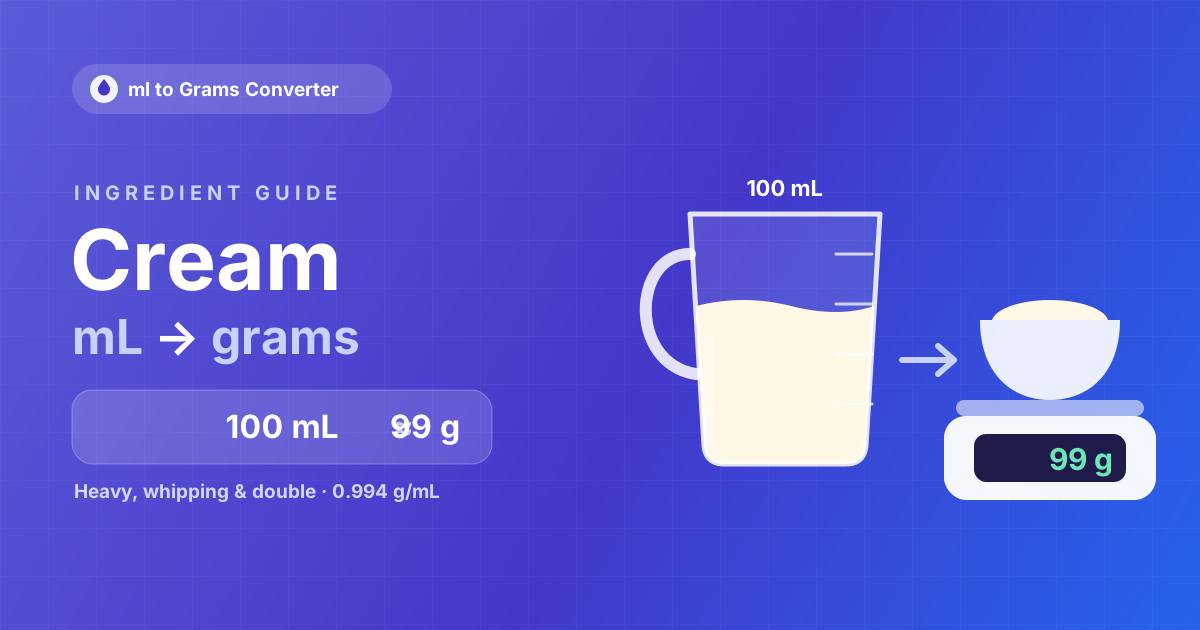
Liquid cream weighs almost, but not exactly, the same in grams as it measures in milliliters. At the converter’s heavy cream density of 0.994 g/mL, 100 mL of heavy cream weighs about 99 g and 250 mL weighs about 249 g. Whipping cream sits at roughly 1 g/mL, and UK double cream comes out slightly lighter per mL because it carries more fat.
Those three figures are never more than about 2% apart, which works out to a few grams per 250 mL. The bigger trap is the names. US heavy cream and UK double cream are different products, so this page keeps them in separate columns.
Heavy cream mL to grams chart
Every row below uses 0.994 g/mL, the same value applied when you select Heavy Cream in the mL to grams converter.
| Volume (mL) | Heavy cream (g) |
|---|---|
| 5 mL | 5 g |
| 10 mL | 9.9 g |
| 15 mL | 14.9 g |
| 30 mL | 30 g |
| 50 mL | 50 g |
| 60 mL | 60 g |
| 100 mL | 99 g |
| 120 mL | 119 g |
| 125 mL | 124 g |
| 150 mL | 149 g |
| 200 mL | 199 g |
| 240 mL | 239 g |
| 250 mL | 249 g |
| 300 mL | 298 g |
| 400 mL | 398 g |
| 500 mL | 497 g |
The density comes from the University of Guelph’s dairy science reference, which measured heavy cream with 36.6% fat at 0.994 g/mL at 20 °C. In other words, the chart assumes liquid cream at room temperature, poured into a jug and not whipped. Small amounts are shown to one decimal place and larger amounts to the nearest gram, which is as precise as a kitchen scale needs to be.
Heavy, whipping and double cream are different products
Cream is sold by fat content, and the US and UK draw the lines in different places. That is why a British recipe and an American recipe can both say “cream” and mean noticeably different things.
In the US, heavy cream (also sold as heavy whipping cream) must contain at least 36% milk fat under federal rules. Light whipping cream, often labeled simply whipping cream, ranges from 30% up to just under 36%. In the UK, the Dairy UK code, which is based on the former Food Labelling Regulations, sets double cream at a minimum of 48% fat, whipping cream at 35% and single cream at 18%.
| Product | Where | Minimum milk fat |
|---|---|---|
| Heavy cream (heavy whipping cream) | US (21 CFR 131.150) | 36% |
| Light whipping cream (whipping cream) | US (21 CFR 131.157) | 30% (under 36%) |
| Whipping cream | UK | 35% |
| Double cream | UK | 48% |
| Single cream | UK | 18% |
Read across the table and one point stands out: US heavy cream is much closer in fat to UK whipping cream than to double cream. Double cream has far more fat. It whips faster and is harder to curdle, so it behaves differently in a hot sauce or a bowl of whipped cream even when the weight conversion barely changes.
So if a British recipe calls for double cream and you are shopping in the US, heavy cream will convert to almost the same weight, but expect it to take longer to whip and to be less forgiving if a sauce boils hard. Going the other way, a US recipe that says heavy cream is not asking for double cream, and swapping it in will give a richer result that whips faster.
Other regional names, such as thickened cream, are not covered by the figures on this page. If your carton carries one of those names, check the fat percentage on the label and use the row in the comparison below that matches it most closely.
Why more fat means fewer grams per mL
Milk fat is lighter than water. The more of it a cream contains, the less each milliliter weighs. The Guelph measurements show the trend clearly: light cream with 20% fat measures 1.012 g/mL at 20 °C, while heavy cream with 36.6% fat measures 0.994 g/mL at the same temperature.
Following that trend upward, this article uses about 0.98 g/mL for UK double cream. That number is an estimate drawn from the fat trend, not a direct measurement of double cream, so treat every double cream figure here as a close kitchen approximation.
The comparison below puts all three side by side. Each column assumes liquid cream at room temperature.
| Volume (mL) | Heavy, 0.994 (g) | Whipping, about 1.00 (g) | Double, about 0.98 (g) |
|---|---|---|---|
| 15 mL | 14.9 g | 15 g | 14.7 g |
| 50 mL | 50 g | 50 g | 49 g |
| 100 mL | 99 g | 100 g | 98 g |
| 150 mL | 149 g | 150 g | 147 g |
| 200 mL | 199 g | 200 g | 196 g |
| 250 mL | 249 g | 250 g | 245 g |
| 300 mL | 298 g | 300 g | 294 g |
| 500 mL | 497 g | 500 g | 490 g |
At 250 mL, heavy cream comes to 249 g, whipping cream to 250 g and double cream to about 245 g. That spread will not show up in a sauce, a gratin or a tray of scones. It starts to matter only in recipes built on exact ratios, such as ganache or caramel, and even there a scale solves it.
How to convert cream from mL to grams
The formula is the same one used for every ingredient: grams = mL × density. For heavy cream, that means multiplying the volume by 0.994:
150 mL × 0.994 g/mL = 149.1 g, which rounds to 149 g.
To go the other way, divide instead: mL = grams ÷ density. Because cream is so close to 1 g/mL, the gram figure always lands near the mL figure. For example, 100 mL of heavy cream is about 99 g, and even 500 mL of double cream is about 490 g by the estimate.
That closeness makes cream one of the few ingredients where reading a jug marking as a rough gram weight gets you near the right answer. It is still not an identity. The gap widens as the fat content rises and as the volume grows. Enter your exact volume and select Heavy Cream in the mL to Grams Converter to calculate an amount that is not in the tables.
Cream by the spoon and cup
American recipes usually measure cream in cups and tablespoons. This table uses 15 mL for a tablespoon, 240 mL for a US cup and 250 mL for a metric cup, matching the rest of this site.
| Measure | Heavy cream (g) |
|---|---|
| 1 teaspoon (5 mL) | 5 g |
| 1 tablespoon (15 mL) | 14.9 g |
| 2 tablespoons (30 mL) | 30 g |
| 1/4 cup (60 mL) | 60 g |
| 1/3 cup (80 mL) | 80 g |
| 1/2 cup (120 mL) | 119 g |
| 2/3 cup (160 mL) | 159 g |
| 3/4 cup (180 mL) | 179 g |
| 1 US cup (240 mL) | 239 g |
| 1 metric cup (250 mL) | 249 g |
USDA FoodData Central lists 1 cup of liquid heavy whipping cream at 238 g, which agrees closely with the 239 g in the table. That match is a useful check that the density holds for ordinary supermarket cream and not only for laboratory samples.
Carton sizes help too. A US half-pint carton holds about 237 mL, so its weight sits very close to the 1 US cup row. UK cream comes in 150 mL, 300 mL and 600 mL pots, and the first two appear directly in the charts above.
Worked examples from real recipes
Each example shows the multiplication or division, so you can repeat it with your own numbers.
Chocolate ganache by weight
Ganache depends on the ratio of chocolate to cream, which is why many recipes give both by weight. Suppose a recipe asks for 200 g of heavy cream and your cream is in a jug rather than on a scale. Divide by the density:
200 g ÷ 0.994 g/mL = 201 mL
Pour to just above the 200 mL line. If you pour exactly to the 200 mL mark instead, that volume gives about 199 g, which is close enough for a standard ganache. For glossy glazes where the ratio is tight, weigh the cream directly.
Whipped cream from a UK carton of double cream
A 300 mL carton of double cream weighs about 294 g using the estimated density:
300 mL × 0.98 g/mL = 294 g
Whip it and the volume roughly doubles as air is beaten in, but the weight stays the same. When a recipe lists cream by volume and then tells you to whip it, measure the liquid first. Measuring already-whipped cream in a jug gives a very different amount of cream.
A creamy pan sauce
Say a pan sauce recipe finishes with 1/4 cup of cream, which is 60 mL. With heavy cream:
60 mL × 0.994 g/mL = 59.64 g, rounded to 60 g.
With UK double cream, the estimate gives about 59 g for the same volume. The weight difference is trivial here. What matters more is behavior: double cream is harder to curdle when the sauce bubbles, while heavy cream, with less fat, curdles more easily, so keep the heat gentle once it goes in.
Cream scones on a scale
A batch of scones calls for 250 mL of heavy cream, and you would rather weigh it straight into the flour bowl than dirty a jug. Multiply:
250 mL × 0.994 g/mL = 248.5 g, so add about 249 g.
Weighing into the bowl has a second advantage. Thick cream clings to the sides of a measuring cup, and whatever stays behind never reaches the dough. If your scone recipe also uses melted butter, the butter mL to grams chart has its own figures, since butter does not share cream’s density.
Older British recipes sometimes ask for half an imperial pint of cream, which is 284 mL. As heavy cream that is 284 mL × 0.994 g/mL = 282 g, and as double cream the estimate gives about 278 g.
Grams of cream back to mL
Recipes written by weight need the reverse calculation when all you have is a measuring jug. Divide the grams by 0.994:
| Weight (g) | Heavy cream (mL) |
|---|---|
| 10 g | 10.1 mL |
| 25 g | 25 mL |
| 50 g | 50 mL |
| 100 g | 101 mL |
| 150 g | 151 mL |
| 200 g | 201 mL |
| 250 g | 252 mL |
| 300 g | 302 mL |
| 500 g | 503 mL |
The mL figures sit at or just above the gram weights because heavy cream is slightly lighter than water. For whipping cream at about 1 g/mL, grams and mL are effectively the same number, so 250 g needs roughly 250 mL.
Double cream needs a little more volume per gram. The division works the same way with the 0.98 estimate:
250 g ÷ 0.98 g/mL = 255 mL
At the same rate, 100 g of double cream takes about 102 mL and 500 g takes about 510 mL. If you convert double cream this way often, a scale will save you from carrying a second set of numbers around.
Liquid cream versus whipped cream
Every figure on this page is for liquid cream. Whipped cream holds a lot of air and roughly doubles in volume when beaten, so a cup of it weighs far less than a cup of the liquid.
USDA FoodData Central shows the contrast plainly. It lists 1 cup of liquid heavy whipping cream at 238 g and 1 cup of whipped cream at 120 g. Some online converters mistakenly apply the whipped figure to liquid cream, which produces weights about half of the real value. If a chart gives a gram figure for liquid cream that is roughly half its mL figure, it has made that error.
The fix is simple. Measure or weigh cream while it is liquid, then whip it. If a recipe gives whipped cream by volume, such as a cup of whipped cream to fold into a mousse, start with about half that volume of liquid cream and whip until you reach the amount you need.
Temperature, fat and other small variables
Cold cream is slightly denser than cream at room temperature. The Guelph measurements put heavy cream at 1.008 g/mL at 4.4 °C, typical fridge temperature, compared with 0.994 g/mL at 20 °C. That is about 1% more weight per mL, which is negligible for cooking. There is no need to warm cream before measuring it.
Brands also vary within the legal ranges. A carton with more fat than the minimum will be marginally lighter per mL, but the change stays inside the small spread shown in the comparison table. Lighter creams run the other way: with less fat, they weigh a little more per mL than heavy cream, and milk, with less fat again, is heavier still. The milk mL to grams guide covers whole, 2% and skim milk.
Sour cream is a different case. It is cultured and much thicker, so it is measured and weighed differently from pouring cream. Use the dedicated sour cream conversion chart rather than these figures.
Measuring cream accurately
A few habits make cream measurements more reliable:
- Weigh when ratios matter. For ganache, caramel, custards and most baking, set the bowl on a scale, press tare and pour. This removes the density question entirely.
- Scrape the jug or cup. Heavy and double cream coat the sides of a measure. A silicone spatula recovers what would otherwise be left behind.
- Read liquid measures at eye level. Set the jug on a flat counter and crouch to the line. Reading from above makes the level hard to judge.
- Match the cup size to the recipe. A US cup is 240 mL and a metric cup is 250 mL. The difference is 239 g against 249 g of heavy cream, enough to notice in a small cake.
- Never measure cream after whipping unless the recipe specifically asks for whipped cream by volume.
- Use carton sizes as a shortcut. A 150 mL pot is about 149 g at the heavy cream density, or 147 g as double cream by estimate. A 300 mL pot is about 298 g, or 294 g as double cream. When a recipe uses a whole pot, you can skip measuring altogether.
- Round small amounts sensibly. A tablespoon of heavy cream is 14.9 g, so treating it as 15 g is perfectly fine.
Frequently asked questions
Is 200 mL of cream the same as 200 g?
Nearly, but not exactly. 200 mL of heavy cream weighs about 199 g, whipping cream about 200 g, and UK double cream about 196 g by estimate. The gap is too small to affect most recipes, although mL and grams remain different units.
How many grams is 1 cup of heavy cream?
A US cup (240 mL) of heavy cream weighs about 239 g, and a metric cup (250 mL) weighs about 249 g. USDA FoodData Central lists 238 g for 1 cup of liquid heavy whipping cream, which agrees closely.
Is heavy cream the same as double cream?
No. US heavy cream must contain at least 36% milk fat, while UK double cream has at least 48%. Double cream whips faster, is harder to curdle and weighs slightly less per mL, at an estimated 0.98 g/mL compared with 0.994 g/mL for heavy cream.
How much does 250 mL of double cream weigh?
About 245 g, using an estimated density of 0.98 g/mL. That estimate comes from the way density falls as fat rises, not from a direct measurement of double cream, so treat it as a close kitchen figure.
Why do some charts show cream at half its real weight?
They use the USDA figure for whipped cream, 120 g per cup, for liquid cream. Liquid heavy whipping cream is listed at 238 g per cup, so use a liquid cream figure unless your cream is already whipped.