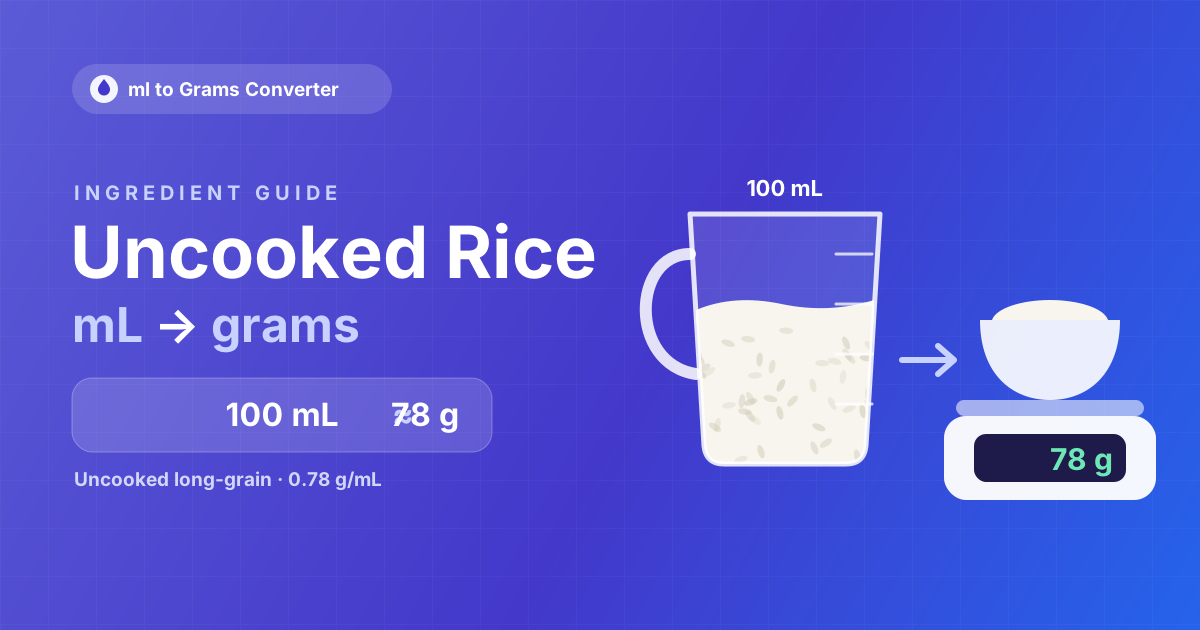
Uncooked long-grain white rice weighs about 78 g per 100 mL. That uses a density of 0.78 g/mL for dry grains poured into a measure and leveled without tapping, which is the value behind the “Rice, uncooked” option in the site’s converter. A 250 mL metric cup of uncooked long-grain rice holds about 195 g.
Cooked rice is a separate conversion with its own density, so first decide which one you are measuring. The charts below keep the two states apart, and each one is labeled UNCOOKED or COOKED so there is no guessing.
Uncooked rice: the main chart
UNCOOKED rice mL to grams (long-grain white, 0.78 g/mL)
Use this chart for dry, UNCOOKED long-grain white rice straight from the bag, measured before rinsing.
| Volume (mL) | Uncooked long-grain rice (g) |
|---|---|
| 15 mL | 11.7 g |
| 30 mL | 23 g |
| 50 mL | 39 g |
| 60 mL | 47 g |
| 75 mL | 59 g |
| 80 mL | 62 g |
| 100 mL | 78 g |
| 120 mL | 94 g |
| 125 mL | 98 g |
| 150 mL | 117 g |
| 180 mL | 140 g |
| 200 mL | 156 g |
| 240 mL | 187 g |
| 250 mL | 195 g |
| 300 mL | 234 g |
| 400 mL | 312 g |
| 500 mL | 390 g |
Density assumption: 0.78 g/mL for UNCOOKED long-grain white rice, filled into the measure and leveled, not shaken or tapped. It matches the 185 g per cup that USDA FoodData Central lists for raw long-grain white rice, and it is the same figure the converter uses for “Rice, uncooked”. Weights under 20 g keep one decimal place; everything else is rounded to the nearest gram.
Why cooked rice needs its own numbers
Rice changes completely in the pot. The grains absorb water and swell, and once cooked they sit loosely against each other with air gaps between them. Both of those things affect how much rice fits into a cup, and they pull in opposite directions.
The surprising result is that cooked white rice weighs less per mL than raw rice, even though every individual grain is heavier after cooking. USDA data puts a cup of raw long-grain white rice at 185 g, but a loosely filled cup of the cooked version at only 158 g. The swollen grains are bulkier, so fewer of them fit in the cup.
Brown rice behaves differently. Cooked long-grain brown rice packs more densely, and USDA lists it at 202 g per cup. So even among cooked rice there is no single figure that fits every type.
You may come across converter sites that use 1.06 g/mL for cooked rice. That would make cooked rice heavier than water by volume, and USDA’s cooked cup weights, 158 g for long-grain white and 202 g for long-grain brown, do not support it. Treat any cooked-rice figure above 1 g/mL with suspicion.
Cooked rice: a separate chart
COOKED rice mL to grams
This chart is for COOKED rice only, spooned loosely into a cup or jug after cooking. Do not use it for dry grains.
| Volume (mL) | Cooked white long-grain, 0.67 (g) | Cooked brown long-grain, 0.85 (g) |
|---|---|---|
| 50 mL | 34 g | 43 g |
| 100 mL | 67 g | 85 g |
| 125 mL | 84 g | 106 g |
| 150 mL | 101 g | 128 g |
| 200 mL | 134 g | 170 g |
| 240 mL | 161 g | 204 g |
| 250 mL | 168 g | 213 g |
| 300 mL | 201 g | 255 g |
| 500 mL | 335 g | 425 g |
The white column uses 0.67 g/mL, based on USDA’s 158 g per cup for COOKED long-grain white rice. The brown column uses 0.85 g/mL, based on 202 g per cup for COOKED long-grain brown rice. Both assume the rice is fluffed and loosely filled. Pressing cooked rice into a cup squeezes out the air gaps and makes it heavier, so a packed cup will weigh more than these figures.
Other cooked types sit elsewhere again. USDA lists cooked medium-grain white rice at 186 g per cup and cooked medium-grain brown rice at 195 g per cup. If you cook those often and need accuracy, weigh the finished rice rather than converting it.
How to convert rice between mL and grams
The formula is the same for both states: grams = mL × density. The only decision is which density to use.
For UNCOOKED long-grain white rice: 100 mL × 0.78 g/mL = 78 g
For COOKED long-grain white rice: 200 mL × 0.67 g/mL = 134 g
Enter your volume and select “Rice, uncooked” in the mL to Grams Converter for dry rice. The converter has no cooked-rice entry, so for cooked rice choose Other (Custom) and enter 0.67 for white long-grain or 0.85 for brown long-grain.
To go from weight to volume, divide instead: mL = grams ÷ density. The two reverse charts near the end of this page cover the usual weights.
Which state does your recipe mean?
Most recipes make it clear if you read the wording closely. An ingredient line such as “1 cup long-grain rice, rinsed” or an instruction to add rice to boiling water means dry, uncooked rice. Phrases like “2 cups cooked rice”, “leftover rice” or “day-old rice” mean the rice is already cooked, and those amounts belong in the COOKED chart.
Nutrition labels and meal plans need the same care. A rice package normally gives its serving as a dry weight, while a meal plan may list a cooked portion. If the source does not say, assume a package figure is uncooked and check the wording of a meal plan before converting it.
Long, medium and short grain
UNCOOKED rice by variety
USDA gives different cup weights for UNCOOKED long-, medium- and short-grain white rice. The table converts each of them at its own density.
| Volume (mL) | Uncooked long-grain, 0.78 (g) | Uncooked medium-grain, 0.82 (g) | Uncooked short-grain, 0.85 (g) |
|---|---|---|---|
| 60 mL | 47 g | 49 g | 51 g |
| 100 mL | 78 g | 82 g | 85 g |
| 120 mL | 94 g | 98 g | 102 g |
| 240 mL | 187 g | 197 g | 204 g |
| 250 mL | 195 g | 205 g | 213 g |
The shorter the grain, the more it weighs per cup in USDA data: 185 g for long-grain, 195 g for medium-grain and 200 g for short-grain. The spread is modest for a side dish, but it adds up in large batches or in recipes where the ratio of rice to liquid matters.
A few other types are worth knowing about:
- Uncooked brown long-grain rice weighs 185 g per cup in USDA data, the same as white long-grain, so the 0.78 g/mL chart works for it before cooking.
- Parboiled long-grain rice is also listed at 185 g per cup, so it converts like regular long-grain rice.
- Basmati and jasmine have no USDA household measure. They are long-grain types, so treat them like long-grain white rice at close to 0.78 g/mL, and weigh them if precision matters.
- Instant rice is precooked and dried, and it is far lighter: about 95 g per cup dry, against 185 g for regular long-grain. None of the charts here apply to it, so follow the package directions.
Measuring dry rice in cups and spoons
UNCOOKED rice by cup (long-grain white, 0.78 g/mL)
Recipes often give dry rice in cups. This table converts UNCOOKED long-grain white rice by spoon and cup.
| Measure | Uncooked rice (g) |
|---|---|
| 1 tablespoon (15 mL) | 11.7 g |
| 1/4 cup (60 mL) | 47 g |
| 1/3 cup (80 mL) | 62 g |
| 1/2 cup (120 mL) | 94 g |
| 2/3 cup (160 mL) | 125 g |
| 3/4 cup (180 mL) | 140 g |
| 1 US cup (240 mL) | 187 g |
| 1 metric cup (250 mL) | 195 g |
The US cup here is 240 mL, while recipes that use a metric cup mean 250 mL. For a single cup the difference is small, but it grows when a recipe calls for several cups. By volume, one cup of raw long-grain white rice makes roughly three cups once cooked, so a small error in the dry measure turns into a larger one in the pot.
From uncooked to cooked: weight gain and servings
USDA moisture data shows how much weight rice picks up in cooking. Long-grain white rice ends up about 2.8 times its dry weight, and long-grain brown rice about 3 times. So 75 g of dry white rice gives roughly 210 g of cooked rice.
Volume grows a little faster than weight. That fits with cooked white rice being lighter per mL than raw rice: the swollen grains, and the air between them, take up extra room.
For planning, a common package guideline is about 60 to 75 g of uncooked rice per person as a side dish. Check your own package, as brands differ. Converted to volume at 0.78 g/mL, 60 g is about 77 mL and 75 g is about 96 mL, so a 1/3 cup of dry long-grain rice (about 62 g) sits inside that range.
Worked examples
A side dish for one (UNCOOKED)
You want 75 g of dry long-grain rice but only have a measuring jug:
75 g ÷ 0.78 g/mL = 96 mL
Measure about 96 mL of dry rice, level it, and rinse it afterwards if you like. After cooking, expect roughly 210 g of rice on the plate.
A pilaf that lists a metric cup (UNCOOKED)
The recipe asks for 1 metric cup of long-grain rice and you would rather weigh it:
250 mL × 0.78 g/mL = 195 g
Weighing 195 g of dry rice gives the same amount every time, whatever the cup and however it was filled.
Short-grain rice by volume (UNCOOKED)
A recipe specifies 200 mL of short-grain white rice:
200 mL × 0.85 g/mL = 170 g
Using the long-grain figure instead would give 156 g for the same 200 mL, so choose the density that matches the grain named in the recipe.
Leftover rice for fried rice (COOKED)
A fried rice recipe calls for 500 mL of cooked white rice and you have a container of leftovers:
500 mL × 0.67 g/mL = 335 g
Weigh out about 335 g of the cooked rice. If the leftovers are brown long-grain, the figure becomes 500 mL × 0.85 g/mL = 425 g instead. For a rice pudding or any dish where you add milk to rice, the milk mL to grams guide handles the liquid side of the recipe.
Grams to mL for rice
When a recipe gives rice by weight and you want a volume, divide the weight by the density. Use the table that matches the state of your rice.
Grams to mL for UNCOOKED long-grain rice (0.78 g/mL)
This chart converts weights of dry, UNCOOKED long-grain rice to volume.
| Weight (g) | Uncooked rice (mL) |
|---|---|
| 50 g | 64 mL |
| 60 g | 77 mL |
| 75 g | 96 mL |
| 100 g | 128 mL |
| 150 g | 192 mL |
| 200 g | 256 mL |
| 250 g | 321 mL |
| 300 g | 385 mL |
| 500 g | 641 mL |
| 1,000 g | 1,282 mL |
For a family-sized pot, 300 g ÷ 0.78 g/mL = 385 mL of dry rice. A full kilogram of uncooked rice fills about 1,282 mL.
Grams to mL for COOKED white long-grain rice (0.67 g/mL)
This chart is for COOKED white long-grain rice only, loosely filled.
| Weight (g) | Cooked rice (mL) |
|---|---|
| 100 g | 149 mL |
| 150 g | 224 mL |
| 180 g | 269 mL |
| 200 g | 299 mL |
| 250 g | 373 mL |
| 300 g | 448 mL |
| 500 g | 746 mL |
This helps with meal prep. If you portion cooked rice at 180 g per container, 180 g ÷ 0.67 g/mL = 269 mL, so a loosely filled container of roughly that size holds one portion. Cooked rice takes up more space per gram than dry rice, which is why the numbers in this chart run higher than the uncooked chart above.
Tips for measuring rice accurately
Weigh before rinsing. Rinsing leaves water clinging to the grains, which adds weight that is not rice. Measure or weigh dry rice first, then rinse.
Fill and level, never tap. Shaking or tapping the cup settles the grains and packs more rice into the same space. Pour the rice in until it mounds, then level it with a straight edge. The same approach works for other dry grains; the rolled oats mL to grams chart explains why settling makes such a difference.
Name the state in your notes. “Two cups of rice” can mean dry rice or a cooked portion. When you write down a recipe, add “uncooked” or “cooked” next to every rice quantity so you pick the right chart later.
Keep cooked rice loose. The COOKED chart assumes fluffy rice spooned into the measure. Pressing it down into a cup or container makes it heavier, so for calorie tracking or portion control, weigh the cooked rice directly.
Use a scale for large batches. A small error in each cup multiplies across a big pot. Place the pot or bowl on a kitchen scale, press tare, and pour until you reach the target weight.
Check the package for unusual rice. Instant, flavored or blended rice products can differ a lot from regular grains. Where the package gives a serving in both grams and cups, that pair is the best conversion for that product.
For an amount that is not in the charts, select “Rice, uncooked” in the mL to Grams Converter and type your volume, or choose Other (Custom) and enter 0.67 for cooked white long-grain rice.
Frequently asked questions
How many grams is 100 mL of rice?
For UNCOOKED long-grain white rice, 100 mL weighs about 78 g. For COOKED white long-grain rice, loosely filled, 100 mL weighs about 67 g, so always check which state a recipe means.
How many grams is 250 mL of uncooked rice?
About 195 g for UNCOOKED long-grain white rice. Uncooked medium-grain comes to about 205 g, and uncooked short-grain to about 213 g.
How much does a cup of cooked rice weigh?
A loosely filled 240 mL US cup of COOKED long-grain white rice weighs about 161 g, close to USDA’s 158 g per cup. Cooked long-grain brown rice is heavier, at about 204 g for the same US cup.
How much cooked rice does 75 g of uncooked rice make?
Roughly 210 g of cooked long-grain white rice, because white long-grain rice ends up about 2.8 times its dry weight. Brown long-grain rice gains a little more, about 3 times its dry weight.
Does basmati rice convert the same as long-grain rice?
There is no USDA household measure for basmati or jasmine rice, so treat them like UNCOOKED long-grain white rice at about 0.78 g/mL. Weigh them if a recipe needs precise amounts.