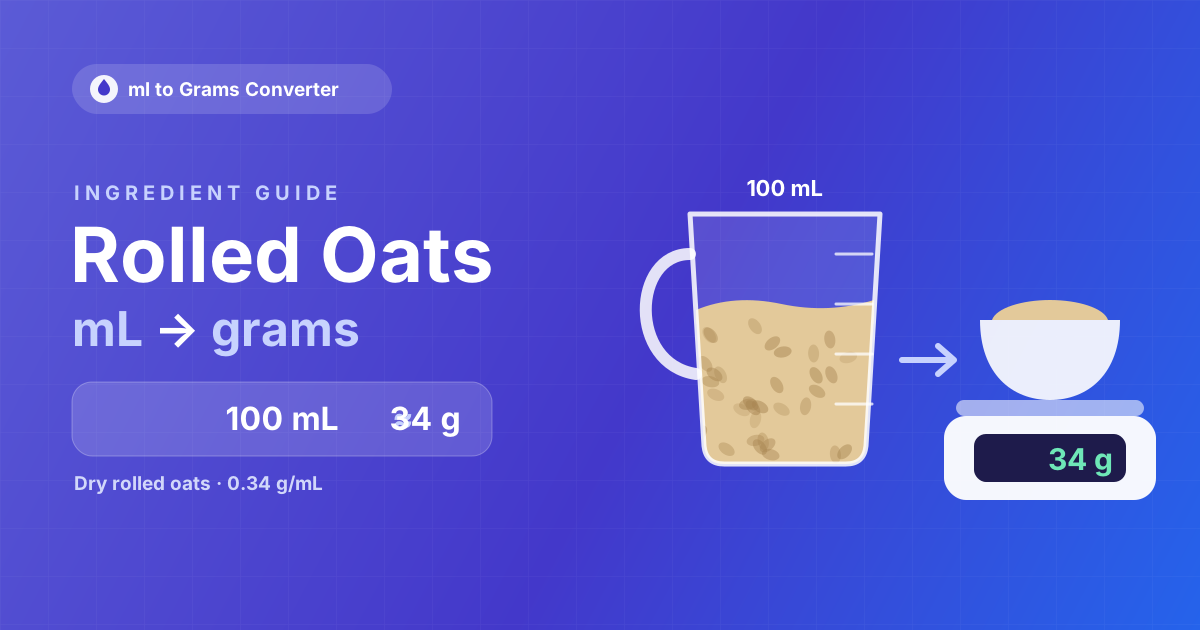
Dry rolled oats weigh about 34 g per 100 mL. That figure uses a bulk density of 0.34 g/mL, which describes old-fashioned or quick oats spooned loosely into a measure and leveled off. A 250 mL metric cup of dry oats comes to about 85 g, and a 240 mL US cup to about 82 g.
Everything on this page is for dry, uncooked oats. Once oats soak up water or milk they turn into a different ingredient with a different weight, so cooked oatmeal and porridge are not covered by these numbers.
Rolled oats mL to grams chart
The chart converts common volumes of dry rolled oats to grams at 0.34 g/mL.
| Volume (mL) | Rolled oats, dry (g) |
|---|---|
| 15 mL | 5.1 g |
| 30 mL | 10.2 g |
| 50 mL | 17 g |
| 60 mL | 20 g |
| 75 mL | 26 g |
| 80 mL | 27 g |
| 100 mL | 34 g |
| 120 mL | 41 g |
| 125 mL | 43 g |
| 150 mL | 51 g |
| 160 mL | 54 g |
| 180 mL | 61 g |
| 200 mL | 68 g |
| 240 mL | 82 g |
| 250 mL | 85 g |
| 300 mL | 102 g |
| 400 mL | 136 g |
| 500 mL | 170 g |
Density assumption: every row uses 0.34 g/mL for dry rolled (old-fashioned) or quick oats that were poured or spooned into the measure without pressing, then leveled with a straight edge. This is the same value behind the Oats option in the site’s converter, so the chart and the calculator give matching answers. Weights under 20 g keep one decimal place; larger weights are rounded to the nearest gram.
Where the 0.34 g/mL figure comes from
USDA FoodData Central lists “oats, regular and quick, dry” at 81 g per cup, which works out to about 0.34 g/mL. Quaker’s Old Fashioned and Quick Oats labels give a half-cup serving of dry oats as 40 g, which points to the same density. When a government database and a major oat brand agree this closely, the number is a fair picture of how most people fill a cup.
Other references run heavier. King Arthur Baking lists old-fashioned or quick oats at 89 g per cup, and its own thick rolled oats at 113 g per cup. Neither figure is a mistake. A firmer scoop gives a heavier cup, and thicker flakes are a different product. If you are baking a recipe from a particular source, that source’s own cup weight is the best guide for that recipe.
One number to ignore: a USDA entry called simply “Oats”, which comes from a food distribution program, lists 156 g per cup. It does not represent the rolled oats sold in supermarkets, yet it has been copied into some online converters. If a chart gives a cup of oats a weight far above the USDA figure for regular dry oats, it has probably pulled from that entry.
How to convert oats from mL to grams
The conversion is a single multiplication: grams = mL × density. For dry rolled oats that means multiplying the volume by 0.34.
150 mL × 0.34 g/mL = 51 g
This is exactly what the calculator does for you. Enter your exact volume and select Oats in the mL to Grams Converter to calculate any amount that is not in the chart. For steel-cut oats, choose Other (Custom) and enter 0.59 as the density instead.
The familiar shortcut of counting one milliliter as one gram only holds for ingredients with a density close to 1 g/mL, like water. Dry oats are far lighter than that by volume, so 100 mL of oats weighs about 34 g, not 100 g. Treating a milliliter of oats as a gram would badly overload any recipe that lists oats by weight.
Rolled, quick and steel-cut oats compared
The table compares rolled or quick oats with steel-cut oats, both measured dry.
| Volume (mL) | Rolled or quick, 0.34 (g) | Steel-cut, 0.59 (g) |
|---|---|---|
| 60 mL | 20 g | 35 g |
| 120 mL | 41 g | 71 g |
| 180 mL | 61 g | 106 g |
| 240 mL | 82 g | 142 g |
| 250 mL | 85 g | 148 g |
Rolled (old-fashioned) oats
These are the large, flat flakes most recipes mean when they just say “oats”. The 0.34 g/mL density in the main chart is built for them. Because the flakes are broad and irregular, they leave plenty of empty space in a measuring cup, which is why a full cup weighs so little.
Quick oats
Quick oats are thinner, smaller flakes. In USDA data they are grouped with regular rolled oats at the same weight per cup, so the same 0.34 g/mL works. The one difference is that small flakes can nest together more tightly if you press them, so be especially gentle when filling the cup with quick oats.
Steel-cut oats
Steel-cut oats are not flakes at all. They are oat groats chopped into small pieces, and those pieces pack densely with very little air between them. King Arthur Baking lists steel-cut oats at 70 g per half cup, about 0.59 g/mL, and the right-hand column of the table uses that value.
The practical result: 100 mL of steel-cut oats weighs about 59 g, while the same 100 mL of rolled oats weighs about 34 g. Do not swap one for the other by volume. A recipe built around rolled oats would end up with far more oats if you filled the same cup with steel-cut. Treat them as separate ingredients with separate numbers.
A quick check for steel-cut: 120 mL × 0.59 g/mL = 70.8 g, so a half US cup comes to about 71 g, which lines up with King Arthur’s 70 g.
Thick or jumbo rolled oats
Extra-thick flakes are a separate product again. King Arthur weighs its thick rolled oats at 113 g per cup, well above regular rolled oats. If you use them often, check the nutrition panel on the bag. Most oat packages state a serving in both a volume and grams, and that pair is the most reliable figure for that exact product.
Oats by the spoon and cup
Most recipes measure oats in cups or spoons rather than milliliters. The table gives dry rolled oats by spoon and cup at 0.34 g/mL.
| Measure | Rolled oats (g) |
|---|---|
| 1 tablespoon (15 mL) | 5.1 g |
| 2 tablespoons (30 mL) | 10.2 g |
| 1/4 cup (60 mL) | 20 g |
| 1/3 cup (80 mL) | 27 g |
| 1/2 cup (120 mL) | 41 g |
| 2/3 cup (160 mL) | 54 g |
| 3/4 cup (180 mL) | 61 g |
| 1 US cup (240 mL) | 82 g |
| 1 metric cup (250 mL) | 85 g |
The US cup in this table is 240 mL. Many recipes written outside the US use a 250 mL metric cup instead, so check which one your recipe assumes before you convert. The half-cup figure of 41 g sits right next to the 40 g serving printed on Quaker labels, which is a useful sanity check.
Spoon measures for oats are rough. Flakes do not settle neatly in a tablespoon, and a heaped spoon can easily hold much more than a level one. For a sprinkle on yogurt or a crumble topping that hardly matters, but if a recipe lists oats in several tablespoons, weighing the total is quicker and more accurate.
Worked examples from everyday recipes
Each example uses grams = mL × 0.34 for dry rolled oats, or mL = grams ÷ 0.34 when you start from a weight.
A single bowl of porridge
Oat packages commonly give one serving as 40 g of dry oats. With no scale to hand, convert that weight to a volume:
40 g ÷ 0.34 g/mL = 118 mL
A half US cup of loosely filled oats is close enough. For a bigger appetite, 45 g of dry oats works out to about 132 mL. Measure the liquid separately; if you cook with milk and want it by weight too, the milk mL to grams guide covers that side of the pot.
Overnight oats
Say your jar recipe calls for 125 mL of rolled oats:
125 mL × 0.34 g/mL = 42.5 g
That is about 43 g of oats. Weigh them dry, before any milk or yogurt goes in, because the flakes start absorbing liquid straight away. If the recipe also lists yogurt by volume, the yogurt mL to grams conversion gives the matching weight.
Oatmeal cookies or flapjacks
A US cookie recipe that asks for 3/4 cup of oats needs:
180 mL × 0.34 g/mL = 61.2 g
Call it about 61 g. Flapjack recipes are usually written by weight, so the problem often runs the other way. If a recipe calls for 250 g of oats and you only have a measuring jug, 250 g ÷ 0.34 g/mL = 735 mL. At that size, a loose or tight fill changes the result a lot, and the syrup and butter in a flapjack need the right amount of oats to bind properly. This is a recipe where a scale pays for itself.
A batch of granola
Granola recipes tend to use large volumes. For 500 mL of rolled oats:
500 mL × 0.34 g/mL = 170 g
Scale it up to a full liter and you need about 340 g. Weighing the oats straight into the mixing bowl saves you filling a cup over and over, and it keeps the ratio of oats to oil and sweetener consistent from batch to batch.
Grams to mL for dry rolled oats
When a recipe gives oats in grams and you want a volume, divide by the density: mL = grams ÷ 0.34. The table lists common weights for dry rolled oats at 0.34 g/mL.
| Weight (g) | Rolled oats (mL) |
|---|---|
| 20 g | 59 mL |
| 25 g | 74 mL |
| 30 g | 88 mL |
| 40 g | 118 mL |
| 50 g | 147 mL |
| 60 g | 176 mL |
| 80 g | 235 mL |
| 100 g | 294 mL |
| 150 g | 441 mL |
| 200 g | 588 mL |
| 250 g | 735 mL |
| 500 g | 1,471 mL |
Two quick examples: 100 g ÷ 0.34 g/mL = 294 mL, and 200 g ÷ 0.34 g/mL = 588 mL. Because oats are so light, volumes climb quickly. Half a kilo of oats fills about 1,471 mL, so at that size a scale is far simpler than refilling a jug.
These volumes are for rolled or quick oats only. Steel-cut oats take up much less space for the same weight: 100 g ÷ 0.59 g/mL = 169 mL.
Why packing changes the weight so much
Oat flakes are flat and uneven, so they leave large air gaps when they fall into a cup. Anything that closes those gaps adds weight to the same volume. Shaking the cup, tapping it on the counter or pressing the flakes down all do this.
The effect is bigger than most people expect. Some references quote about 90 g for a loosely filled cup of rolled oats and about 120 g for a tapped one. That gap is larger than the difference between most brands, so how you fill the cup matters more than which bag you bought.
To match the 0.34 g/mL figure used here:
- Spoon or pour the oats into the measuring cup until they mound slightly above the rim.
- Do not shake, tap or press the cup.
- Sweep a knife or other straight edge across the top to level it.
Dragging the cup through the bag tends to push flakes together, much like pressing them. Pouring from the bag or spooning into the cup gives a lighter, more repeatable fill.
Tips for accurate oat measurements
Use a kitchen scale where it counts. For cookies, flapjacks, granola bars and anything else where oats hold the structure together, weigh them. Put the bowl on the scale, press tare, and add oats until you reach the target weight. It is faster than cups and removes the packing problem entirely.
Weigh oats dry, always. Measure before adding milk, water or yogurt. Soaked oats are heavier and take up a different volume, so any conversion made after soaking will be off.
Treat cooked oatmeal as its own ingredient. If you track portions of cooked porridge, weigh the cooked bowl directly or record the dry weight you started with. Do not convert cooked oatmeal with 0.34 g/mL; that density only describes dry flakes.
Read the label for unusual oats. Thick-cut, jumbo, gluten-free and blended oat products can differ from regular rolled oats. The serving line on the package, given in both grams and cups, is the best conversion for that product.
Be relaxed about small amounts. A tablespoon of oats weighs about 5 g. Many kitchen scales read in whole grams, so tiny quantities are easier to measure with a spoon, and a gram either way will not change the result.
Keep one method per recipe. If you start measuring by weight, stay with weight for every ingredient in that recipe. Mixing a weighed quantity of oats with cup measures for everything else brings back the uncertainty you were trying to remove. For the other dry ingredients in an oat bake, the flour mL to grams chart follows the same approach.
For anything not covered here, select Oats in the mL to Grams Converter and type your volume, or choose Other (Custom) and enter 0.59 for steel-cut oats. If you are planning a meal with a grain side as well, the rice mL to grams guide keeps uncooked and cooked rice in separate charts for the same reason this page sticks to dry oats.
Frequently asked questions
How many grams is 250 mL of rolled oats?
A 250 mL measure of dry rolled oats weighs about 85 g at 0.34 g/mL. Steel-cut oats are much heavier, at about 148 g for the same volume.
How many grams is 1 cup of rolled oats?
A 240 mL US cup holds about 82 g of dry rolled oats, and a 250 mL metric cup about 85 g. USDA data lists 81 g per cup, and pressing the oats down can push the weight noticeably higher.
Do quick oats weigh the same as rolled oats?
Very nearly. USDA data gives regular and quick oats the same weight per cup, so 0.34 g/mL works for both, although quick oats pack a little tighter if you press them.
Can I use this chart for cooked oatmeal?
No. The chart covers dry oats only, and cooked oats have absorbed liquid, which changes their weight and volume. Weigh the cooked portion directly or measure the oats dry before cooking.
How many mL is 40 g of oats?
About 118 mL of dry rolled oats, which is just under half a US cup. Many oat packages use 40 g of dry oats as one serving.