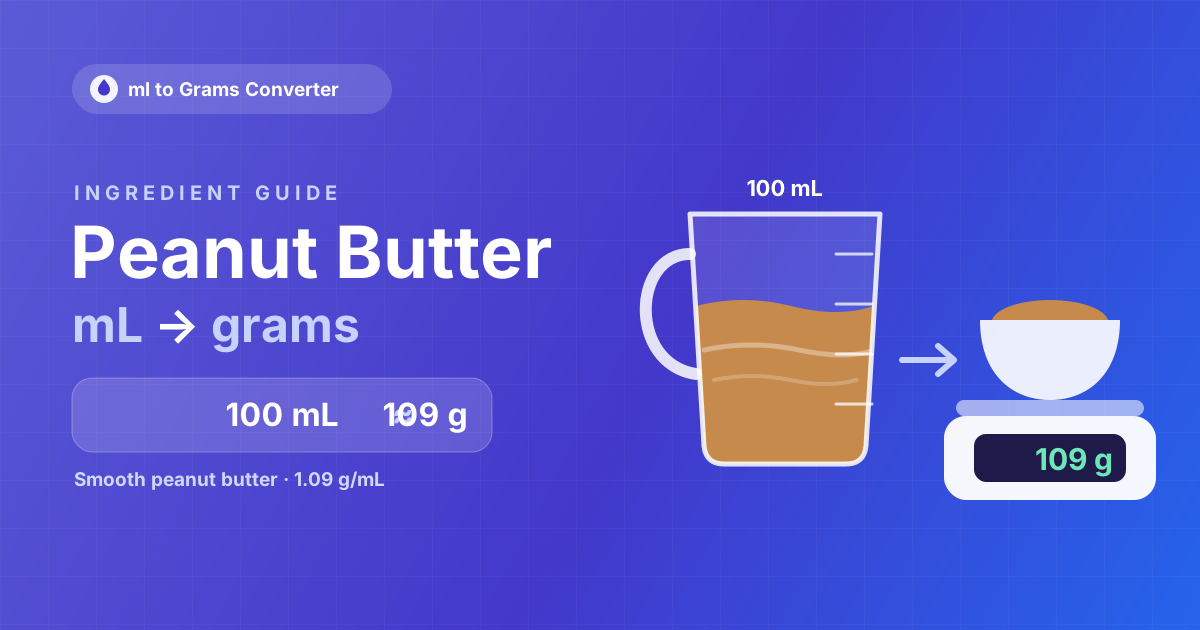
Peanut butter weighs about 1.09 g per mL. A level 15 mL tablespoon comes to about 16.4 g, and 100 mL comes to about 109 g. That density assumes smooth or crunchy peanut butter, stirred and at room temperature, and it is the same 1.09 g/mL the site’s converter uses for Peanut Butter.
Because peanut butter is only a little denser than water, grams and milliliters stay close for a teaspoon or two. Past that, the gap grows, so a cookie dough or sauce made by weight will come out closer to the recipe than one made by guessing.
Peanut butter mL to grams chart
| Volume (mL) | Peanut butter (g) |
|---|---|
| 5 mL | 5.5 g |
| 10 mL | 10.9 g |
| 15 mL | 16.4 g |
| 20 mL | 22 g |
| 30 mL | 33 g |
| 45 mL | 49 g |
| 50 mL | 55 g |
| 60 mL | 65 g |
| 75 mL | 82 g |
| 80 mL | 87 g |
| 100 mL | 109 g |
| 120 mL | 131 g |
| 125 mL | 136 g |
| 150 mL | 164 g |
| 180 mL | 196 g |
| 200 mL | 218 g |
| 240 mL | 262 g |
| 250 mL | 273 g |
| 300 mL | 327 g |
| 500 mL | 545 g |
What the chart assumes: 1.09 g/mL, for smooth or crunchy peanut butter that has been stirred, is at room temperature and is leveled off without big air pockets. The figure matches the cup weight in USDA FoodData Central exactly, and it is the value behind the Peanut Butter option in the converter, so the chart and the calculator agree.
The conversion itself is one multiplication: grams = mL × 1.09. For a quick example, 100 mL × 1.09 g/mL = 109 g. For any volume the chart skips, enter the amount and select Peanut Butter in the mL to Grams Converter.
Where 1.09 g/mL comes from
The strongest reference is USDA FoodData Central, which lists 258 g for a cup of smooth peanut butter. That works out to 1.09 g/mL. USDA also gives 32 g for a 2 tablespoon serving, which is about 1.08 g/mL, close enough that the small difference comes down to rounding.
Jar labels tell the same story. Natural peanut butters made from just peanuts and salt list the same 32 g serving for 2 tablespoons as the regular kind. So the figure holds across the types most people actually buy.
Other references land a little higher or lower, and the reason is usually technique rather than a different product:
- King Arthur Baking lists 135 g for half a cup of peanut butter, or about 1.14 g/mL. That is a firmly packed measure, pressed into the cup so no air remains. If you pack peanut butter hard, expect your cups to weigh more than the chart.
- Some conversion sites use about 1.01 g/mL. That value is lower than the USDA figures, and using it will make your weights come out light.
The practical takeaway: 1.09 g/mL is the well-supported middle value for a normal, leveled measure. If a recipe comes from a baker who packs cups firmly, weighing is the way to match their results.
Why peanut butter weighs more than water
Peanut butter is about half fat, and oil is lighter than water. You might expect the spread to be lighter than water too, but it is not. The other half is ground peanut solids (protein, carbohydrate and fiber), and those solids are denser than water. They outweigh the lighter oil, leaving the finished spread a little heavier than the same volume of water.
That is why the popular rule that 1 mL equals 1 g only roughly fits peanut butter. For a teaspoon, the difference is too small to notice. For a US cup, the table gives 262 g, which is noticeably more than the number of milliliters in the cup. The 1 to 1 shortcut is really only reliable for water and liquids with a density near 1 g/mL.
Smooth, crunchy and natural peanut butter
Smooth and crunchy convert the same way. USDA lists identical cup and tablespoon weights for smooth and chunky peanut butter, so there is no need for a separate crunchy chart. Use 1.09 g/mL for both and level the spoon carefully.
Natural peanut butter needs one extra step. Left to stand in the jar, its oil separates and rises to the top. That oily layer is lighter than the spread underneath, and the stiff paste at the bottom of the jar is heavier. A spoonful taken from the top can weigh less than the chart says, and one dug from the bottom can weigh more.
The fix is simple: stir thoroughly before measuring. Work the oil all the way down to the bottom of the jar until the texture is even. Once it is stirred, natural peanut butter converts at the same 1.09 g/mL, and its label lists the same 32 g for 2 tablespoons.
Peanut butter by the spoon and cup
The tablespoon is the measure people ask about most, and most recipes give peanut butter in spoons or cups. These are the weights for level measures:
| Measure | Peanut butter (g) |
|---|---|
| 1 teaspoon (5 mL) | 5.5 g |
| 1/2 tablespoon (7.5 mL) | 8.2 g |
| 1 tablespoon (15 mL) | 16.4 g |
| 2 tablespoons (30 mL) | 33 g |
| 1/4 cup (60 mL) | 65 g |
| 1/3 cup (80 mL) | 87 g |
| 1/2 cup (120 mL) | 131 g |
| 2/3 cup (160 mL) | 174 g |
| 3/4 cup (180 mL) | 196 g |
| 1 US cup (240 mL) | 262 g |
| 1 metric cup (250 mL) | 273 g |
A level tablespoon is about 16 g, and 2 tablespoons land at about 33 g. That sits within a gram of the 32 g serving used by USDA and printed on peanut butter labels, so the chart and the nutrition panel describe the same amount.
Cup sizes differ by country. American recipes use the US cup, shown here as 240 mL. Many metric recipes use a 250 mL cup, which holds slightly more. When a recipe gives peanut butter in cups without saying which kind, the recipe’s origin is the best guide.
What makes a spoonful heavier or lighter
The chart describes a tidy, level measure. Real spoonfuls vary, and with peanut butter the variation is mostly about how the spread sits in the spoon, not about the spread itself.
Heaped versus level spoons
This is the easiest way to end up with far more peanut butter than intended. A heaped tablespoon of peanut butter can easily weigh 25 g or more, well above the 16.4 g of a level one. Peanut butter holds its shape, so a casual scoop tends to come out rounded rather than flat.
Label nutrition values assume level measures. If you are measuring a serving to match the label, level the spoon with a knife, or weigh 32 g for 2 tablespoons and skip the spoon altogether.
Fridge-cold peanut butter
Some people keep peanut butter in the fridge. Cold peanut butter is stiff, hard to press into a spoon and hard to level. It also traps air as you force it in, so a cold cupful can hold less peanut butter than it appears to.
Let the jar come to room temperature before measuring, or weigh it cold. The weight is correct at any temperature; it is the volume measurement that suffers.
Air pockets in cups
Scooping a thick spread into a measuring cup leaves gaps along the bottom and sides. Loose, gappy cups weigh less than the chart. Firmly packed cups weigh more, which is why the King Arthur figure above is higher than the USDA one. Press the peanut butter down with a spatula as you fill the cup, then level the top.
Worked examples
Each example shows the multiplication, so you can repeat it for any recipe.
Peanut butter cookies
A peanut butter cookie recipe calls for 1 US cup of peanut butter. That is 240 mL:
240 mL × 1.09 g/mL = 261.6 g
Weigh about 262 g. This is the example where weighing saves the most effort, since a full cup of peanut butter is the hardest measure to fill and scrape clean. Some cookie recipes use butter alongside the peanut butter; melted butter has a very different density, so convert it separately with the butter mL to grams chart.
Satay sauce
A satay sauce uses 1/4 cup of peanut butter, or 60 mL:
60 mL × 1.09 g/mL = 65.4 g
That is about 65 g. For a sauce, a few grams either way changes little, but weighing lets you whisk the peanut butter straight into the pan or bowl with the other ingredients without greasing a cup.
Morning smoothie
A smoothie recipe asks for 1 tablespoon of peanut butter:
15 mL × 1.09 g/mL = 16.35 g
Call it about 16.4 g. If you normally use a generous heaped spoonful, you are likely adding 25 g or more. For a daily smoothie, that difference is worth knowing, and a scale settles it.
No-bake energy balls
An energy ball recipe uses 1/2 cup of peanut butter:
120 mL × 1.09 g/mL = 130.8 g
Weigh about 131 g. Energy balls often combine peanut butter with rolled oats and a sweetener, and each of those has its own density. The rolled oats mL to grams chart covers the oats, and the honey mL to grams conversion covers honey if you use it to bind the mixture.
Converting peanut butter grams to mL
When a recipe gives peanut butter in grams and you only have spoons and cups, divide by the density:
mL = grams ÷ 1.09
| Weight (g) | Peanut butter (mL) |
|---|---|
| 10 g | 9.2 mL |
| 16 g | 14.7 mL |
| 20 g | 18.3 mL |
| 25 g | 23 mL |
| 32 g | 29 mL |
| 50 g | 46 mL |
| 100 g | 92 mL |
| 150 g | 138 mL |
| 200 g | 183 mL |
| 250 g | 229 mL |
| 340 g | 312 mL |
| 454 g | 417 mL |
| 500 g | 459 mL |
Two rows line up with the nutrition label. A 16 g portion works out as 16 g ÷ 1.09 g/mL = 14.7 mL, just under a level tablespoon. The 32 g serving comes to about 29 mL, just under 2 level tablespoons. Both confirm that the label serving describes level spoons, not heaped ones.
For a recipe written in grams, 100 g ÷ 1.09 g/mL = 92 mL, and 250 g ÷ 1.09 g/mL = 229 mL. If you have a jug with milliliter marks, the water displacement method described below turns those numbers into accurate volumes.
How much is in the jar?
Peanut butter is sold by weight, commonly in 12 oz (340 g) and 16 oz (454 g) jars, plus larger 1 kg tubs. The weight tells you how much volume you have to work with:
- A 340 g jar:
340 g ÷ 1.09 g/mL = 312 mL, which covers a full US cup with some to spare. - A 454 g jar:
454 g ÷ 1.09 g/mL = 417 mL, enough for the 1 cup cookie recipe above with plenty left over.
Remember that some peanut butter always stays on the sides of the jar, so plan on a little less than the full figure.
Four ways to measure peanut butter cleanly
Peanut butter clings to every surface, so the method matters as much as the conversion.
- Weigh it straight into the bowl. Place the bowl on the scale, press tare so it reads zero, and spoon in peanut butter until you hit the weight from the chart. There is no cup to scrape and nothing left behind. This is the most accurate method and the least messy.
- Oil the measuring cup or spoon. A thin film of neutral oil lets the peanut butter slide out in one piece. If your recipe includes oil anyway, measure it first in the same cup.
- Use water displacement. Fill a measuring jug with water to a line you can read easily. Add peanut butter until the water level rises by the volume you need, then pour off the water. For 1/2 cup, for example, add peanut butter until the level climbs by 120 mL. The method avoids air pockets completely, because the water fills every gap.
- Level with a straight edge. If you do use spoons and cups, press the peanut butter in to remove air and sweep the top flat with a knife. This is the step that stops a tablespoon from quietly becoming 25 g.
For any amount that is not in the tables, enter the volume and select Peanut Butter in the mL to Grams Converter to get the weight at the same 1.09 g/mL.
Frequently asked questions
How many grams are in a tablespoon of peanut butter?
A level 15 mL tablespoon of peanut butter weighs about 16.4 g. A heaped tablespoon can easily reach 25 g or more, so level the spoon if you want the label amount.
How much does 100 mL of peanut butter weigh?
About 109 g, based on a density of 1.09 g/mL for stirred peanut butter at room temperature. That matches the cup weight listed by USDA FoodData Central.
Do smooth and crunchy peanut butter weigh the same?
Yes. USDA lists the same cup and tablespoon weights for smooth and chunky peanut butter, so both convert at about 1.09 g/mL.
Does natural peanut butter convert differently?
Not once it is stirred. Natural peanut butter separates into a light oily layer and a heavier paste, so stir it thoroughly before measuring; after that, it converts at the same 1.09 g/mL and its label lists the same 32 g per 2 tablespoons.
Is 1 mL of peanut butter equal to 1 gram?
Not quite. Peanut butter weighs about 1.09 g per mL, so the difference is small for a teaspoon but adds up in larger amounts, with a US cup weighing about 262 g.