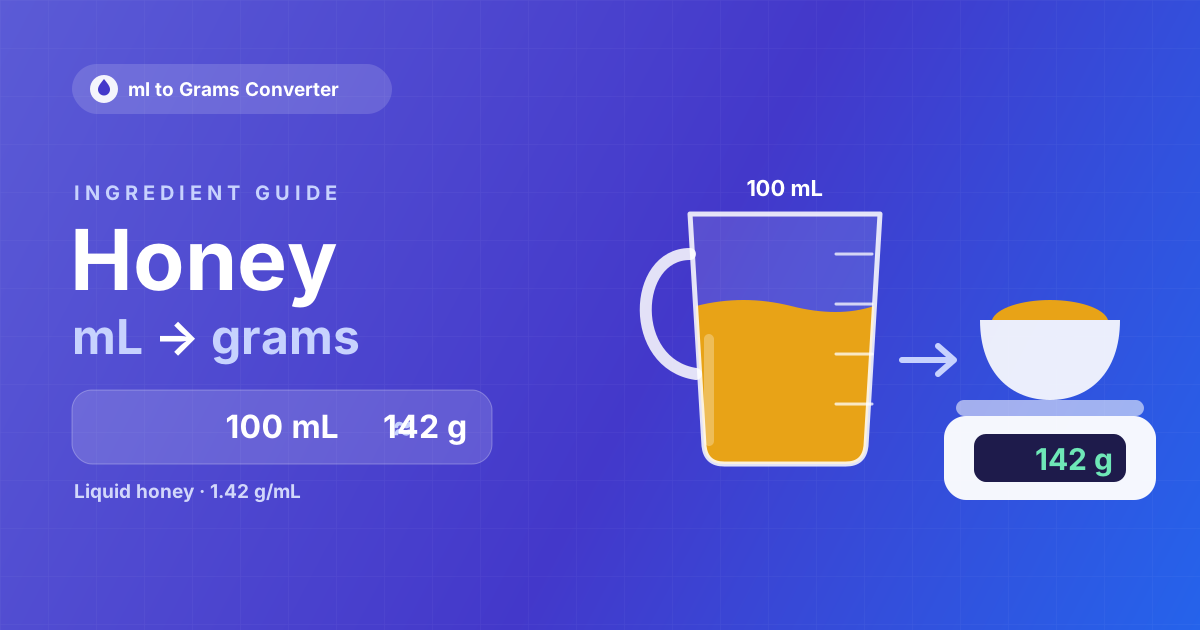
Honey weighs about 1.42 g per mL, so a milliliter of honey is roughly 1.42 g rather than 1 g. That puts 100 mL of honey at about 142 g and a level 15 mL tablespoon at about 21 g. Every number on this page uses 1.42 g/mL, the same density as the Honey setting in the site’s converter.
The chart covers the volumes that show up most often in recipes, from a couple of teaspoons up to half a liter. Weights are rounded to practical kitchen values: one decimal place under 20 g, whole grams above that.
Honey mL to grams chart (10 to 500 mL)
| Volume (mL) | Honey (g) |
|---|---|
| 10 mL | 14.2 g |
| 15 mL | 21 g |
| 20 mL | 28 g |
| 25 mL | 36 g |
| 30 mL | 43 g |
| 40 mL | 57 g |
| 50 mL | 71 g |
| 60 mL | 85 g |
| 75 mL | 107 g |
| 80 mL | 114 g |
| 100 mL | 142 g |
| 120 mL | 170 g |
| 125 mL | 178 g |
| 150 mL | 213 g |
| 175 mL | 249 g |
| 200 mL | 284 g |
| 240 mL | 341 g |
| 250 mL | 355 g |
| 300 mL | 426 g |
| 350 mL | 497 g |
| 400 mL | 568 g |
| 450 mL | 639 g |
| 500 mL | 710 g |
Density used: 1.42 g/mL. This is ordinary runny honey with a typical water content of about 17 to 18%. It lines up with the tablespoon weight published by USDA FoodData Central and King Arthur Baking (21 g each), and it is the exact value behind the Honey option in the converter, so the chart and the calculator give the same answers.
Real honey varies a little from jar to jar. The section on water content further down shows how much, and why the everyday figure still holds up.
Why honey weighs more than water
Honey is mostly sugar. Fructose and glucose make up the bulk of it, dissolved in a small amount of water that typically sits around 17 to 18% of the total. Dissolved sugar packs a lot of mass into a small space, which is why honey is about 40% heavier than water by volume.
That single fact breaks the popular shortcut that 1 mL equals 1 g. The shortcut only works for liquids with a density close to 1 g/mL, such as water. Honey is well above that, so treating milliliters and grams as interchangeable gives the wrong amount in both directions.
Here is how the mistake plays out. Suppose a recipe lists 142 g of honey and you pour 142 mL instead: you have added roughly 40% more honey than the recipe asked for. Now flip it. A recipe lists 100 mL, you set the scale to 100 g, and you end up with only about 70 mL of honey in the bowl.
In a glaze or a dressing, that kind of error changes sweetness and thickness. In a cake or a batch of granola, it also changes how much liquid the mixture holds, which affects texture. Converting properly takes a few seconds and removes the guesswork.
How to convert honey mL to grams
Multiply the volume in milliliters by the density:
grams = mL × 1.42
For example, 250 mL × 1.42 g/mL = 355 g. The reverse works the same way with division, which is covered in the grams to mL section below.
You rarely need more precision than whole grams for honey. A scale that reads in 1 g steps is fine, and rounding the result to the nearest gram is how the tables on this page are built. For small amounts under 20 g, one decimal place is enough.
Enter your exact volume and select Honey in the mL to Grams Converter to calculate any amount the chart does not list, such as 65 mL or 330 mL.
How water content changes the weight of honey
Honey is not a single fixed product. The biggest thing that moves its density is water content: less water means more sugar in every spoonful, and a heavier honey. Classic measurements by White (1975), reproduced in an FAO report on value-added beekeeping products, show the pattern clearly at 20 °C.
| Water content | Specific gravity at 20 °C | 100 mL weighs about |
|---|---|---|
| 14% | 1.440 | 144 g |
| 16% | 1.430 | 143 g |
| 17% | 1.424 | 142 g |
| 18% | 1.417 | 141 g |
| 20% | 1.403 | 140 g |
Specific gravity here can be read as grams per mL for kitchen purposes. At 14% water, honey weighs about 144 g per 100 mL. At 20% water, the figure drops to about 140 g. That band, from about 140 g to about 144 g per 100 mL, is the realistic range for nearly all honey you can buy.
Why “nearly all”? The international Codex Standard for Honey caps moisture at 20% for most honey, so standard retail honey should not fall below the bottom row. Heather honey is the exception, allowed up to 23% water, so it can sit a little below the lightest row in the table.
The typical 17 to 18% band falls between the 17% and 18% rows, which is where 1.42 g/mL comes from. For a recipe, the difference between a dry honey and a wet one is a few grams per 100 mL. You would only notice it in large batches, and even then the fix is simply to weigh.
Why some charts use 1.44 g/mL
Many conversion sites use 1.44 g/mL for honey. That value corresponds to drier honey, around 14 to 15% water, or to the USDA cup figure, which lists 339 g for a cup of honey (about 1.43 g/mL). The practical gap between 1.44 and 1.42 is about 2 g per 100 mL.
Neither number is wrong. This site uses 1.42 g/mL because it matches the USDA and King Arthur tablespoon weights and the water content of typical honey. If you already work from a chart based on 1.44, your results will be a touch higher, and in a normal recipe that difference will not show.
Temperature: warm honey pours, but barely changes weight
Warming honey makes it far thinner and easier to pour. What changes a lot is viscosity, the thickness and resistance to flow. Density changes much less, so warm honey and room temperature honey convert with the same 1.42 g/mL for kitchen use.
Temperature matters more for measuring technique than for the math. Cold, stiff honey clings to a spoon or cup, and a good part of it can stay behind when you tip it out. Honey at room temperature, or warmed gently, drains more completely, so the amount that reaches the bowl is closer to what you measured.
Crystallized, set and raw honey
Crystallized (set) honey weighs the same as it did when it was runny, because crystallizing does not change the amount of honey in the jar. The problem is volume. Set honey forms lumps and air pockets and will not level in a measuring spoon the way liquid honey does, so a “tablespoon” of it is unreliable.
You have two good options. Warm the jar gently until the honey liquefies, then measure by volume with the chart. Or skip volume entirely and weigh the set honey, which gives the correct amount whatever its texture.
Raw honey does not have a separate figure in the reference data. If your raw honey is runny, convert it at 1.42 g/mL like any other honey. If it has set, treat it like crystallized honey and weigh it.
Honey by the spoon and cup
Most recipes measure honey with spoons and cups rather than a measuring jug. These are the weights for level measures at 1.42 g/mL.
| Measure | Honey (g) |
|---|---|
| 1 teaspoon (5 mL) | 7.1 g |
| 1/2 tablespoon (7.5 mL) | 10.7 g |
| 1 tablespoon (15 mL) | 21 g |
| 2 tablespoons (30 mL) | 43 g |
| 1/4 cup (60 mL) | 85 g |
| 1/3 cup (80 mL) | 114 g |
| 1/2 cup (120 mL) | 170 g |
| 3/4 cup (180 mL) | 256 g |
| 1 US cup (240 mL) | 341 g |
| 1 metric cup (250 mL) | 355 g |
The tablespoon is the most searched honey measure, and the sources agree on it: USDA FoodData Central and King Arthur Baking both list 21 g, matching the table. For the cup, USDA’s 339 g is close to the 341 g shown for a 240 mL US cup.
Check which cup your recipe means. American recipes use the US cup, listed here as 240 mL. Many metric recipes use a 250 mL cup, which holds a little more honey. When a recipe does not say, the source of the recipe is usually the best clue.
For teaspoon amounts, such as honey stirred into tea or a marinade, a level teaspoon comes to about 7.1 g. At that size, the honey that clings to the spoon is a larger share of the total, so a scale or an oiled spoon makes a real difference.
Worked examples from everyday recipes
Each example below shows the multiplication so you can repeat it with your own amounts.
Honey mustard dressing. A dressing calls for 2 tablespoons of honey, which is 30 mL. 30 mL × 1.42 g/mL = 42.6 g, so weigh about 43 g. Pour it straight into the jar you will shake the dressing in, with the jar sitting on the scale.
Homemade granola. The recipe asks for 1/3 cup of honey to bind the oats. That is 80 mL: 80 mL × 1.42 g/mL = 113.6 g, or about 114 g. Weighing makes it easy to warm the honey with the oil in one pan without dirtying a measuring cup.
Honey cake. A US recipe uses 1/2 cup of honey, or 120 mL. 120 mL × 1.42 g/mL = 170.4 g, which rounds to about 170 g. If you double the cake, double the weight rather than trying to scrape out two full cups.
Metric recipe with a measuring jug. A recipe written in milliliters lists 250 mL of honey. 250 mL × 1.42 g/mL = 355 g. Measuring 250 mL of honey in a jug is slow and messy, while pouring 355 g onto a scale takes seconds.
For bulk cooking, the same multiplication scales up cleanly: 1000 mL × 1.42 g/mL = 1420 g, so a full liter of honey weighs about 1,420 g.
Converting honey from grams to mL
Sometimes you need to go the other way: the recipe gives honey in grams, but you only have measuring spoons or a jug. Divide the weight by the density:
mL = grams ÷ 1.42
| Weight (g) | Honey (mL) |
|---|---|
| 10 g | 7 mL |
| 20 g | 14.1 mL |
| 25 g | 17.6 mL |
| 50 g | 35 mL |
| 100 g | 70 mL |
| 150 g | 106 mL |
| 200 g | 141 mL |
| 250 g | 176 mL |
| 340 g | 239 mL |
| 350 g | 246 mL |
| 454 g | 320 mL |
| 500 g | 352 mL |
| 1,000 g | 704 mL |
A good check on the density: 21 g ÷ 1.42 g/mL = 14.8 mL. In other words, the 21 g tablespoon listed by USDA fits a 15 mL tablespoon almost exactly.
The rows for 340 g and 454 g are there because honey in the US is sold by weight. A 12 oz jar holds 340 g, and 340 g ÷ 1.42 g/mL = 239 mL, which is almost exactly one 240 mL US cup. A 1 lb jar holds 454 g, and 454 g ÷ 1.42 g/mL = 320 mL, which covers a full US cup with a generous amount left over.
That makes it easy to judge whether a jar is enough for a recipe before you open it. A recipe that needs 1 cup of honey will use nearly the whole 12 oz jar, so it is worth having a second jar ready.
For a round 500 g of honey, 500 g ÷ 1.42 g/mL = 352 mL. A 1 kg tub works out to about 704 mL.
How to measure honey accurately
Honey is one of the ingredients where weighing is clearly easier than measuring by volume. It sticks to everything, it leaves a coating in spoons and cups, and it is hard to read in a jug because it clings to the sides and takes time to settle. A few habits fix most of that.
Weigh it straight into the bowl. Put the mixing bowl or pan on the scale, press tare so it reads zero, and pour until you reach the weight from the chart. Nothing is lost to a measuring cup, and there is nothing sticky to wash.
Oil the measure if you use one. A light film of oil on a spoon or cup lets the honey slide out cleanly. If the recipe also uses oil, measure the oil first in the same cup and the honey will release on its own.
Level the spoon. The weights in the tables assume level measures. A domed spoonful of honey carries more than the stated volume, and several of them in one recipe add up.
Measure honey at room temperature. Cold honey from a cool pantry drains slowly and leaves more behind. Standing the jar in warm water for a few minutes makes it easier to pour without changing the conversion.
Scrape it out. A small silicone spatula gets the last of the honey out of a cup or jug. With thick honey, the portion left behind can be a meaningful part of a small measurement.
Weigh set honey. If the honey has crystallized, a spoon measurement will not be consistent. Weigh it, or liquefy it gently first.
The same weigh-it-in-the-bowl approach suits other sticky ingredients. The peanut butter mL to grams chart covers another spread that is much easier to weigh than to scoop.
Other sweeteners need their own numbers. Maple syrup looks similar in a jug but has a different density, so use the maple syrup mL to grams conversion rather than the honey chart. For granulated, brown and powdered sugar, see the sugar mL to grams guide.
Frequently asked questions
Is 1 mL of honey equal to 1 gram?
No. Honey has a density of about 1.42 g/mL, so 1 mL of honey weighs roughly 1.42 g. The 1 mL to 1 g match only works for water and liquids with a similar density.
How many grams are in a tablespoon of honey?
A level 15 mL tablespoon of honey weighs about 21 g. USDA FoodData Central and King Arthur Baking both list the same figure.
How much does 250 mL of honey weigh?
About 355 g, based on 1.42 g/mL. A 240 mL US cup of honey weighs about 341 g.
Does crystallized honey weigh the same as liquid honey?
Yes, crystallizing does not change the weight of the honey. It does make volume measurements unreliable, because set honey will not level in a spoon, so weigh it or warm it gently until it is runny before measuring by volume.
Why do some honey charts use 1.44 g/mL?
That value matches drier honey with about 14 to 15% water, or the USDA cup figure. Typical honey holds about 17 to 18% water, which gives about 1.42 g/mL, and the difference between the two is only about 2 g per 100 mL.