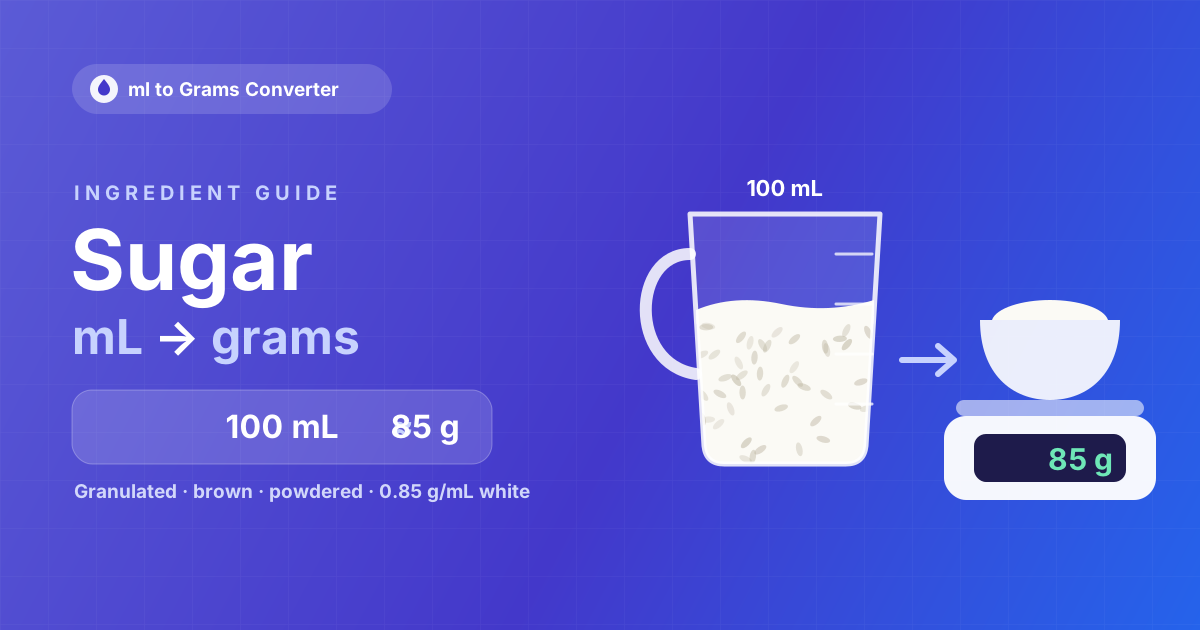
Granulated sugar weighs about 0.85 g/mL, so 100 mL of white sugar comes to roughly 85 g and a 250 mL metric cup is about 213 g. Brown and powdered sugar sit on either side of that figure: packed brown sugar is heavier at about 0.93 g/mL, and unsifted powdered sugar is much lighter at about 0.56 g/mL. There is no single density for “sugar”, so always read the column for the sugar your recipe names.
Sugar mL to grams chart
Find your volume in the left column and read across to the type of sugar you are using. Values under 20 g are shown to one decimal place; larger amounts are rounded to the nearest gram.
| Volume (mL) | Granulated (g) | Brown, packed (g) | Powdered, unsifted (g) |
|---|---|---|---|
| 5 mL | 4.3 g | 4.7 g | 2.8 g |
| 10 mL | 8.5 g | 9.3 g | 5.6 g |
| 15 mL | 12.8 g | 14 g | 8.4 g |
| 30 mL | 26 g | 28 g | 16.8 g |
| 50 mL | 43 g | 47 g | 28 g |
| 60 mL | 51 g | 56 g | 34 g |
| 100 mL | 85 g | 93 g | 56 g |
| 125 mL | 106 g | 116 g | 70 g |
| 150 mL | 128 g | 140 g | 84 g |
| 200 mL | 170 g | 186 g | 112 g |
| 240 mL | 204 g | 223 g | 134 g |
| 250 mL | 213 g | 233 g | 140 g |
| 300 mL | 255 g | 279 g | 168 g |
| 400 mL | 340 g | 372 g | 224 g |
| 500 mL | 425 g | 465 g | 280 g |
Each column rests on one density, and each matches an option in the site’s converter:
- Granulated sugar, 0.85 g/mL. White sugar spooned or poured into a measure and leveled off. In the converter this is “Granulated Sugar”.
- Brown sugar, packed, 0.93 g/mL. Brown sugar pressed firmly into the measure, which is what most US recipes mean by a cup of brown sugar. In the converter this is “Brown Sugar (packed)”.
- Powdered sugar, unsifted, 0.56 g/mL. Powdered (icing) sugar spooned straight from a bag where it has settled. In the converter this is “Powdered Sugar”.
Treat every figure as a practical kitchen estimate. Two cooks filling the same cup will get slightly different weights, and the gap grows with brown and powdered sugar. The sections below explain how large that gap can be and what to do about it.
Why 100 mL of sugar does not weigh 100 g
Milliliters tell you how much space an ingredient fills. Grams tell you how heavy it is. The two numbers only match for ingredients with a density of about 1 g/mL, such as water, and sugar is not one of them.
A measuring cup of sugar is really a cup of crystals with air in the gaps between them. That air takes up volume but adds no weight, so the cup weighs less than the same cup of water. How much air there is depends on the crystal size and on how tightly the sugar sits, which is why the three sugars in the chart land so far apart.
Granulated crystals are fairly uniform, pour freely and level off cleanly, so a leveled cup comes out close to the same weight every time. That makes its volume conversion the most reliable of the three. Brown sugar is moist and squashable, so its weight depends on how hard you press it into the cup. Powdered sugar is so fine that it fluffs up when stirred or sifted and compacts when it sits in the bag, so a cup of it can vary more than you might expect.
How to convert sugar mL to grams
The rule is short: grams = mL × density. Pick the density for your sugar and multiply.
- Granulated:
100 mL × 0.85 g/mL = 85 g - Brown, packed:
100 mL × 0.93 g/mL = 93 g - Powdered, unsifted:
100 mL × 0.56 g/mL = 56 g
For a volume the chart does not list, enter your exact volume and select Granulated Sugar, Brown Sugar (packed) or Powdered Sugar in the mL to Grams Converter to calculate another amount. It uses the same three densities as this page, so its answers line up with the tables here. The converter has no option for loose brown sugar or for sifted powdered sugar, so use the dedicated tables below for those.
Granulated sugar and caster sugar
Plain white granulated sugar is the reference point for most baking. At 0.85 g/mL, a teaspoon (5 mL) is about 4.3 g, a tablespoon (15 mL) is about 12.8 g and half a US cup (120 mL) is about 102 g.
Published cup weights agree closely with this figure. USDA FoodData Central lists 1 cup of granulated sugar at 200 g, King Arthur uses 198 g per cup, and Domino Sugar puts 1 lb at about 2 1/4 cups. The tables on this page round the US cup to 240 mL. A true US customary cup is slightly smaller than that, which is part of why those published cup weights sit a little under the 204 g shown for a 240 mL cup.
Caster sugar, sold as superfine sugar in the US, is granulated sugar with finer crystals. It is the same sugar in a smaller crystal size, and there is no separate figure for it in this guide. The granulated column is the closest volume guide, but finer crystals can settle into a cup a little differently, so weigh caster sugar when a recipe depends on exact amounts, such as meringue or macarons. If a UK recipe gives caster sugar in grams and you only have spoons and cups, use the grams to mL table further down.
Brown sugar: packed vs loose
Brown sugar causes more measuring errors than any other sugar, because the same cup can hold very different weights. Most US recipes that give brown sugar by volume specify “packed”. That means pressing the sugar firmly into the cup until it holds the cup’s shape when you tip it out. Loose brown sugar, simply spooned in, weighs roughly a third less for the same volume.
Here is the same volume measured both ways:
| Volume (mL) | Packed, 0.93 (g) | Loose, 0.61 (g) |
|---|---|---|
| 15 mL | 14 g | 9.2 g |
| 30 mL | 28 g | 18.3 g |
| 60 mL | 56 g | 37 g |
| 80 mL | 74 g | 49 g |
| 120 mL | 112 g | 73 g |
| 160 mL | 149 g | 98 g |
| 180 mL | 167 g | 110 g |
| 240 mL | 223 g | 146 g |
| 250 mL | 233 g | 153 g |
The packed column uses 0.93 g/mL, which matches USDA’s figure of 220 g for a packed cup and the converter’s Brown Sugar (packed) option. The loose column uses 0.61 g/mL, taken from USDA’s 145 g for an unpacked cup. King Arthur lists a packed cup at 213 g, a reminder that “firmly packed” is not identical from one kitchen to the next.
In practice, the difference is large enough to change a recipe. Spoon brown sugar loosely into a 3/4 cup measure when the recipe expects it packed, and you add about 110 g instead of about 167 g. Cookies, bars and sticky sauces all rely on that sugar for sweetness, moisture and color, so a shortfall of that size shows in the result.
To pack brown sugar consistently, break up any lumps first, fill the cup, press down with the back of a spoon or your fingertips, top it up and press again, then level the rim. Properly packed sugar keeps the shape of the cup when turned out onto the counter. If a recipe gives a weight as well as a cup measure, use the weight and skip the packing question entirely.
Powdered sugar and icing sugar: sifted vs unsifted
Powdered sugar, confectioners’ sugar (US) and icing sugar (UK) are the same product: sugar ground to a fine powder, usually with a little starch mixed in. Because the particles are so small, the amount of air in a cup changes a lot with handling.
The converter’s Powdered Sugar option uses 0.56 g/mL, which reflects sugar that has settled in the bag and been spooned out. Sifted powdered sugar holds far more air. USDA puts a cup of sifted powdered sugar at 100 g, which gives the 0.42 g/mL used in the right-hand column:
| Volume (mL) | Unsifted, 0.56 (g) | Sifted, 0.42 (g) |
|---|---|---|
| 15 mL | 8.4 g | 6.3 g |
| 30 mL | 16.8 g | 12.6 g |
| 60 mL | 34 g | 25 g |
| 80 mL | 45 g | 34 g |
| 120 mL | 67 g | 50 g |
| 160 mL | 90 g | 67 g |
| 240 mL | 134 g | 101 g |
| 250 mL | 140 g | 105 g |
| 500 mL | 280 g | 210 g |
Other published figures fall between the two columns. USDA lists a cup of unsifted powdered sugar at 120 g and 1 tablespoon at 8 g, while King Arthur uses 113 g for an unsifted cup. Put simply, a cup filled lightly and leveled weighs less than the converter’s figure, and sifted sugar weighs much less. Small spoon measures come closest to the converter value, while larger cup measures show the widest spread.
Recipe wording tells you which column to use. “1 cup sifted powdered sugar” means sift first, then measure, so use the sifted column. “1 cup powdered sugar, sifted” means measure first, then sift, so use the unsifted column. For frosting, glaze and fondant, where the ratio of sugar to liquid or fat controls the texture, weighing avoids the problem altogether.
Common recipe amounts in grams
Spoon and cup measures are where most sugar conversions start. The table below covers granulated sugar at 0.85 g/mL:
| Measure | Granulated sugar (g) |
|---|---|
| 1 teaspoon (5 mL) | 4.3 g |
| 1 tablespoon (15 mL) | 12.8 g |
| 2 tablespoons (30 mL) | 26 g |
| 1/4 cup (60 mL) | 51 g |
| 1/3 cup (80 mL) | 68 g |
| 1/2 cup (120 mL) | 102 g |
| 2/3 cup (160 mL) | 136 g |
| 3/4 cup (180 mL) | 153 g |
| 1 US cup (240 mL) | 204 g |
| 1 metric cup (250 mL) | 213 g |
Check which cup your recipe uses. A US cup (240 mL) of granulated sugar weighs about 204 g, while a metric cup (250 mL) weighs about 213 g. The difference is small for a single cup but adds up when a recipe calls for several.
For brown and powdered sugar, the packed vs loose and sifted vs unsifted tables above use the same spoon and cup volumes: 15 mL for a tablespoon, 30 mL for two, 60 mL for 1/4 cup, 80 mL for 1/3 cup, 120 mL for 1/2 cup, 160 mL for 2/3 cup and 240 mL for a US cup. Read across from the volume you need.
One more thing the cup table shows clearly: sugars are not interchangeable by volume. A 240 mL cup of granulated sugar weighs about 204 g, while the same cup of unsifted powdered sugar holds only about 134 g. If you substitute one for the other in a recipe, swap by weight rather than by cup.
Worked examples
150 mL of granulated sugar for a sponge cake
150 mL × 0.85 g/mL = 127.5 g
Weigh out about 128 g. For a cake, that rounding is well within normal kitchen variation.
3/4 cup of packed brown sugar for cookies
A 3/4 US cup is 180 mL.
180 mL × 0.93 g/mL = 167.4 g
That is about 167 g. If the sugar went into the cup loose instead, the same measure gives 180 mL × 0.61 g/mL = 109.8 g, or about 110 g, which is why the packing instruction matters.
250 mL of powdered sugar for buttercream
Unsifted, spooned from the bag:
250 mL × 0.56 g/mL = 140 g
Sifted before measuring:
250 mL × 0.42 g/mL = 105 g
Same measuring cup, two very different amounts. Check the recipe wording before you start.
10 mL of sugar for a salad dressing
Small amounts follow the same rule:
10 mL × 0.85 g/mL = 8.5 g
At this size, a measuring spoon is accurate enough. A scale is more useful once you get into cup measures.
Converting grams of sugar to mL
To go the other way, divide: mL = grams ÷ density. This is handy when a recipe lists sugar by weight and you only have measuring cups and spoons, or when you want to know whether a jar will hold a certain amount.
| Weight (g) | Granulated (mL) | Brown, packed (mL) | Powdered, unsifted (mL) |
|---|---|---|---|
| 25 g | 29 mL | 27 mL | 45 mL |
| 50 g | 59 mL | 54 mL | 89 mL |
| 100 g | 118 mL | 108 mL | 179 mL |
| 150 g | 176 mL | 161 mL | 268 mL |
| 200 g | 235 mL | 215 mL | 357 mL |
| 250 g | 294 mL | 269 mL | 446 mL |
| 300 g | 353 mL | 323 mL | 536 mL |
| 500 g | 588 mL | 538 mL | 893 mL |
A worked example: 200 g ÷ 0.85 g/mL = about 235 mL of granulated sugar. A UK recipe asking for 100 g of caster sugar works out to about 118 mL using the granulated figure, which is close to half a US cup.
The table covers the converter’s three options. For the other two states, the numbers shift sharply. 100 g of loose brown sugar fills about 164 mL, compared with about 108 mL packed. 100 g of sifted powdered sugar fills about 238 mL, compared with about 179 mL unsifted. If you convert grams to cups for powdered sugar, measure it the way you calculated it: do not sift after scooping if you used the unsifted figure.
Tips for measuring sugar accurately
- Use a scale when precision matters. Candy, meringue, macarons and large batches of cookies all benefit from weighing. Put the bowl on the scale, press tare, and add sugar until you reach the target.
- Use dry measuring cups for sugar. A jug marked for liquids is hard to level, so the reading depends on how the sugar mounds. Fill a dry cup and sweep the top flat with a knife.
- Do not tap or shake the cup. Tapping settles granulated and powdered sugar and packs more into the same volume, so the cup weighs more than the tables assume.
- Pack brown sugar the same way every time. Firm pressure, full rim, level top. Break up hard lumps first so they do not leave air pockets.
- Follow the sifting instruction exactly. Whether you sift before or after measuring changes the weight of a cup of powdered sugar more than any other factor.
- Keep sugars in closed containers. Brown sugar that dries out forms hard clumps that are difficult to pack evenly, and powdered sugar that sits open compacts and lumps.
The spoon-and-level method works the same way for other dry baking ingredients; the flour mL to grams guide covers the extra care flour needs. Liquid sweeteners behave in the opposite way and weigh more than water, so see the maple syrup mL to grams chart and the honey mL to grams chart when a recipe calls for syrup instead of sugar. For any other volume, the mL to Grams Converter handles granulated, packed brown and powdered sugar in one step.
Frequently asked questions
How many grams is 100 mL of sugar?
100 mL of granulated sugar weighs about 85 g. The same volume of packed brown sugar is about 93 g, and unsifted powdered sugar is about 56 g.
How many grams is 250 mL of sugar?
A 250 mL metric cup of granulated sugar weighs about 213 g. Packed brown sugar comes to about 233 g, unsifted powdered sugar about 140 g, and sifted powdered sugar about 105 g.
Should brown sugar be packed when measuring?
Yes, unless the recipe says otherwise. Most US recipes that list brown sugar by volume mean packed, pressed firmly so it holds the cup’s shape, and loose brown sugar weighs roughly a third less for the same volume.
How many grams is a tablespoon of icing sugar?
A 15 mL tablespoon of unsifted icing (powdered) sugar weighs about 8.4 g. If the sugar is sifted before measuring, the same tablespoon holds about 6.3 g.
Can I use the granulated sugar figures for caster sugar?
Caster (superfine) sugar is granulated sugar with finer crystals, so the granulated figures are the closest volume guide. Weigh it when a recipe needs precise amounts, because finer crystals can settle into a spoon or cup a little differently.