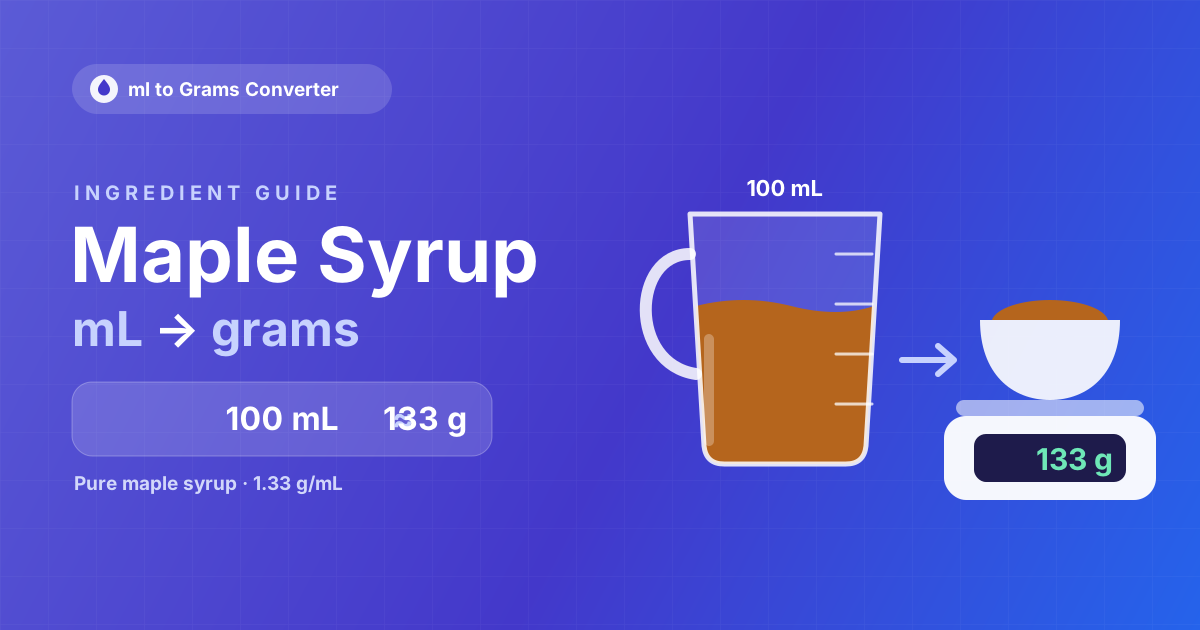
Pure maple syrup weighs about 1.33 g/mL, so 100 mL comes to roughly 133 g and a tablespoon (15 mL) is about 20 g. That figure assumes 100% maple syrup at room temperature. Because syrup is much heavier than water, a milliliter of it is never just a gram, and the gap grows quickly in larger amounts.
Maple syrup mL to grams chart
Every row below uses 1.33 g/mL. Amounts under 20 g keep one decimal; everything else is rounded to the nearest gram.
| Volume (mL) | Maple syrup (g) |
|---|---|
| 5 mL | 6.7 g |
| 10 mL | 13.3 g |
| 15 mL | 20 g |
| 20 mL | 27 g |
| 30 mL | 40 g |
| 45 mL | 60 g |
| 50 mL | 67 g |
| 60 mL | 80 g |
| 75 mL | 100 g |
| 80 mL | 106 g |
| 100 mL | 133 g |
| 120 mL | 160 g |
| 125 mL | 166 g |
| 150 mL | 200 g |
| 200 mL | 266 g |
| 240 mL | 319 g |
| 250 mL | 333 g |
| 300 mL | 399 g |
| 500 mL | 665 g |
Density used: 1.33 g/mL. This is pure maple syrup at about 66 to 67 °Brix (the measure of dissolved sugar), poured at room temperature. It is the same value the site’s converter uses for its Maple Syrup option, so the chart and the calculator agree. Two rows make handy anchors: 75 mL is about 100 g and 150 mL is about 200 g, so a recipe that asks for a round weight can be poured to those marks on a jug.
Published food data backs it up. USDA FoodData Central lists a cup of maple syrup at 315 g and a tablespoon at 20 g, and its Canadian maple syrup entry gives 60 mL = 80 g. King Arthur’s baking chart puts half a cup at 156 g, a touch under the 160 g shown in the table, which is within normal variation between measuring cups and pourers.
How to convert maple syrup from mL to grams
Multiply the volume by the density: grams = mL × 1.33. A few quick checks:
30 mL × 1.33 g/mL = 39.9 g, about 40 g100 mL × 1.33 g/mL = 133 g500 mL × 1.33 g/mL = 665 g
For any amount not in the chart, enter your exact volume and select Maple Syrup in the mL to Grams Converter to calculate another amount. The converter shows more decimal places than this page, but the rounded results are the same.
Why maple syrup is heavier than water
Water weighs about 1 g/mL. Maple syrup is heavier because it is mostly sugar: pure syrup is about two-thirds sugar by weight, mainly sucrose, dissolved in water. A sugar solution packs more mass into each milliliter than plain water does, and the more sugar it holds, the denser it gets.
Sugar makers measure that concentration in degrees Brix. Under the US grade standards introduced in 2015, pure maple syrup must be at least 66% solids, and Grade A syrup can be no more than 68.9%. Using the USDA’s sucrose conversion tables, that legal window of 66 to 68.9 °Brix works out to about 1.32 to 1.34 g/mL at 20 °C. The 1.33 g/mL figure used here sits in the middle of that range, which is why it holds up for any bottle labeled pure maple syrup. The USDA grade standards for maple syrup set out the Brix limits in full.
This also shows why a few online converters get maple syrup badly wrong. Some list it near 1.01 g/mL, which would describe a liquid with hardly any sugar in it. Real maple syrup cannot be that light and still be syrup, so treat any figure close to water with suspicion.
Grade and color do not change the conversion
Maple syrup is sold as golden, amber, dark or very dark. Those grades describe flavor and color, which depend mostly on when in the season the trees were tapped. They do not describe density. Every legal pure syrup falls inside the same Brix range, so the same 1.33 g/mL conversion works for a delicate golden syrup and a strong very dark one.
Pure maple syrup vs pancake syrup
Pancake syrup, sometimes labeled table syrup, is a different product. It is usually corn or glucose syrup with maple flavouring, and its sugar content and density are not the same as pure maple syrup. The numbers on this page apply only to 100% maple syrup. If the ingredient list mentions corn syrup, glucose, colouring or flavouring, this chart is not the right reference.
Warm syrup pours faster but weighs almost the same
Heat makes maple syrup far runnier, but it barely changes its density. Warm syrup flows off a spoon quickly, while cold syrup straight from the fridge is thick and clings to the sides of a measuring cup, so less of it ends up in the bowl. For consistent volume measurements, let the syrup come to room temperature first. If you weigh it instead, temperature hardly matters.
Spoon and cup weights
Recipes rarely give maple syrup in round milliliters. They use spoons and cups, so here are the common measures:
| Measure | Maple syrup (g) |
|---|---|
| 1 teaspoon (5 mL) | 6.7 g |
| 1 tablespoon (15 mL) | 20 g |
| 2 tablespoons (30 mL) | 40 g |
| 1/4 cup (60 mL) | 80 g |
| 1/3 cup (80 mL) | 106 g |
| 1/2 cup (120 mL) | 160 g |
| 3/4 cup (180 mL) | 239 g |
| 1 US cup (240 mL) | 319 g |
| 1 metric cup (250 mL) | 333 g |
The table rounds the US cup to 240 mL. A US customary cup is closer to 236 mL, and 236 mL × 1.33 g/mL = about 314 g, which lines up with the USDA figure of 315 g per cup. A metric cup (250 mL) holds about 333 g, so check which cup your recipe was written for before converting several cups at once.
Maple syrup in everyday recipes
Each example below shows the multiplication, so you can repeat it with your own amounts.
Pancakes and waffles
A generous drizzle over a stack of pancakes is often around 1/4 cup, or 60 mL.
60 mL × 1.33 g/mL = 79.8 g, about 80 g.
Weighing it is also handy if you are tracking how much syrup goes on the plate, since a pour straight from the bottle is hard to judge by eye.
Oatmeal, yogurt and coffee
Small amounts are where guessing is most common. A teaspoon of maple syrup stirred into coffee is about 6.7 g, and two teaspoons (10 mL) over a bowl of oatmeal or yogurt comes to about 13.3 g.
10 mL × 1.33 g/mL = 13.3 g
A measuring spoon is accurate enough at this scale. If you sweeten the same breakfast every day, weigh your usual pour once so you know what a “drizzle” actually adds up to.
Granola
Maple syrup binds granola clusters and helps them brown. A typical batch might call for 1/2 cup, or 120 mL.
120 mL × 1.33 g/mL = 159.6 g, about 160 g.
Weighing the syrup straight into the bowl with the oats saves scraping a sticky cup. The rolled oats mL to grams chart covers the dry side of the same recipe.
Glazes for vegetables or salmon
A glaze for roasted carrots or a salmon fillet might use 3 tablespoons, or 45 mL.
45 mL × 1.33 g/mL = 59.85 g, about 60 g.
Glazes thicken as they cook, so a few grams either way will not matter much. The bigger risk is scorching, since the sugar in the syrup browns fast under high heat.
Salad dressing
A maple vinaigrette might use 20 mL of syrup, a little over a tablespoon.
20 mL × 1.33 g/mL = 26.6 g, about 27 g.
In dressings the balance of sweetness and acidity is a matter of taste, so treat the weight as a starting point and adjust.
Scaling a glaze or dressing up
Making dressing by the jar, or glazing a whole tray of vegetables instead of one side dish, means multiplying spoon amounts, and counting out spoonfuls of syrup gets tedious and messy. Scale the volume first, convert once, and pour the total in a single go. Five portions of the vinaigrette above use 100 mL of syrup:
100 mL × 1.33 g/mL = 133 g
Multiplying the rounded 27 g by five would give 135 g instead. Two grams will not spoil a dressing, but converting once at the end stops the rounding from growing as batches get bigger.
Baking
Maple cakes, muffins and cookies are where weight earns its keep, because the syrup supplies both sugar and liquid. A recipe calling for a metric cup of syrup needs:
250 mL × 1.33 g/mL = 332.5 g, about 333 g.
Weighing removes the syrup left clinging to the cup, which otherwise adds up to a real shortfall in a large measure.
Swapping maple syrup for sugar
When a recipe replaces granulated sugar with maple syrup, you are adding water along with the sweetness, because only about two-thirds of the syrup’s weight is sugar. Recipes that make this swap usually reduce the other liquid to make room. Working in grams keeps the sugar amount predictable, since you can see exactly how much syrup, and so how much sugar and water, goes in. The sugar mL to grams guide gives the granulated, brown and powdered sugar weights you will need for the dry side of the swap.
How much is in a bottle?
Maple syrup is sold by volume, not weight. In metric markets the common sizes are 250 mL, 500 mL and 1 L, while US bottles come in 8, 12 or 32 fl oz. Converting the metric sizes:
- A 250 mL bottle holds about 333 g.
- A 500 mL bottle holds about 665 g.
- A 1 L bottle:
1000 mL × 1.33 g/mL = 1,330 g.
That is useful when a recipe asks for syrup by weight and you want to know whether one bottle is enough.
How far a bottle goes
Converting the recipe amount into the same units as the bottle tells you how many batches it covers. The granola above uses 1/2 cup, or 120 mL per batch. Two batches take 240 mL from a 250 mL bottle, which leaves 10 mL behind. That remainder weighs about 13.3 g, or two teaspoons for your coffee. Pancake mornings work the same way: a 500 mL bottle gives eight 1/4 cup pours of 60 mL each. The last 20 mL, about 27 g, is left for another day.
A scale also answers the question without any arithmetic. Put the bottle on the scale, press tare, and pour straight into the pan or bowl. The display counts down, and when it reads minus 60 g you have poured the 3 tablespoon glaze from the recipe section. This helps most with glazes, because a hot pan cannot sit on the scale but the bottle can.
To keep track over weeks, weigh the bottle when you open it and write the figure on the label. Any later weight loss is syrup used, and dividing by 1.33 turns it back into volume: a bottle that is 200 g lighter has had about 150 mL poured from it.
Grams to mL for maple syrup
To convert weight back to volume, divide by the density: mL = grams ÷ 1.33. You will need this when a recipe lists maple syrup in grams and you would rather pour it into a measuring jug.
| Weight (g) | Maple syrup (mL) |
|---|---|
| 10 g | 7.5 mL |
| 20 g | 15 mL |
| 25 g | 18.8 mL |
| 50 g | 38 mL |
| 80 g | 60 mL |
| 100 g | 75 mL |
| 150 g | 113 mL |
| 200 g | 150 mL |
| 250 g | 188 mL |
| 315 g | 237 mL |
| 500 g | 376 mL |
Two worked examples:
150 g ÷ 1.33 g/mL = about 113 mL315 g ÷ 1.33 g/mL = about 237 mL, which is the USDA cup weight turned back into almost exactly one US customary cup.
Notice that 100 g of maple syrup takes up only about 75 mL. That surprises people who expect grams and milliliters to match, and it is the most common source of error when converting maple recipes between metric and cup measures.
How to measure maple syrup accurately
- Weigh it directly into the bowl. Set the mixing bowl on a kitchen scale, press tare and pour until you reach the target weight. Nothing is lost on the sides of a cup.
- Grease the spoon or cup. If you do measure by volume, a thin film of oil lets the syrup slide out cleanly. Scrape the rest out with a small spatula.
- Use a liquid measuring jug. Read it at eye level on a flat surface. Syrup forms a slight curve at the edges, so read the level in the center.
- Measure at room temperature. Cold syrup is thick and slow, which makes both filling and emptying a measure less accurate.
- Check the label. Confirm it says pure maple syrup. Pancake syrup converts differently and should not be measured with this chart.
Honey is another heavy liquid sweetener, and it needs the same handling; the honey mL to grams chart gives its figures. For maple syrup at any volume, the mL to Grams Converter returns the weight as soon as you select Maple Syrup and type in the amount.
Frequently asked questions
How many grams is 1 tablespoon of maple syrup?
A 15 mL tablespoon of pure maple syrup weighs about 20 g. USDA food data lists the same 20 g per tablespoon.
Is 100 mL of maple syrup the same as 100 g?
No. 100 mL of maple syrup weighs about 133 g, because the dissolved sugar makes it much denser than water. Going the other way, 100 g of syrup fills only about 75 mL.
How many grams is a cup of maple syrup?
A US cup, rounded to 240 mL, holds about 319 g of maple syrup. A 250 mL metric cup holds about 333 g.
Does the grade or color of maple syrup change the conversion?
No. Golden, amber, dark and very dark grades describe flavor and color, not density. All pure maple syrup falls in the same legal sugar range, so the same 1.33 g/mL conversion applies.
Can I use this chart for pancake syrup?
No. Pancake or table syrup is usually flavored corn or glucose syrup, and it has a different density from pure maple syrup. Use these figures only for 100% maple syrup.