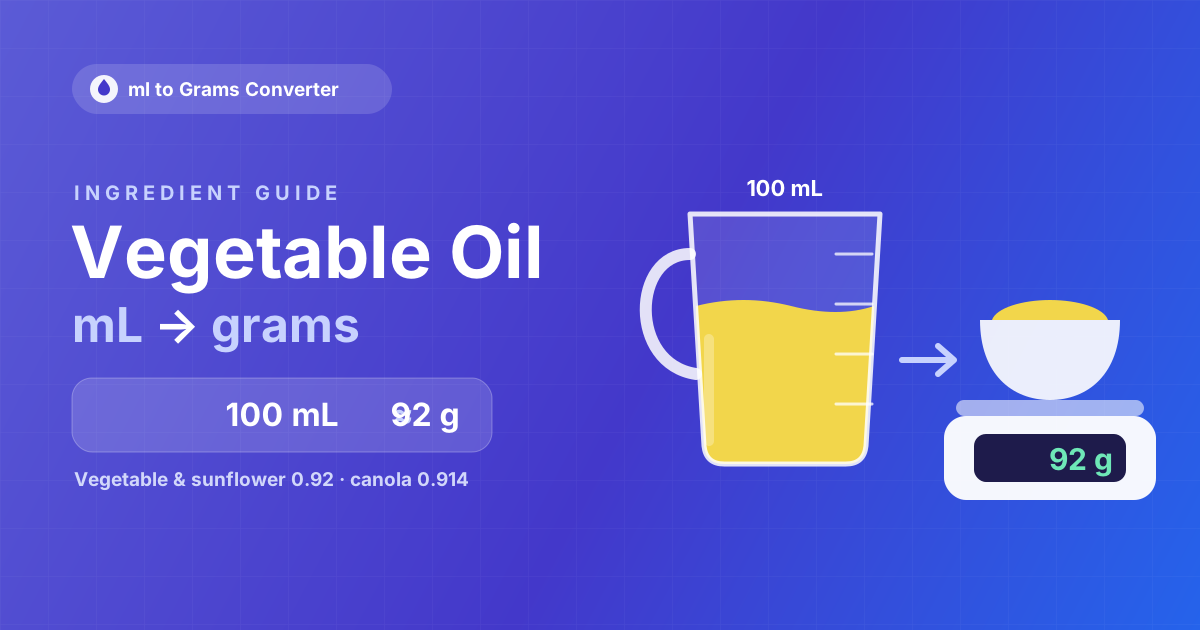
Vegetable oil weighs about 0.92 g per mL, so 100 mL comes to about 92 g and a 250 mL metric cup to about 230 g. Canola oil is a touch lighter at 0.914 g/mL, which puts 100 mL at about 91 g, and sunflower oil uses the same 0.92 g/mL figure as generic vegetable oil. All three values assume oil at room temperature and match the settings in our converter.
In practice the oils are close enough that one chart covers them all. The table below gives canola its own column only because the converter lists it separately.
Vegetable, sunflower and canola oil mL to grams
Find your volume in the left column and read across. Use the middle column for generic vegetable oil, sunflower oil and most blends, and the right column for bottles labeled canola or rapeseed.
| Volume (mL) | Vegetable or sunflower oil, 0.92 (g) | Canola oil, 0.914 (g) |
|---|---|---|
| 5 mL | 4.6 g | 4.6 g |
| 10 mL | 9.2 g | 9.1 g |
| 15 mL | 13.8 g | 13.7 g |
| 30 mL | 28 g | 27 g |
| 50 mL | 46 g | 46 g |
| 60 mL | 55 g | 55 g |
| 80 mL | 74 g | 73 g |
| 100 mL | 92 g | 91 g |
| 120 mL | 110 g | 110 g |
| 125 mL | 115 g | 114 g |
| 150 mL | 138 g | 137 g |
| 200 mL | 184 g | 183 g |
| 240 mL | 221 g | 219 g |
| 250 mL | 230 g | 229 g |
| 300 mL | 276 g | 274 g |
| 400 mL | 368 g | 366 g |
| 500 mL | 460 g | 457 g |
| 750 mL | 690 g | 686 g |
| 1,000 mL | 920 g | 914 g |
Densities used: 0.92 g/mL for vegetable oil, cooking oil and sunflower oil, and 0.914 g/mL for canola (rapeseed) oil, both for liquid oil at room temperature. These are the exact values behind the Vegetable Oil, Cooking Oil and Canola Oil options in the converter. There is no separate sunflower entry, because sunflower oil sits at about 0.92 g/mL; choose Vegetable Oil for it.
Notice how little the two columns disagree. Up to about 150 mL they differ by a gram at most, and even at a full liter the gap stays in single digits. The differences between common cooking oils are under about 1.5%, so for a typical recipe amount you are looking at a gram or two either way.
What is in a bottle of “vegetable oil”?
“Vegetable oil” is a name for a category, not a single product. In the US, a bottle labeled vegetable oil is usually soybean oil or a blend of oils. In the UK, vegetable oil is often rapeseed oil, which is the same type of oil sold elsewhere as canola. The ingredient line on the label tells you which one you have.
For converting, that label check decides which setting to use:
- Canola or rapeseed oil: use the Canola Oil option (0.914 g/mL), or the right-hand column of the chart.
- Soybean, corn, sunflower, a blend, or no oil named: use Vegetable Oil or Cooking Oil (both 0.92 g/mL), or the middle column.
If you pick the “wrong” one, very little happens. A recipe that uses 1/2 cup (120 mL) of oil comes out at about 110 g on either setting. The choice only starts to show at a liter or more, and even then the difference is a handful of grams.
One variant is worth knowing about. High-oleic sunflower oil is slightly lighter than regular sunflower oil, at about 0.907 to 0.913 g/mL (measured at 25 °C). It still converts closely enough with the standard figures for home cooking, but it is the one common oil that sits a little below the rest.
How the oils compare: density ranges
The Codex standard for named vegetable oils (CXS 210-1999) sets a density range for each oil. Converted to g/mL at 20 °C, the ranges look like this:
| Oil | Density at 20 °C | 100 mL weighs about |
|---|---|---|
| Canola (low erucic acid rapeseed) | 0.912 to 0.918 g/mL | 91 to 92 g |
| Sunflower | 0.916 to 0.921 g/mL | 92 g |
| Soybean | 0.917 to 0.923 g/mL | 92 g |
| Corn (maize) | about 0.915 to 0.923 g/mL | 92 g |
The ranges overlap almost completely. Canola sits at the lighter end, which is why the converter gives it a separate value, while sunflower, soybean and corn cluster around 0.92 g/mL.
Nutrition data tells the same story. USDA FoodData Central lists canola, soybean, sunflower and corn oil at the same weights: 13.6 g per tablespoon and 218 g per cup, or about 0.92 g/mL. USDA’s direct lab measurements found 90.9 g in 100 mL of canola and 91.3 g in 100 mL of soybean oil, both within a gram of the chart.
Two figures to ignore
Some websites give vegetable or sunflower oil a density of 0.96 g/mL. That is too high. None of the ranges above reaches even 0.93, so a 0.96 figure will overstate the weight of every amount you convert.
At the other end, some baking weight charts list a cup of vegetable oil at 198 g. That number looks like a rounded 7 oz rather than a measured density. It may be convenient for a single recipe, but it is not a reliable basis for converting other amounts.
Converting vegetable oil from mL to grams
Multiply the volume by the density:
- Vegetable, cooking or sunflower oil:
grams = mL × 0.92 - Canola oil:
grams = mL × 0.914
For example, 150 mL × 0.92 g/mL = 138 g of sunflower oil, while 150 mL × 0.914 g/mL = 137.1 g, about 137 g, of canola. The one-gram gap is typical of what separates the two oils at recipe scale.
To skip the arithmetic for an amount that is not in the chart, enter the volume in the mL to Grams Converter and select Vegetable Oil, Cooking Oil or Canola Oil to match your bottle.
Spoon and cup weights for vegetable oil
American recipes in particular give oil in cups and spoons. At 0.92 g/mL, the standard measures weigh:
| Measure | Vegetable oil (g) |
|---|---|
| 1 teaspoon (5 mL) | 4.6 g |
| 1 tablespoon (15 mL) | 13.8 g |
| 2 tablespoons (30 mL) | 28 g |
| 1/4 cup (60 mL) | 55 g |
| 1/3 cup (80 mL) | 74 g |
| 1/2 cup (120 mL) | 110 g |
| 2/3 cup (160 mL) | 147 g |
| 3/4 cup (180 mL) | 166 g |
| 1 US cup (240 mL) | 221 g |
| 1 metric cup (250 mL) | 230 g |
A US cup (240 mL) of vegetable oil weighs about 221 g, and a metric cup (250 mL) about 230 g. USDA’s figure of 218 g per cup lands in the same neighbourhood, so any of these numbers will serve a home recipe. For canola in a US cup, the main chart gives about 219 g.
The tablespoon figure, about 13.8 g, sits beside USDA’s 13.6 g and the roughly 14 g printed on many nutrition labels. For calorie tracking, those small differences matter less than how you measure: a heaped, dripping or half-filled spoon moves the number far more. Weighing is the most reliable method if you log what you eat.
Oil amounts in everyday recipes
The same few volumes of neutral oil come up again and again. Here is how they convert in the kinds of recipes where vegetable oil is the usual choice.
Oil-based cakes
Suppose a carrot cake recipe calls for 1 US cup of oil:
240 mL × 0.92 g/mL = 220.8 g, so weigh about 221 g of vegetable or sunflower oil.
With canola, 240 mL × 0.914 g/mL = 219.36 g, or about 219 g. Either weight gives the same cake. Pouring onto a scale also means you are not left scraping a greasy cup.
Muffins and quick breads
Now take a muffin recipe that asks for 1/3 cup of oil.
80 mL × 0.92 g/mL = 73.6 g, which rounds to about 74 g.
Canola comes to about 73 g for the same volume. For a single tray of muffins, a one-gram difference is far below anything you could taste or see.
Dressings and marinades
A marinade using 1/4 cup (60 mL) of oil needs about 55 g, and here the two oils give the identical answer. For small amounts like this, measuring spoons are perfectly adequate. The scale earns its place when you batch dressings in larger jars.
Bread-machine loaves and big batches
Bread-machine recipes tend to list oil in tablespoons, and a fair amount clings to the spoon on its way to the pan. Set the bread pan on the scale, tare it, and pour instead: 2 tablespoons is about 28 g, and 3 tablespoons (45 mL) is about 41 g.
For batch baking, scale the volume first and convert once. Tripling a muffin recipe that uses 1/3 cup of oil gives a full US cup, so pour about 221 g in one go instead of filling the small cup three times.
Shallow and deep frying
Frying uses much larger volumes. At room temperature, 750 mL of vegetable oil weighs about 690 g, and a liter about 920 g. Canola comes in at about 686 g and 914 g for the same volumes.
Temperature matters more here than anywhere else. Warm oil expands slightly and weighs a little less per mL, and hot frying oil noticeably less. That means the level in the pan rises a bit as the oil heats, even though the weight has not changed. Always measure frying oil cold, at room temperature, before it goes on the heat. The figures on this page are for room-temperature oil and do not apply to oil that is already hot.
Grams to mL for vegetable oil
When a recipe gives oil by weight and you only have a jug, divide: mL = grams ÷ 0.92. This table covers vegetable and sunflower oil.
| Weight (g) | Vegetable oil (mL) |
|---|---|
| 5 g | 5.4 mL |
| 10 g | 10.9 mL |
| 14 g | 15.2 mL |
| 25 g | 27 mL |
| 50 g | 54 mL |
| 100 g | 109 mL |
| 150 g | 163 mL |
| 200 g | 217 mL |
| 250 g | 272 mL |
| 500 g | 543 mL |
| 1,000 g | 1,087 mL |
Say a bread recipe asks for 200 g of sunflower oil. 200 g ÷ 0.92 g/mL = 217.39 mL, so measure about 217 mL. If your bottle is canola, 200 g ÷ 0.914 g/mL = 218.82 mL, about 219 mL. Canola needs a slightly larger volume for the same weight because it is slightly lighter.
For smaller weights the two oils are effectively the same: 100 g is about 109 mL whichever oil you use, and 25 g is about 27 mL. The 14 g row lines up with nutrition labels, since 14 g of vegetable oil is about 15.2 mL, a hair over one tablespoon.
Filling, topping up and straining frying oil
Filling a deep pan or fryer with a jug means several pours, each with its own small error. Weighing handles the whole amount in one step.
Filling by weight
If the pan fits on your scale, tare it and pour straight from the bottle. For a fill line at 2 liters, 2,000 mL × 0.92 g/mL = 1,840 g, so stop at about 1,840 g. When the fryer is too big for the scale, weigh the bottle instead: note its weight, pour, then weigh it again. Every 92 g that leaves the bottle is about 100 mL in the fryer.
Topping up after frying
Some oil leaves with each batch of food, so the level drops over a session. Judge the top-up once the oil has cooled to room temperature, since warm oil sits higher in the pan than the same weight cold.
Suppose you filled the fryer with 920 g (1 liter) and the cooled, strained oil now weighs 830 g. The shortfall is 90 g, and 90 g ÷ 0.92 g/mL = 97.83 mL, so add about 98 mL of fresh oil. Topping up with canola gives the same rounded answer.
Straining and storing used oil
To keep oil for another session, let it cool completely, then pour it through a fine sieve lined with paper towel or cheesecloth into a clean, dry container with a lid. Weigh the strained oil and write the figure on the container. Next time, the gap between that number and your usual fill weight tells you exactly how much fresh oil to add. Throw out oil that smells stale or rancid rather than topping it up.
Measuring tips for vegetable oil
- Measure at room temperature. Oil straight from a cold pantry or garage is fine to use, but let it sit indoors first if you are measuring by volume for baking.
- Use a liquid measuring jug. A dry cup filled to the brim is hard to carry without spilling, and oil that runs down the outside never reaches the bowl.
- Weigh in the mixing bowl. Tare the bowl with the other wet ingredients already in it, then pour the oil to the target weight. One container, no scraping.
- Measure before heating. For frying, measure the cold oil and pour it into the pan, rather than judging by the level in a hot pan.
- Stick to one method per recipe. Mixing a scale for some ingredients and spoons for others is fine, but convert a single ingredient one way and keep to it, so the numbers stay consistent each time you bake.
- Write the grams on the recipe. Once you have converted a cup or spoon amount, note the weight in the margin and skip the conversion next time.
Vegetable oil compared with other fats
Olive oil is close to vegetable oil but not identical, and it has its own grades and storage quirks, which the olive oil mL to grams chart covers. Coconut oil is a different case because it is usually measured melted; see the coconut oil conversion guide.
If a recipe gives you the choice between oil and melted butter, convert each fat with its own density rather than assuming equal volumes weigh the same. The butter mL to grams chart has the melted butter figures. For any other amount of oil, select the matching oil in the mL to grams calculator and enter your volume.
Frequently asked questions
How many grams is 100 mL of vegetable oil?
About 92 g for vegetable, sunflower or cooking oil at room temperature. Canola oil is slightly lighter, so 100 mL of canola weighs about 91 g.
How much does 1 cup of vegetable oil weigh in grams?
A US cup (240 mL) of vegetable oil weighs about 221 g, and a metric cup (250 mL) weighs about 230 g. Canola oil comes out a gram or two lighter for the same cup.
Is sunflower oil heavier than canola oil?
Very slightly. Sunflower oil falls between about 0.916 and 0.921 g/mL and canola between about 0.912 and 0.918 g/mL, so the difference in a recipe amount is usually a gram or two.
Can I use the same conversion for canola and vegetable oil?
Yes, for nearly all recipes. Common cooking oils differ by less than about 1.5% in density, so 0.92 g/mL gives a close result for canola too, though 0.914 g/mL is the more exact figure.
How many mL is 100 g of vegetable oil?
About 109 mL. The answer is the same for canola oil at this weight, because the small density difference does not change the rounded result.