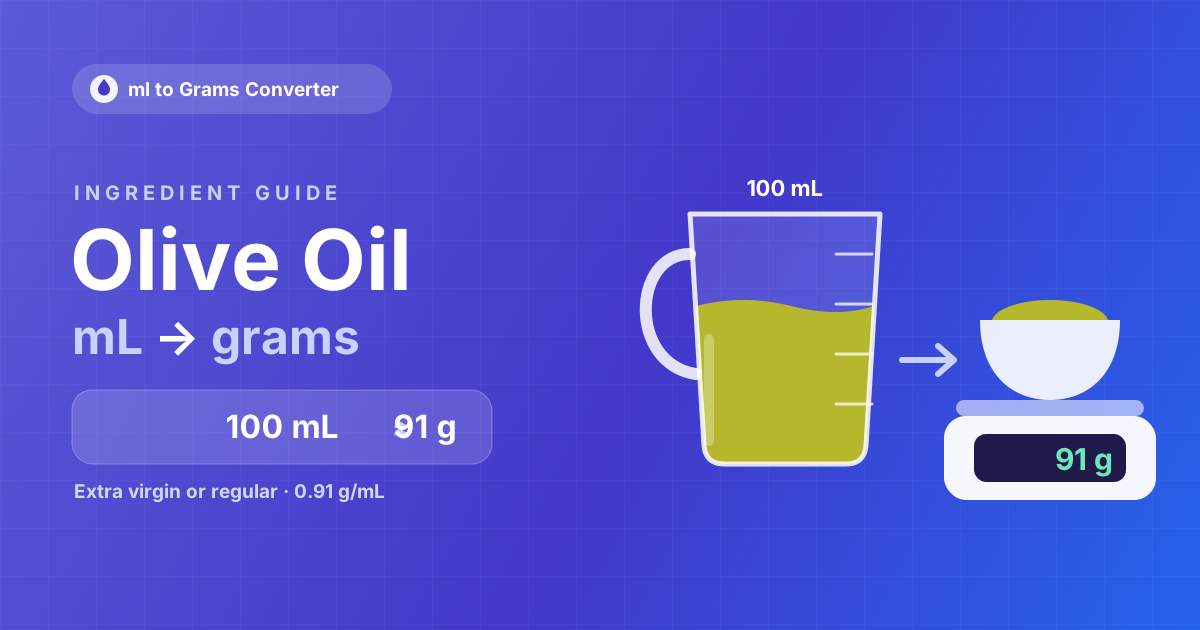
A milliliter of olive oil weighs about 0.91 g, so 100 mL of olive oil comes to roughly 91 g, not 100 g. That figure uses a density of 0.91 g/mL for olive oil at room temperature (about 20 °C), which is the same value behind the Olive Oil option in our converter. For a quick everyday reference, one 15 mL tablespoon weighs about 13.7 g.
The chart below runs from 5 to 500 mL. Further down you will find spoon and cup weights, a grams-to-mL table for recipes written by weight, and the reason extra virgin and light olive oil convert exactly the same way.
Olive oil mL to grams chart
Each row multiplies the volume by 0.91 g/mL and rounds to a practical kitchen figure.
| Volume (mL) | Olive oil (g) |
|---|---|
| 5 mL | 4.6 g |
| 10 mL | 9.1 g |
| 15 mL | 13.7 g |
| 20 mL | 18.2 g |
| 25 mL | 23 g |
| 30 mL | 27 g |
| 45 mL | 41 g |
| 50 mL | 46 g |
| 60 mL | 55 g |
| 75 mL | 68 g |
| 80 mL | 73 g |
| 100 mL | 91 g |
| 120 mL | 109 g |
| 125 mL | 114 g |
| 150 mL | 137 g |
| 200 mL | 182 g |
| 240 mL | 218 g |
| 250 mL | 228 g |
| 300 mL | 273 g |
| 400 mL | 364 g |
| 500 mL | 455 g |
Density used: 0.91 g/mL, for liquid olive oil of any grade at ordinary room temperature (about 20 °C). This matches the Olive Oil setting in the converter on our homepage, so the chart and the calculator give the same answers. Spoon-sized amounts keep one decimal place because a fraction of a gram matters more in a teaspoon than in a jug.
Where the 0.91 g/mL figure comes from
Olive oil is one of the better documented ingredients in the kitchen. The international Codex standard for olive oils (CXS 33-1981) sets its relative density at 0.910 to 0.916, measured at 20 °C against water at the same temperature. In kitchen units that works out to about 0.908 to 0.914 g/mL, and 0.91 g/mL sits inside that band.
Nutrition data agrees. USDA FoodData Central lists a tablespoon of olive oil at 13.5 g and a cup at 216 g, which is about 0.913 g/mL. A separate USDA measurement of extra virgin olive oil recorded 90.7 g per 100 mL. The chart above says 91 g for that volume, so the two agree to well under a gram.
You will find other figures online. Many sites round olive oil down to 0.9 g/mL, which is slightly low, and a few use 0.92, which is slightly high. Neither error will spoil a salad, but there is no reason to use a number outside the measured range when 0.91 fits it.
How to convert olive oil from mL to grams
The conversion is one multiplication:
grams = mL × 0.91
Take the volume in milliliters, multiply by 0.91, and round to the nearest gram (or to a tenth of a gram for spoon amounts). For 200 mL, the working is 200 mL × 0.91 g/mL = 182 g. The same rule fills in any volume that falls between the rows of the chart.
For an awkward amount like 185 mL, you do not need to do the sum by hand. Enter your exact volume and select Olive Oil in the mL to Grams Converter to calculate another amount. The homepage also explains the general volume-to-weight formula if you want to apply it to other ingredients.
Extra virgin, regular and light olive oil weigh the same
People often ask whether extra virgin olive oil is heavier than regular or “light” olive oil. For measuring, the answer is no. The Codex density range quoted above covers the whole family: extra virgin, virgin, refined olive oil, the grade labeled simply “olive oil”, and olive pomace oil all fall in the same narrow band.
The word “light” on a label describes flavor and color. It does not mean the oil weighs less, and it does not mean it has fewer calories. A tablespoon of light olive oil weighs the same as a tablespoon of extra virgin, so one chart serves every bottle in the cupboard.
That matters when you substitute one grade for another. If a recipe was written with extra virgin oil and you only have a milder refined bottle, use the same number of milliliters or grams. The dish may taste gentler, but the amount of oil in the pan will be identical.
Temperature, fridge storage and cloudy oil
The chart assumes oil at normal room temperature, about 20 °C. Oil expands slightly as it warms and contracts as it cools, so a milliliter of warm oil weighs a touch less than a milliliter of cool oil. At kitchen temperatures the effect is small, and you can ignore it for everyday cooking.
Cold storage causes a more practical problem. Olive oil kept in the fridge can turn cloudy, thicken or partly solidify. Oil in that state will not settle to a clean line in a jug or fill a spoon evenly, so any volume reading becomes unreliable. Leave the bottle at room temperature until the oil is clear and pourable, then measure.
A scale sidesteps the issue. It reads grams whether the oil is clear, cloudy or half set, which is one more reason to weigh oil when the amount matters. For oil that will be heated, measure it cold from the bottle before it goes into the pan.
Olive oil vs water: is 100 mL of olive oil 100 g?
No. Olive oil is less dense than water, about 9% lighter, which is why a splash of it floats on top of water instead of sinking. Water has a density of about 1 g/mL, so its milliliter and gram readings match. Olive oil drifts further from water as the volume grows:
| Volume (mL) | Water (g) | Olive oil (g) |
|---|---|---|
| 15 mL | 15 g | 13.7 g |
| 100 mL | 100 g | 91 g |
| 250 mL | 250 g | 228 g |
| 500 mL | 500 g | 455 g |
| 1,000 mL | 1,000 g | 910 g |
At tablespoon scale the gap is barely noticeable. At a liter, the oil weighs 910 g against 1,000 g for the same volume of water. The mistake usually shows up in the other direction: if a recipe gives olive oil in grams and you pour the same number of milliliters, you add more oil than the author intended. As the reverse table further down shows, 100 g of olive oil is about 110 mL.
Tablespoons, teaspoons and cups of olive oil in grams
Plenty of recipes still measure olive oil with spoons and cups. This table converts the standard measures at 0.91 g/mL.
| Measure | Olive oil (g) |
|---|---|
| 1 teaspoon (5 mL) | 4.6 g |
| 1 tablespoon (15 mL) | 13.7 g |
| 2 tablespoons (30 mL) | 27 g |
| 1/4 cup (60 mL) | 55 g |
| 1/3 cup (80 mL) | 73 g |
| 1/2 cup (120 mL) | 109 g |
| 2/3 cup (160 mL) | 146 g |
| 3/4 cup (180 mL) | 164 g |
| 1 US cup (240 mL) | 218 g |
| 1 metric cup (250 mL) | 228 g |
Cup size is the first thing to check. A US cup is 240 mL and holds about 218 g of olive oil, while a metric cup is 250 mL and holds about 228 g. Recipes from different countries may use either, so look at where the recipe comes from before you convert a large amount.
Spoons are the second. Use real measuring spoons rather than cutlery, since everyday tablespoons vary a lot in size, and fill them right to the rim without letting oil run over the edge. If a recipe specifies a 20 mL tablespoon, use the 20 mL row of the main chart instead: about 18.2 g.
Nutrition labels also work in tablespoons. Many print a tablespoon of olive oil as about 14 g, and USDA data uses 13.5 g. The figure of about 13.7 g for a level 15 mL spoon sits between the two, and the differences are small next to the error from an overfilled or underfilled spoon.
Worked examples from everyday recipes
Each example uses the same formula, grams = mL × 0.91, then rounds the result to something a kitchen scale can show.
Olive oil cake
Suppose an olive oil cake recipe asks for 1 metric cup (250 mL) of oil and you would rather weigh it straight into the mixing bowl.
250 mL × 0.91 g/mL = 227.5 g, so weigh out about 228 g.
Weighing is the cleaner method for a cake batter. Put the bowl on the scale, tare it to zero, and pour until the display reads 228 g. There is no oily cup to scrape out, and none of the oil stays behind clinging to the sides of a measure.
Vinaigrette for two
A small dressing might use 3 tablespoons (45 mL) of olive oil with 1 tablespoon of vinegar.
45 mL × 0.91 g/mL = 40.95 g, which rounds to about 41 g.
Set the jar on the scale, zero it, pour in 41 g of oil, then add the vinegar with a spoon. For a larger batch that uses 3/4 cup (180 mL) of oil, the spoon table gives about 164 g, and a jar you can shake and store saves measuring every time.
Sautéing and calorie tracking
A recipe tells you to heat 2 tablespoons (30 mL) of olive oil in a pan.
30 mL × 0.91 g/mL = 27.3 g, or about 27 g.
If you log food, this is where weighing pays off. A “drizzle” or a “glug” is not a measurement, and oil poured freely from the bottle is hard to judge by eye. Place the pan (cold) on the scale, zero it, and pour to 27 g. You then have a precise number to enter instead of a guess at how full the spoon was.
Grams to mL for olive oil
Some recipes, particularly bread and baking recipes, list olive oil in grams. If you have a measuring jug but no scale, divide instead of multiplying:
mL = grams ÷ 0.91
| Weight (g) | Olive oil (mL) |
|---|---|
| 5 g | 5.5 mL |
| 10 g | 11 mL |
| 14 g | 15.4 mL |
| 25 g | 27 mL |
| 50 g | 55 mL |
| 100 g | 110 mL |
| 150 g | 165 mL |
| 200 g | 220 mL |
| 250 g | 275 mL |
| 500 g | 549 mL |
| 1,000 g | 1,099 mL |
A focaccia dough that asks for 50 g of olive oil works like this: 50 g ÷ 0.91 g/mL = 54.95 mL, so measure about 55 mL. For a larger amount, 200 g ÷ 0.91 g/mL = 219.78 mL, which is about 220 mL, a little less than a full US cup.
The 14 g row is there for nutrition labels. A 14 g serving of olive oil is about 15.4 mL, very close to one standard tablespoon, which is why labels and spoons line up so neatly for this ingredient.
How much oil is in the bottle
Olive oil is sold by volume, most commonly in 250 mL, 500 mL, 750 mL and 1 L bottles. In weight, the oil inside comes to roughly:
- 250 mL bottle: about 228 g
- 500 mL bottle: about 455 g
- 750 mL bottle: about 683 g
- 1 L bottle: about 910 g
These figures help when a recipe calls for a large weight of oil, such as a confit or a batch of preserved vegetables. A recipe that needs 500 g of olive oil needs about 549 mL, so a single 500 mL bottle will not be enough.
The bottle is also a handy tracking tool. Weigh it before you start cooking and again when you finish, and the difference in grams is exactly how much oil went into the dish, with no spoons involved.
Olive oil next to other kitchen fats
The 0.91 g/mL figure applies to olive oil only. Neutral cooking oils such as canola and sunflower have their own values, set out in the vegetable oil mL to grams guide. Coconut oil needs separate treatment because it is usually measured melted, which the coconut oil conversion chart covers.
Baking recipes sometimes suggest swapping melted butter for olive oil, or the other way round. This page covers the olive oil side of that swap. Butter has its own density, so convert it separately with the melted butter conversion chart rather than assuming equal volumes weigh the same.
Tips for measuring olive oil accurately
- Weigh whenever you can. A digital scale gives the most reliable figure for baking and for calorie tracking. Pour directly into the bowl, jar or pan after taring it to zero.
- Read a jug at eye level. Set the jug on a flat counter and crouch so your eye is level with the markings. Reading the line from above, at an angle, makes it easy to misjudge.
- Let it drain. Oil clings to the inside of cups and spoons. Tip the measure fully and give it a few seconds, or use a silicone spatula for larger amounts.
- Measure oil before sticky ingredients. If a recipe also calls for honey or syrup, measure the oil first with the same spoon; the thin coating helps the sticky ingredient slide out cleanly.
- Warm cold oil first. Do not measure fridge-cold oil by volume while it is cloudy or thick. Let it return to room temperature.
- Round sensibly. Whole grams are fine for anything above a couple of tablespoons. Keep one decimal only for teaspoon and tablespoon amounts.
For volumes that are not in the charts, enter the amount in milliliters and choose Olive Oil in the mL to grams calculator, which applies the same 0.91 g/mL density used throughout this page.
Frequently asked questions
Is 100 mL of olive oil equal to 100 g?
No. 100 mL of olive oil weighs about 91 g because olive oil is less dense than water. Milliliters and grams only match for liquids with a density of about 1 g/mL, such as water.
How many grams is 1 mL of olive oil?
About 0.91 g at room temperature. Multiply any volume in milliliters by 0.91 to get the approximate weight in grams.
How much does a tablespoon of olive oil weigh?
A level 15 mL tablespoon of olive oil weighs about 13.7 g. Nutrition labels often round it to about 14 g, and USDA data uses 13.5 g, so all three describe essentially the same spoonful.
Does extra virgin olive oil weigh more than light olive oil?
No. All olive oil grades share the same density range, about 0.908 to 0.914 g/mL, so extra virgin, regular and light olive oil convert the same way. “Light” refers to flavor and color, not weight or calories.
How many mL is 100 g of olive oil?
About 110 mL. To convert any weight of olive oil to volume, divide the grams by 0.91.