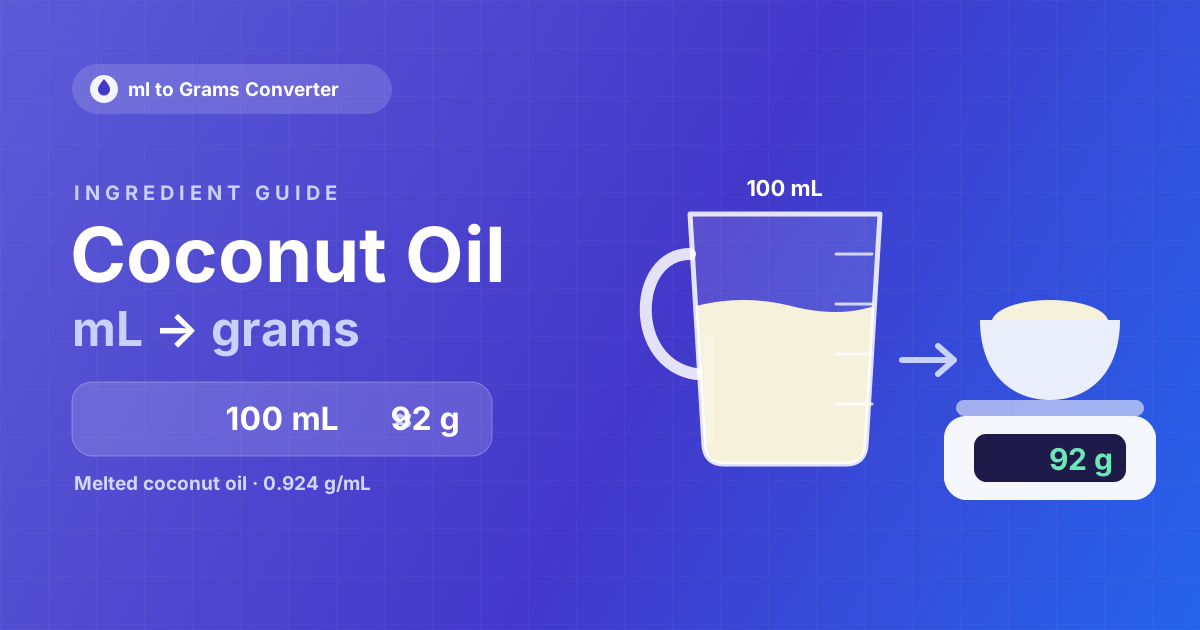
Melted coconut oil weighs about 0.92 g per milliliter, so 100 mL of melted coconut oil comes to roughly 92 g. The conversions below use 0.924 g/mL, the value behind the Coconut Oil option in the site’s converter, and they assume the oil is fully liquid. One tablespoon (15 mL) of melted coconut oil is about 13.9 g.
Scooped solid coconut oil does not follow these numbers, and the reasons are explained just after the chart.
Melted coconut oil mL to grams
Measured state: melted (liquid) coconut oil, clear and pourable, measured in a liquid jug or spoon. Density used: 0.924 g/mL, matching the Coconut Oil setting in the converter.
| Volume (mL) | Melted coconut oil (g) |
|---|---|
| 5 mL | 4.6 g |
| 10 mL | 9.2 g |
| 15 mL | 13.9 g |
| 20 mL | 18.5 g |
| 30 mL | 28 g |
| 45 mL | 42 g |
| 50 mL | 46 g |
| 60 mL | 55 g |
| 75 mL | 69 g |
| 80 mL | 74 g |
| 100 mL | 92 g |
| 120 mL | 111 g |
| 125 mL | 116 g |
| 150 mL | 139 g |
| 200 mL | 185 g |
| 240 mL | 222 g |
| 250 mL | 231 g |
| 300 mL | 277 g |
| 500 mL | 462 g |
Every weight in this chart is for oil that has been melted before it goes into the measure. If your jar is solid, melt it first or weigh it; do not read these values against a scooped cup.
Is your coconut oil melted, soft or solid?
Coconut oil melts at about 24 to 26 °C (76 to 78 °F). Below that range it is soft or firmly solid, and above it the oil turns into a clear liquid. So the same jar can be pourable in a warm summer kitchen and hard enough to need a spoon in winter.
That matters for conversion because only the liquid state has a dependable volume. Solid coconut oil scooped or pressed into a cup either leaves air gaps or compresses by different amounts depending on how hard you push. Two people filling the same cup with solid oil can end up with noticeably different weights.
A published figure shows the problem. King Arthur lists 1/2 cup of coconut oil at 113 g without saying whether it was solid or melted. That is heavier than the 111 g you get from a melted 1/2 cup in the chart, possibly because the oil was measured solid and pressed into the cup. Neither number is wrong as such; without the state, you cannot tell which one your recipe writer meant.
The weight itself never changes. Melt 100 g of solid coconut oil and you have 100 g of liquid coconut oil. Only its volume reading shifts, which is why the scale is the one tool that works in either state.
You have two reliable options with a solid jar:
- Weigh it solid. Put the bowl on the scale, tare it, and spoon in coconut oil until you reach the gram figure you need.
- Melt it, then measure. Warm the jar gently until the oil is clear, then pour it into a liquid measure and use the chart above.
Soft, half-melted oil is the worst of both worlds. It holds pockets of air like the solid does but looks as though it should pour, so finish melting it before you measure by volume.
Where the 0.924 g/mL figure comes from
Coconut oil is lighter than water, and several sources agree on roughly where it sits. The international Codex standard for coconut oil (CXS 210-1999) gives a relative density of 0.908 to 0.921, measured at 40 °C because the oil is solid at 20 °C. That works out to about 0.906 to 0.919 g/mL. A 2020 study in PLoS One measured coconut oil at 0.916 g/mL, and USDA FoodData Central lists 13.6 g per tablespoon and 218 g per cup, which is about 0.92. USDA works from US spoon and cup sizes, which are slightly smaller than the rounded 15 mL tablespoon and 240 mL cup used on this site, so its per-spoon figures run a little lower than the tables here.
Put together, melted coconut oil sits around 0.91 to 0.92 g/mL depending on its temperature. The converter’s 0.924 is at the upper end of that spread. Against the 0.916 g/mL measurement, the difference is under 1 g per 100 mL, which you would not notice in a recipe.
Temperature does move the number slightly. Hot oil takes up a little more room than warm oil, so it weighs slightly less per mL. Oil that has just been melted over heat will come in a touch under the chart, and that difference is too small to matter in a batter or a pan.
Refined and virgin (unrefined) coconut oil differ in flavor and smoke point, but there is no reliable density difference between them for kitchen purposes. Use the same chart for both.
Converting any amount of coconut oil
The formula is the one used for every ingredient on this site:
grams = mL × 0.924
For example, 100 mL × 0.924 g/mL = 92.4 g, which rounds to about 92 g. For amounts that are not in the chart, enter your exact volume and select Coconut Oil in the mL to Grams Converter. It uses the same 0.924 g/mL, so its results line up with the tables here.
Coconut oil weighs close to other cooking oils per milliliter, but not exactly the same. When a recipe calls for a different oil, the vegetable oil mL to grams guide and the olive oil conversion chart give the right weights for those.
Tablespoons, cups and calorie counting
Most recipes give coconut oil in spoons or cups. The table below converts the common sizes.
Measured state: melted coconut oil (0.924 g/mL). The site uses a 15 mL tablespoon, a 240 mL US cup and a 250 mL metric cup.
| Measure | Melted coconut oil (g) |
|---|---|
| 1 teaspoon (5 mL) | 4.6 g |
| 1 tablespoon (15 mL) | 13.9 g |
| 2 tablespoons (30 mL) | 28 g |
| 1/4 cup (60 mL) | 55 g |
| 1/3 cup (80 mL) | 74 g |
| 1/2 cup (120 mL) | 111 g |
| 2/3 cup (160 mL) | 148 g |
| 3/4 cup (180 mL) | 166 g |
| 1 US cup (240 mL) | 222 g |
| 1 metric cup (250 mL) | 231 g |
If you track what you eat, the nutrition label on the jar usually lists a serving as 1 tablespoon, about 13 to 14 g. That lines up with the melted tablespoon above. The catch is that a tablespoon of solid oil scooped from a cold jar is rarely a level, air-free tablespoon, so the real amount on your spoon can drift well away from the label.
For tracking, the most accurate method is to weigh. Put the whole jar on the scale, note the reading, scoop out what you need, and weigh the jar again. The difference is exactly what went into the pan, whether the oil was solid or liquid. It also saves you from scraping a greasy spoon clean over a bowl.
Recipe examples
Each example shows the multiplication so you can repeat it with your own quantities.
Granola. A batch of baked granola calls for 1/3 cup of melted coconut oil to coat the oats. A 1/3 cup is 80 mL.
80 mL × 0.924 g/mL = 73.92 g
Weigh about 74 g of coconut oil, solid or melted, straight into the pan you will warm it in. Then add the honey or maple syrup and stir while the oil is still liquid.
Vegan muffins. A dairy-free muffin recipe asks for 1/2 cup of melted coconut oil in place of butter.
120 mL × 0.924 g/mL = 110.88 g
That rounds to about 111 g. Because coconut oil sets below its melting point, cold plant milk or other chilled ingredients can make it firm up into small lumps when you combine them. Letting those ingredients come to room temperature first keeps the batter smooth.
Stir-fry. Two tablespoons of coconut oil for a wok is 30 mL.
30 mL × 0.924 g/mL = 27.72 g
About 28 g. For frying, measuring by eye is fine, but if you are counting calories it is worth weighing the oil since this is where the grams add up quickly.
Salad dressing or drizzle. A recipe uses 20 mL of melted coconut oil.
20 mL × 0.924 g/mL = 18.48 g
So you need about 18.5 g. A coconut oil dressing can firm up on cold leaves straight from the fridge, so it works best with ingredients at room temperature.
Swapping for butter. Coconut oil is often used in place of butter in dairy-free baking. The two fats have similar but not identical densities in melted form, and butter also contains water and milk solids, so convert each from its own chart rather than assuming a cup of one weighs the same as a cup of the other. The melted butter mL to grams chart covers the butter side.
When the recipe says “1/2 cup coconut oil, melted”
Recipe wording around coconut oil is often ambiguous. “1/2 cup melted coconut oil” usually means melt the oil first, then measure 1/2 cup of liquid. “1/2 cup coconut oil, melted” can mean scoop 1/2 cup of solid oil, then melt it.
The two give different amounts, because a scooped solid cup and a poured liquid cup do not hold the same weight of oil. Weighing avoids the question entirely. If the recipe gives grams anywhere, trust the grams. If it only gives cups, the melted reading from the chart (about 111 g for 1/2 cup) is a sensible default.
Grams to mL for melted coconut oil
To go from weight back to volume, divide by the density:
mL = grams ÷ 0.924
This is useful when a recipe lists coconut oil in grams and you only have a measuring jug, or when you want to know where melted oil should reach on the jug before you pour.
Measured state: melted coconut oil (0.924 g/mL).
| Weight (g) | Melted coconut oil (mL) |
|---|---|
| 5 g | 5.4 mL |
| 10 g | 10.8 mL |
| 14 g | 15.2 mL |
| 25 g | 27 mL |
| 50 g | 54 mL |
| 100 g | 108 mL |
| 113 g | 122 mL |
| 150 g | 162 mL |
| 200 g | 216 mL |
| 250 g | 271 mL |
| 500 g | 541 mL |
A worked example: a recipe calls for 150 g of coconut oil.
150 g ÷ 0.924 g/mL = 162.34 mL
Melt the oil and pour it to about 162 mL. The 113 g row is a useful check too. That is the weight King Arthur gives for 1/2 cup, and melted it fills about 122 mL, which is slightly more than a 1/2 cup line. It shows how far a cup measure can drift when a recipe does not say whether the oil was solid or melted.
Because coconut oil is lighter than water, the milliliter figure is always larger than the gram figure. A 14 g label serving, for instance, fills about 15.2 mL once melted.
Getting consistent results
Weighing is the single best habit with coconut oil. It works whether the jar is solid, soft or liquid, and it removes every question about how the recipe writer measured.
When you do measure by volume, melt the oil completely first. Set the jar in a bowl of warm water, or warm a portion in the microwave in short bursts, stirring until no cloudy or solid bits remain. Then pour it into a clear liquid measure on a flat surface and read the level at eye level.
Use the melted chart only for melted oil. Mixing a solid scoop with a liquid density is the most common source of error in coconut oil conversions, and it is easy to avoid once you know to look for it.
Finally, keep the temperature of your other ingredients in mind. Melted coconut oil can firm up again as soon as it meets cold eggs, milk or yogurt, which affects texture more than weight. For any amount not listed here, enter the volume and select Coconut Oil in the mL to Grams Converter.
Frequently asked questions
How many grams is 100 mL of coconut oil?
100 mL of melted coconut oil weighs about 92 g, based on a density of 0.924 g/mL. Solid coconut oil measured by volume is unreliable, so weigh it or melt it first.
How many grams is 1 tablespoon of coconut oil?
A 15 mL tablespoon of melted coconut oil is about 13.9 g. Nutrition labels usually list a tablespoon at about 13 to 14 g, and USDA FoodData Central gives 13.6 g.
Does melted coconut oil weigh the same as solid coconut oil?
Yes, the weight does not change when coconut oil melts, so 100 g solid becomes 100 g liquid. What changes is how it fills a measure, which is why a scooped cup of solid oil and a poured cup of melted oil weigh different amounts.
How many grams is 1 cup of coconut oil?
A 240 mL US cup of melted coconut oil is about 222 g, and a 250 mL metric cup is about 231 g. A cup of scooped solid oil can weigh more or less depending on how firmly it is packed.