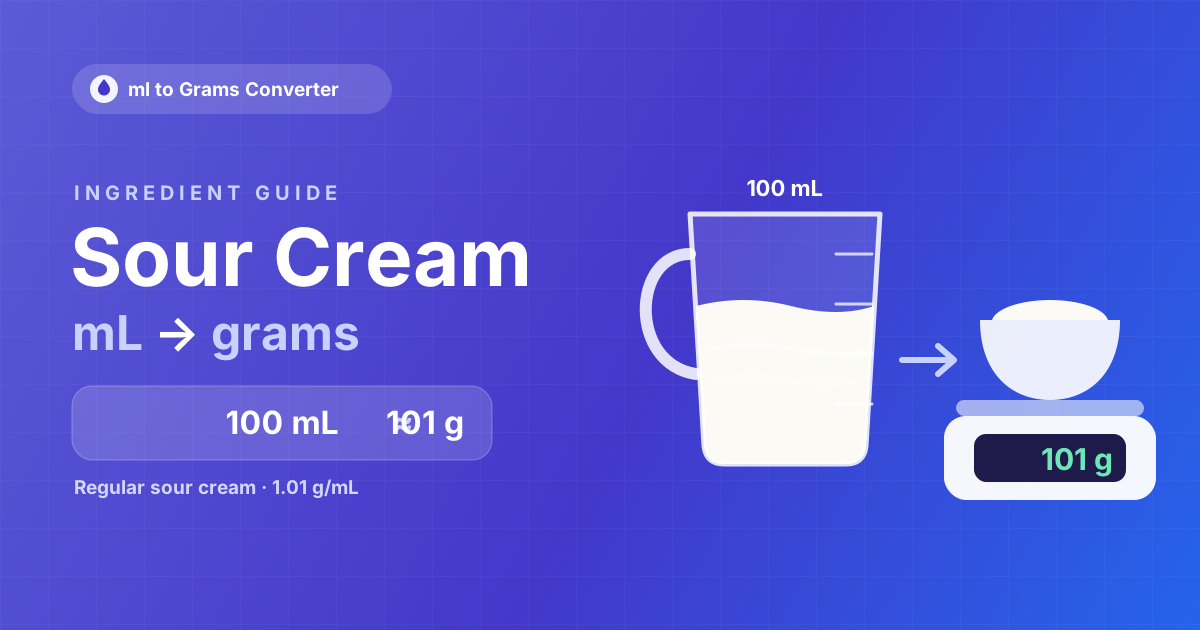
Sour cream weighs a touch more than water, at about 1.01 g/mL for regular sour cream that has been stirred. So 100 mL of sour cream weighs about 101 g, and a US cup (240 mL) comes to about 242 g. For everyday cooking, “1 mL is roughly 1 g” is a fair shortcut here, off by about 1%, provided the measure is filled without air pockets.
Sour cream mL to grams chart
The figures below use 1.01 g/mL, the same density behind the Sour Cream option in the mL to Grams Converter.
| Volume (mL) | Sour cream (g) |
|---|---|
| 5 mL | 5.1 g |
| 10 mL | 10.1 g |
| 15 mL | 15.2 g |
| 30 mL | 30 g |
| 45 mL | 45 g |
| 50 mL | 51 g |
| 60 mL | 61 g |
| 75 mL | 76 g |
| 80 mL | 81 g |
| 100 mL | 101 g |
| 120 mL | 121 g |
| 125 mL | 126 g |
| 150 mL | 152 g |
| 180 mL | 182 g |
| 200 mL | 202 g |
| 240 mL | 242 g |
| 250 mL | 253 g |
| 300 mL | 303 g |
| 400 mL | 404 g |
| 500 mL | 505 g |
This chart assumes regular sour cream, stirred smooth and spooned into the measure so there are no gaps. That condition matters more than you might expect, and the section on published cup weights below explains why. Small amounts are given to one decimal place; everything else is rounded to the nearest gram.
Why a milliliter of sour cream weighs about a gram
Sour cream is cultured cream, typically around 18 to 20% fat in the US, and UK soured cream is similar. Two things pull its density in opposite directions. Fat is lighter than water and lowers the weight of each milliliter, while milk solids are heavier than water and raise it. The two effects nearly cancel, which leaves sour cream sitting just above 1 g/mL.
That is a lucky result for anyone converting a recipe. Unlike flour or honey, sour cream will not throw your quantities far off if you treat the jug marking as a gram figure. It is still a different unit, though: mL measures how much space the sour cream takes up and grams measure how heavy it is. The two numbers only line up because the density happens to be close to 1.
Dairy with more fat drifts lighter. Pouring cream with much more fat weighs slightly less per mL than sour cream does, which is covered in the cream mL to grams guide for heavy, whipping and double cream.
The formula in one line
To convert any amount, multiply the volume by the density: grams = mL × 1.01. For a typical half-cup:
120 mL × 1.01 g/mL = 121.2 g, which rounds to 121 g.
For a volume that is not in the chart, enter it and select Sour Cream in the mL to grams calculator to get the weight straight away.
Sour cream by the spoon and cup
Most US recipes list sour cream in cups and tablespoons. This table uses a 15 mL tablespoon, a 240 mL US cup and a 250 mL metric cup.
| Measure | Sour cream (g) |
|---|---|
| 1 teaspoon (5 mL) | 5.1 g |
| 1 tablespoon (15 mL) | 15.2 g |
| 2 tablespoons (30 mL) | 30 g |
| 1/4 cup (60 mL) | 61 g |
| 1/3 cup (80 mL) | 81 g |
| 1/2 cup (120 mL) | 121 g |
| 2/3 cup (160 mL) | 162 g |
| 3/4 cup (180 mL) | 182 g |
| 1 US cup (240 mL) | 242 g |
| 1 metric cup (250 mL) | 253 g |
The 2 tablespoon row is a good reality check. Daisy and Breakstone’s both print a serving of 2 tablespoons as 30 g on their labels, which is exactly what the table shows. A third of a cup, a common amount in muffin and quick bread recipes, comes to about 81 g.
Why published cup weights for sour cream disagree
Look up “1 cup sour cream in grams” and you will find several different answers. They come from reputable places, and they do not match:
| Source | Measure | Weight |
|---|---|---|
| Daisy and Breakstone’s labels | 2 tablespoons | 30 g |
| USDA FNDDS, regular sour cream | 1 cup | 240 g |
| USDA SR Legacy, cultured sour cream | 1 cup | 230 g |
| King Arthur Baking | 1 cup | 227 g |
The label figures and the USDA FNDDS cup weight both work out to about 1.01 g/mL, the density this page uses. The two lower cup weights are explained by air, not by different sour cream. Sour cream is thick, and when you spoon it into a cup it folds over itself and leaves pockets. A loosely filled cup can easily weigh less than the chart suggests.
King Arthur’s 227 g figure also follows the familiar 8 ounce convention, which treats a cup as half a pound. If a recipe was written with that figure, the author weighed 227 g, so weigh 227 g too. The cup was only ever a rough guide to it.
The practical lesson is simple. When a recipe gives sour cream in grams, trust the grams. When it gives cups, fill them firmly and you will land close to the chart.
How to measure sour cream so the numbers hold
A few habits close the gap between a cup of sour cream and the weight in the chart:
- Stir the tub first. A quick stir smooths the sour cream so it packs evenly instead of sitting in stiff folds.
- Spoon, then press. Spoon it into a dry measuring cup, press lightly with the back of the spoon to push out air, and level the top with a knife.
- Scrape the cup clean. A silicone spatula gets out what clings to the sides. Thick dairy leaves a surprising amount behind.
- Or skip the cup and weigh. Put the mixing bowl on a scale, press tare, and spoon sour cream straight in until you reach the gram figure. It is faster, more accurate and leaves one less thing to wash.
- Use a liquid jug only for thinned sour cream. Straight from the tub, sour cream will not level itself in a jug, so reading the line is guesswork.
For baking, the scale method is worth the habit. Sour cream brings moisture and fat to cakes and muffins, so a short cup quietly changes the batter you end up with.
Weighing straight from the tub
When the bowl already holds other ingredients, or you only need part of a tub, weigh by subtraction. Set the whole tub on the scale, press tare so it reads zero, and spoon sour cream into the bowl. The display counts down in negative numbers, so stop when it shows minus the amount you need, such as minus 121 g for half a US cup. There is no measuring cup to scrape, and no risk of an extra spoonful landing in the batter.
The same reading tells you what is left for the next recipe. An 8 oz tub holds 227 g, so after taking out 121 g you have about 106 g remaining. That covers another 1/3 cup (81 g) with a spoonful or two to spare.
Regular, light and fat-free sour cream
Light and reduced-fat sour cream weigh almost the same as regular. USDA lists reduced-fat sour cream at 242 g per cup, which is practically identical to the 242 g the chart gives for a US cup of regular sour cream. You can use the same table for both.
Fat-free sour cream is where things get less predictable. These versions often contain thickeners and can trap more air, so a cup of fat-free sour cream may weigh less than the table suggests. If you are baking with it, weigh rather than measure by volume.
Between brands, texture matters more than the fat figure on the label. A stiff or airy sour cream measures less reliably by the cup than a smooth one, because it holds its shape and leaves gaps. A scale removes that variable entirely.
Recipe examples with the working shown
Each example uses the 1.01 g/mL density, with the multiplication or division written out.
Sour cream coffee cake
Say your coffee cake recipe calls for 1 cup of sour cream. With a 240 mL US cup:
240 mL × 1.01 g/mL = 242.4 g, so weigh out about 242 g.
If the recipe instead lists 227 g, the author has used the 8 ounce convention. Weigh 227 g and do not worry that it does not match a full cup. In volume terms, that weight is 227 g ÷ 1.01 g/mL = 225 mL, a little under a US cup.
Beef stroganoff with a UK pot
In the UK, soured cream often comes in 150 mL pots, and a family-sized stroganoff might use one whole pot stirred in at the end. If you are adapting a recipe that lists grams:
150 mL × 1.01 g/mL = 151.5 g, about 152 g.
So a recipe asking for 150 g of soured cream is, in practice, one pot. There is no need to measure it at all.
A party dip from a large tub
US sour cream is sold by weight, and a 16 oz tub holds 454 g. To see how much volume that is:
454 g ÷ 1.01 g/mL = 450 mL
That tells you a large-batch dip calling for 500 mL of sour cream needs a little more than one tub, while a recipe calling for 400 mL (about 404 g) leaves you a few spoonfuls to spare.
Muffins and tacos: the small amounts
A muffin recipe using 1/3 cup of sour cream works out as:
80 mL × 1.01 g/mL = 80.8 g, about 81 g.
For tacos and baked potatoes, a dollop of 2 tablespoons is 30 mL, or about 30 g, which matches the serving size printed on common US labels. Three tablespoons (45 mL) comes to about 45 g. At these sizes, a spoon is accurate enough and nobody needs a scale.
Halving or scaling a recipe
Cup fractions get awkward once you scale. Halve a recipe that uses 3/4 cup of sour cream and you are left measuring 3/8 cup, which means combining a 1/4 cup and two tablespoons. In grams it is one number:
90 mL × 1.01 g/mL = 90.9 g, about 91 g, exactly half of the 182 g in the spoon and cup table.
Scaling up works the same way. Making one and a half batches of a muffin recipe with 1/3 cup of sour cream takes it to 120 mL, or about 121 g, the half cup row in the table. Scale the volume or the weight first and convert once at the end, rather than multiplying a rounded cup figure several times.
Converting grams of sour cream to mL
Recipes written by weight and tubs sold by weight both call for the reverse sum. Divide the grams by 1.01:
| Weight (g) | Sour cream (mL) |
|---|---|
| 15 g | 14.9 mL |
| 25 g | 25 mL |
| 30 g | 30 mL |
| 50 g | 50 mL |
| 100 g | 99 mL |
| 150 g | 149 mL |
| 200 g | 198 mL |
| 227 g | 225 mL |
| 250 g | 248 mL |
| 300 g | 297 mL |
| 454 g | 450 mL |
| 500 g | 495 mL |
The two tub sizes are included on purpose. An 8 oz tub (227 g) holds about 225 mL, which is slightly less than a 240 mL US cup, so a recipe that asks for “1 cup” measured by volume may need a spoonful from a second tub. A 16 oz tub (454 g) holds about 450 mL. UK pots are labeled by volume, in 150 mL and 300 mL sizes, so they convert the other way using the first chart.
For a single worked division, take 100 g:
100 g ÷ 1.01 g/mL = 99 mL
Because the density is so close to 1, the mL figure always sits just below the gram figure. For most cooking, you can treat them as the same number and move on.
Crème fraîche, crema and yogurt
Recipes often allow a swap between sour cream and its close relatives, and the weights shift slightly:
- Crème fraîche has more fat, so it is a little lighter per mL than sour cream.
- Mexican crema is thinner and pours more easily, which makes it simpler to measure in a jug.
- Greek yogurt is a common substitute and is slightly heavier per mL. The yogurt mL to grams guide has the figures for plain and Greek yogurt.
If a cheesecake or dip recipe pairs sour cream with cream cheese, the cream cheese conversion guide covers the other half of the mixture.
Swapping by weight or by volume
For a dip or a topping, swap cup for cup and move on. In baking, the choice makes a small difference, because the same cup holds a different weight of each ingredient. The converter’s Greek yogurt value is 1.05 g/mL and its plain yogurt value is 1.04 g/mL, against 1.01 g/mL for sour cream. Filling one US cup with each:
- Sour cream:
240 mL × 1.01 g/mL = 242.4 g, about 242 g - Plain yogurt:
240 mL × 1.04 g/mL = 249.6 g, about 250 g - Greek yogurt:
240 mL × 1.05 g/mL = 252 g
A cup of Greek yogurt therefore carries about 10 g more than a cup of sour cream, less than a tablespoon. If the recipe gives sour cream in grams, weigh the same number of grams of the substitute. Since 242 g ÷ 1.05 g/mL = 230 mL, a cup of Greek yogurt weighed to that figure will look slightly short of the line, and that is expected. Crème fraîche goes the other way: it is a little lighter per mL, so a full cup weighs a little less than the sour cream it replaces, and weighing it to the sour cream figure is the simplest fix.
Frequently asked questions
How many grams is 100 mL of sour cream?
About 101 g, using a density of 1.01 g/mL for regular, stirred sour cream. A loosely filled measure with air pockets can weigh a little less.
How many grams is 1 cup of sour cream?
A US cup (240 mL) of sour cream weighs about 242 g, and a metric cup (250 mL) about 253 g. Published figures range from 227 g to 240 g per cup because thick sour cream traps air when spooned into a cup.
Is 1 mL of sour cream equal to 1 g?
Almost. Sour cream is about 1.01 g/mL, so treating 1 mL as 1 g is off by only about 1%, which is fine for cooking. The units still measure different things: mL is volume and grams are weight.
Does light sour cream weigh the same as regular?
Practically, yes. USDA lists reduced-fat sour cream at 242 g per cup, the same as regular sour cream at the chart density. Fat-free versions can contain thickeners and trap more air, so weigh them for baking.
How much sour cream is in an 8 oz tub?
An 8 oz tub holds 227 g, which is about 225 mL. That is slightly less than a 240 mL US cup.