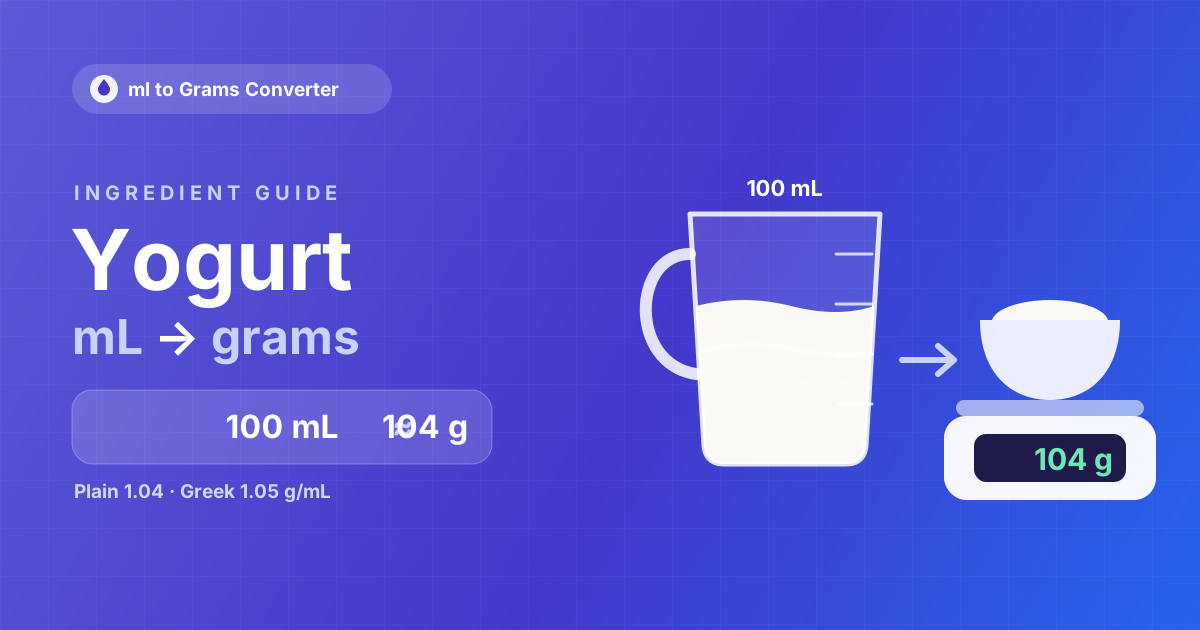
Yogurt is slightly heavier than water. At 1.04 g/mL, 100 mL of plain yogurt weighs about 104 g, while Greek yogurt, figured at 1.05 g/mL, comes to about 105 g for the same volume. A US cup (240 mL) of plain yogurt is about 250 g.
The two densities are so close that the style of yogurt matters less than how you fill the measure. Thick yogurt spooned loosely into a cup traps air, so a scale can read lower than any chart. The table below covers the volumes recipes ask for most often.
Yogurt mL to grams chart: plain vs Greek
| Volume (mL) | Plain yogurt, 1.04 (g) | Greek yogurt, 1.05 (g) |
|---|---|---|
| 5 mL | 5.2 g | 5.3 g |
| 10 mL | 10.4 g | 10.5 g |
| 15 mL | 15.6 g | 15.8 g |
| 30 mL | 31 g | 32 g |
| 50 mL | 52 g | 53 g |
| 60 mL | 62 g | 63 g |
| 100 mL | 104 g | 105 g |
| 125 mL | 130 g | 131 g |
| 150 mL | 156 g | 158 g |
| 170 mL | 177 g | 179 g |
| 200 mL | 208 g | 210 g |
| 240 mL | 250 g | 252 g |
| 250 mL | 260 g | 263 g |
| 300 mL | 312 g | 315 g |
| 400 mL | 416 g | 420 g |
| 500 mL | 520 g | 525 g |
Plain yogurt values use 1.04 g/mL, which is the “Yogurt” option in the converter, and Greek yogurt values use 1.05 g/mL, the “Greek Yogurt” option. The chart therefore matches what the calculator on the homepage returns. Both columns assume yogurt stirred smooth and filled to the line with no air gaps. Amounts under 20 g are shown to one decimal place; larger ones are rounded to the nearest gram.
Where the 1.04 and 1.05 figures come from
USDA FoodData Central lists both plain whole-milk yogurt and plain low-fat yogurt at 245 g per cup, which works out to about 1.035 g/mL. The converter’s 1.04 is that figure rounded, so for everyday plain yogurt the chart rests on measured data.
Greek yogurt is less settled. The USDA’s survey database (FNDDS) gives Greek yogurt the same 245 g per cup at every fat level, which looks like an assigned serving value rather than a separate measurement. No authoritative density specific to Greek yogurt turned up in our research. Treat 1.05 g/mL as a practical approximation: a touch heavier than plain yogurt, reflecting the thicker strained product, and well inside the range the reference data supports.
You may also see a much higher figure, 1.18 g/mL, quoted for Greek yogurt on conversion sites. We could not trace it to any measurement or official table, and neither the USDA data nor brand labels back it up. Using it would inflate every Greek yogurt conversion you make.
How to convert yogurt from mL to grams
Multiply the volume by the density:
grams = mL × density
- Plain:
100 mL × 1.04 g/mL = 104 g - Greek:
100 mL × 1.05 g/mL = 105 g
Because yogurt sits close to 1 g/mL, treating milliliters as grams gets you near the right answer, but it runs consistently low. For example, 250 mL of plain yogurt is about 260 g, not 250 g. In a quick sauce that hardly matters. In a cake where yogurt is one of the main wet ingredients, use the real figure.
Enter your exact volume and select Yogurt or Greek Yogurt in the mL to Grams Converter to calculate another amount. The same page explains the general formula for any ingredient.
Plain vs Greek yogurt: thickness matters more than density
Greek yogurt is yogurt that has been strained to remove whey. What remains is thicker and higher in protein, and on paper slightly denser: 1.05 g/mL against 1.04 for plain. In a 100 mL measure the difference is a single gram (104 g against 105 g), which no recipe will notice.
The bigger effect is physical. Thick yogurt doesn’t flow into the corners of a measuring cup the way a liquid does. Spooned in, it folds over itself and traps air pockets, and a cup with pockets in it holds less yogurt. So a loosely filled cup of Greek yogurt can weigh less than the density suggests, even though the yogurt itself is the denser of the two.
Tub labels show how much this varies. Some Greek yogurt brands describe a 170 g serving as 2/3 cup, while others call the same 170 g a 3/4 cup. By the converter density, 170 g of Greek yogurt takes up about 162 mL, which lines up with 2/3 cup (160 mL). A label that calls it three-quarters of a cup (180 mL) is describing a looser, airier cupful. The weight on both labels is identical; only the volume changes, which is exactly why weight is the number to trust.
This is also why answers to “how many grams in a cup of Greek yogurt” range so widely. A US cup packed without gaps comes to about 252 g at the converter density. Spooned in loosely and left unleveled, the same cup weighs less, and by how much depends on the yogurt and the cook.
Other things that change how yogurt measures
- Fat level. Nonfat, 2% and whole-milk yogurts differ in density only slightly, so one chart serves all three.
- Fruit, sugar and thickeners. Flavored yogurts with fruit pieces, added sugar or stabilizers shift further from the chart than fat level does. The converter values are for plain yogurt, so weigh flavored ones.
- Set vs stirred. Set yogurt holds its shape and breaks into firm pieces in a spoon, which leaves gaps in a measure. Stirred yogurt is smooth and settles more evenly. Stir set yogurt smooth before you measure it by volume.
- Skyr and labneh. Both are thicker still than Greek yogurt, so they trap even more air in a cup. Weigh them rather than using a volume conversion.
- Brand. Two tubs both sold as Greek yogurt can differ noticeably in thickness, and the label inconsistency above shows that manufacturers don’t agree on cup measures either.
On spelling: yoghurt (the usual UK form) and yogurt (the US form) are the same food, and every figure on this page applies to both.
Yogurt by the spoon and cup
Recipes written in US units usually give yogurt in tablespoons and cups. This table uses 15 mL for a tablespoon, 240 mL for a US cup and 250 mL for a metric cup, so check which cup your recipe was written with.
| Measure | Plain yogurt (g) | Greek yogurt (g) |
|---|---|---|
| 1 teaspoon (5 mL) | 5.2 g | 5.3 g |
| 1 tablespoon (15 mL) | 15.6 g | 15.8 g |
| 2 tablespoons (30 mL) | 31 g | 32 g |
| 1/4 cup (60 mL) | 62 g | 63 g |
| 1/3 cup (80 mL) | 83 g | 84 g |
| 1/2 cup (120 mL) | 125 g | 126 g |
| 2/3 cup (160 mL) | 166 g | 168 g |
| 3/4 cup (180 mL) | 187 g | 189 g |
| 1 US cup (240 mL) | 250 g | 252 g |
| 1 metric cup (250 mL) | 260 g | 263 g |
At spoon sizes the plain and Greek columns differ by a fraction of a gram, so either works. Even at a full cup they are only a few grams apart; how well you pack the cup has a bigger effect than which column you read. For a breakfast smoothie, 200 mL of plain yogurt is about 208 g, a convenient amount to weigh straight into the blender jar.
Worked examples
Each example multiplies the recipe volume by the density of the yogurt being used.
Yogurt marinade
A chicken marinade calls for 150 mL of plain yogurt.
150 mL × 1.04 g/mL = 156 g
Put the bowl on the scale, tare it, and spoon in about 156 g. Marinades are forgiving, so a few grams either way won’t matter. The main benefit of weighing here is that you skip scraping thick yogurt out of a measuring jug.
Yogurt cake
A loaf cake uses 250 mL of plain yogurt as its main liquid.
250 mL × 1.04 g/mL = 260 g
This is where the conversion earns its place. A loosely filled measure could come in well short of 260 g and leave the batter drier than the recipe intended. Weighing 260 g gives the cake the amount of yogurt it was written for. If you plan to replace some of the yogurt with sour cream, use the figures in the sour cream mL to grams chart for that portion rather than the yogurt numbers.
Tzatziki with Greek yogurt
A tzatziki recipe calls for 250 mL of Greek yogurt.
250 mL × 1.05 g/mL = 262.5 g, so about 263 g.
When shopping for it, remember that a 500 g tub holds roughly 476 mL of Greek yogurt, so one tub covers this recipe with plenty left over. If your recipe gives the yogurt already by weight, you can skip the conversion entirely and weigh from the tub.
Overnight oats
One jar of overnight oats uses 120 mL (1/2 cup) of Greek yogurt.
120 mL × 1.05 g/mL = 126 g
Weigh the yogurt into the jar, tare the scale again, and add the oats on top, so one container does all the measuring. The rolled oats mL to grams chart gives the oat weights for common volumes.
Grams to mL: turning a yogurt weight into volume
Yogurt is sold by weight, so the reverse conversion comes up often. A recipe might say “one 150 g pot” when you are working from a large tub, or you might want to know how many cups a tub will give you. Divide the weight by the density:
mL = grams ÷ density
- Plain:
150 g ÷ 1.04 g/mL = 144 mL - Greek:
170 g ÷ 1.05 g/mL = 162 mL
| Weight (g) | Plain yogurt (mL) | Greek yogurt (mL) |
|---|---|---|
| 15 g | 14.4 mL | 14.3 mL |
| 25 g | 24 mL | 24 mL |
| 50 g | 48 mL | 48 mL |
| 100 g | 96 mL | 95 mL |
| 125 g | 120 mL | 119 mL |
| 150 g | 144 mL | 143 mL |
| 170 g | 163 mL | 162 mL |
| 200 g | 192 mL | 190 mL |
| 250 g | 240 mL | 238 mL |
| 500 g | 481 mL | 476 mL |
| 1,000 g | 962 mL | 952 mL |
Single-serve pots usually come in 150 g or 170 g sizes. Large tubs are typically 500 g or 1 kg, and in the US the big size is 32 oz (907 g). A 1 kg tub of plain yogurt holds about 962 mL, a little under a liter, and the same weight of Greek yogurt is about 952 mL.
The volume these figures give will not always match the cup measure printed on a pot, for the reasons covered above. When a recipe gives yogurt by weight, weighing it is simpler than converting it back to a volume and then trying to fill a cup to that line.
Tips for measuring yogurt accurately
Weigh whenever you can. Tare the bowl and spoon the yogurt straight in. There is no cup to scrape, no air pockets to worry about, and the reading doesn’t depend on how carefully anything was filled.
Stir before measuring. If liquid has collected on the surface, stir it back in unless the recipe asks for drained yogurt. A uniform yogurt measures the way the chart expects.
Use a dry measuring cup for thick yogurt. Greek yogurt sits in a mound in a liquid jug and is hard to read against the markings. Fill a dry cup, press it down with the back of a spoon to collapse air pockets, then level the top with a knife. Runnier plain yogurt can go in a liquid jug read at eye level.
Level your spoons. A heaped tablespoon of Greek yogurt holds far more than 15 mL. For 1 tablespoon at about 15.6 g of plain or 15.8 g of Greek yogurt, level the spoon with a knife.
Scrape the measure clean. Thick yogurt clings to cups and spoons, and what stays behind never reaches the bowl. A flexible spatula recovers most of it; weighing avoids the problem entirely.
Keep substitutions by weight. If you swap skyr, labneh or a flavored yogurt into a recipe written for plain yogurt, match the weight rather than the volume. Likewise, if you thin yogurt with milk for a dressing or smoothie, the milk mL to grams guide covers whole, 2% and skim milk.
For any volume not listed here, select Yogurt or Greek Yogurt in the mL to Grams Converter and it applies the matching density for you.
Frequently asked questions
How many grams is 100 mL of yogurt?
About 104 g for plain yogurt and about 105 g for Greek yogurt. These figures use densities of 1.04 g/mL and 1.05 g/mL, the same values the site’s converter uses.
How many grams is 1 cup of Greek yogurt?
A US cup (240 mL) of Greek yogurt weighs about 252 g when packed without air gaps. Spooned in loosely, it can weigh less, which is why brand labels disagree on how many grams make a cup.
How many grams is 250 mL of yogurt?
About 260 g of plain yogurt or about 263 g of Greek yogurt. That is the size of one metric cup.
Is 1 mL of yogurt equal to 1 gram?
Not quite. Yogurt is slightly denser than water, so 1 mL weighs about 1.04 g for plain yogurt and 1.05 g for Greek yogurt. The difference is small for a spoonful but adds up over larger amounts.
Do yoghurt and yogurt convert the same way?
Yes. Yoghurt is the UK spelling and yogurt the US spelling of the same food, so the same densities and tables apply to both.