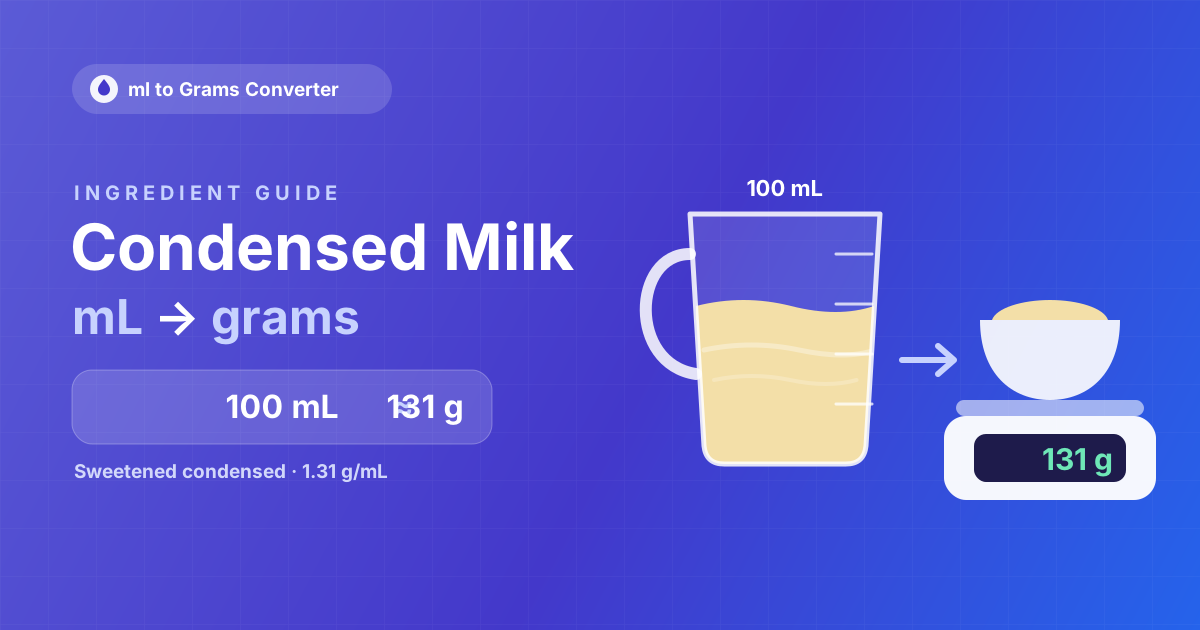
Sweetened condensed milk has a density of about 1.31 g/mL, so 100 mL comes to about 131 g and a single tablespoon (15 mL) to about 19.7 g. The standard 397 g can holds only about 303 mL. Because condensed milk is so much denser than water or plain milk, the gram figure always runs well ahead of the milliliter figure.
Sweetened condensed milk mL to grams chart
The chart covers everything from a teaspoon stirred into coffee to a double batch of fudge. Values under 20 g are rounded to one decimal; larger values are rounded to the nearest gram.
| Volume (mL) | Sweetened condensed milk (g) |
|---|---|
| 5 mL | 6.6 g |
| 10 mL | 13.1 g |
| 15 mL | 19.7 g |
| 30 mL | 39 g |
| 45 mL | 59 g |
| 50 mL | 66 g |
| 60 mL | 79 g |
| 75 mL | 98 g |
| 80 mL | 105 g |
| 100 mL | 131 g |
| 120 mL | 157 g |
| 125 mL | 164 g |
| 150 mL | 197 g |
| 180 mL | 236 g |
| 200 mL | 262 g |
| 240 mL | 314 g |
| 250 mL | 328 g |
| 300 mL | 393 g |
| 400 mL | 524 g |
| 500 mL | 655 g |
Density assumption: 1.31 g/mL for sweetened condensed milk as it comes out of the can, stirred smooth. This is the value behind the Condensed Milk option in the mL to Grams Converter, so the chart and the calculator agree. It does not apply to evaporated milk, which is covered separately further down.
How many mL are in a can of condensed milk?
This is the question most people are really asking, so here is the short version. The standard can in the US is 14 oz (397 g), and UK and EU tins of sweetened condensed milk are also 397 g. At 1.31 g/mL, a 397 g can holds about 303 mL, which is roughly 1 1/4 US cups.
Two details trip people up here:
- The 14 oz on the label is net weight, not fluid ounces. It tells you how much the contents weigh, not how much space they fill. You cannot read it as a volume.
- Some charts overstate the contents. You will find claims that a 397 g can holds 414 mL or 1 3/4 cups. At the density condensed milk actually has, that is too high, and a recipe built on it will come up short.
The division behind the can figure is simple:
397 g ÷ 1.31 g/mL = 303.05 mL, or about 303 mL.
If a recipe says “one can”, the most reliable approach is to use the whole can and scrape it out well. If it gives a volume and you want to know whether one can is enough, compare against the 303 mL figure. A recipe calling for 1 US cup (240 mL) fits comfortably inside one can, while a recipe calling for 400 mL does not: 400 mL weighs about 524 g, which is more than a single 397 g can contains.
Why condensed milk is so heavy
Plain milk weighs only slightly more than water, as our milk mL to grams guide explains. Sweetened condensed milk is a different product. It is milk that has had much of its water cooked off and a lot of sugar added, leaving concentrated milk solids, dissolved sugar and relatively little water. Sugar and milk solids carry far more mass per milliliter than water does, so the whole mixture ends up heavy and thick.
That density is also why guessing is risky. If you treat condensed milk like water and assume every milliliter weighs a gram, you will measure out too much by volume for a gram-based recipe, or too little by weight for a volume-based one. The error is large enough to change how a fudge sets or how sweet a pie filling tastes.
If you are adjusting the sweetness of a recipe and want to weigh plain sugar as well, the sugar mL to grams guide has those figures. Just remember that condensed milk already brings a large dose of sugar with it.
How much brands and batches vary
Published figures for sweetened condensed milk do not agree to the gram, and it helps to know why. Here is what the main references say:
- USDA FoodData Central lists 1 cup at 306 g, which works out to about 1.29 g/mL.
- Eagle Brand’s label gives 2 tablespoons as 39 g, which works out to about 1.32 g/mL.
- King Arthur Baking lists 1/4 cup at 78 g, also about 1.32 g/mL.
The converter’s 1.31 g/mL sits between those values. Sugar content, the amount of milk solids and the rounding used on nutrition labels all move the figure by a couple of percent, so real products fall somewhere around 1.29 to 1.32 g/mL. That spread is small next to the difference between measuring by volume and weighing, so a single working value serves well.
When a recipe already gives condensed milk in grams, follow the grams. The writer weighed their own brand, and matching that weight is more reliable than converting it to a volume and back. The chart is most useful in the opposite situation: a recipe written in cups or milliliters that you would rather weigh.
Temperature is the other variable people worry about. Chilled condensed milk is noticeably stiffer and slower to pour than condensed milk at room temperature, but its density changes only a little. In other words, cold condensed milk is harder to measure accurately in a spoon or cup, yet a gram of it is still a gram. The chart holds whether the can came from the fridge or the cupboard.
Converting mL to grams
The formula is grams = mL × 1.31. Multiply the volume by the density and round the answer to a sensible kitchen figure.
For any amount outside the chart, enter your volume and select Condensed Milk in the mL to Grams Converter. Take care not to choose Evaporated Milk by mistake; both appear in the Milk & Dairy list, only a couple of lines apart, and they give very different results.
Spoon and cup measurements
Plenty of recipes still give condensed milk in cups and spoons, particularly for small amounts like a drink sweetener or a glaze. This table turns those measures into grams:
| Measure | Condensed milk (g) |
|---|---|
| 1 teaspoon (5 mL) | 6.6 g |
| 1 tablespoon (15 mL) | 19.7 g |
| 2 tablespoons (30 mL) | 39 g |
| 1/4 cup (60 mL) | 79 g |
| 1/3 cup (80 mL) | 105 g |
| 1/2 cup (120 mL) | 157 g |
| 2/3 cup (160 mL) | 210 g |
| 3/4 cup (180 mL) | 236 g |
| 1 US cup (240 mL) | 314 g |
Condensed milk clings to spoons and cups, so a measured tablespoon often delivers less than it should. The gram figures above describe what the measure holds, not what drips off it. When the amount matters, weighing gets around the problem completely.
Worked examples
Sweetening a coffee with 2 tablespoons
30 mL × 1.31 g/mL = 39.3 g, or about 39 g.
That matches the 39 g Eagle Brand prints for 2 tablespoons. If you make the same drink every day, weigh it once and you will know exactly what your usual spoonful looks like.
A dessert recipe that calls for 1 US cup
240 mL × 1.31 g/mL = 314.4 g, or about 314 g.
Rather than filling a cup and scraping it out, set the mixing bowl on a scale, tare it, and pour straight from the can until you reach about 314 g. That fits inside a single 397 g can, with some left over for another use.
Scaling a recipe down to 125 mL
125 mL × 1.31 g/mL = 163.75 g, which rounds to about 164 g.
Awkward volumes like this are where a scale really pays off. Leveling half a metric cup of something this thick is slow, while pouring to 164 g takes seconds.
Grams to mL
To go from weight back to volume, divide by the density: mL = grams ÷ 1.31. This helps when a recipe lists condensed milk in grams and you only have measuring cups, or when you want to know how much of a can a recipe will use.
| Weight (g) | Condensed milk (mL) |
|---|---|
| 25 g | 19.1 mL |
| 50 g | 38 mL |
| 100 g | 76 mL |
| 150 g | 115 mL |
| 200 g | 153 mL |
| 250 g | 191 mL |
| 300 g | 229 mL |
| 397 g | 303 mL |
| 400 g | 305 mL |
| 500 g | 382 mL |
Two examples:
- A recipe asks for 100 g.
100 g ÷ 1.31 g/mL = 76.34 mL, so measure about 76 mL. - A recipe asks for 200 g.
200 g ÷ 1.31 g/mL = 152.67 mL, or about 153 mL.
Notice how much smaller the milliliter figure is than the gram figure. With plain milk the two numbers sit close together, but with condensed milk the volume is always clearly below the weight.
Sweetened condensed vs evaporated milk
Evaporated milk and sweetened condensed milk are often shelved together and come in similar cans, but they are not interchangeable. Evaporated milk is unsweetened milk with about 60% of its water removed. It is thinner, not sweet, and much lighter per milliliter. The converter uses 1.067 g/mL for evaporated milk, and USDA lists 1 cup at 252 g, about 1.065 g/mL.
Here is how far apart the two are at the same volume:
| Volume (mL) | Sweetened condensed, 1.31 (g) | Evaporated, 1.067 (g) |
|---|---|---|
| 15 mL | 19.7 g | 16 g |
| 60 mL | 79 g | 64 g |
| 100 mL | 131 g | 107 g |
| 120 mL | 157 g | 128 g |
| 240 mL | 314 g | 256 g |
| 250 mL | 328 g | 267 g |
Never use the evaporated milk density for condensed milk, or the other way round, and never swap one for the other in a recipe without adjusting the sugar and texture. The packaging adds to the confusion:
- US evaporated milk (Carnation) comes in a 12 fl oz (354 mL) can, sold by volume. That can weighs about 378 g of evaporated milk.
- UK evaporated milk (Carnation) comes in a 410 g tin, sold by weight.
410 g ÷ 1.067 g/mL = 384.25 mL, so about 384 mL. - Sweetened condensed milk is sold by weight in both markets, in the 397 g can.
Mixing up the densities produces errors you would notice in the finished dish. Apply the condensed milk figure to that 354 mL can of evaporated milk and you would expect about 464 g, well above the roughly 378 g it really holds. Run the UK 410 g tin through the condensed milk density and you would get about 313 mL, when the tin actually contains about 384 mL. Pick the right option first, then convert.
Some desserts, tres leches cake among them, combine evaporated milk, condensed milk and cream in a single recipe. Measure each one with its own density; for the cream, the cream mL to grams guide has the right numbers.
Getting every gram out of the can
Condensed milk is thick and sticky, so a lot of it stays behind if you are not careful. A few habits help:
- Scrape with a flexible spatula. Run it around the inside of the can and under the rim. What stays in the can is not in your recipe, and with a product this heavy that can be a meaningful amount.
- Weigh instead of measuring. Put your bowl on a scale, tare it, and pour directly from the can. The scale shows what actually went in, including whatever you scraped out.
- Let it come to room temperature. Its density barely changes with temperature, but its thickness changes a lot. Warmer condensed milk pours and scrapes far more easily than cold.
- Use the can as a reference point. If a recipe uses “half a can”, weigh the full can’s contents into a bowl first and then divide by weight rather than by eye.
Dulce de leche deserves a special mention. It is condensed milk that has been cooked until thick and caramelized, which makes it even harder to level in a cup. Weigh it rather than measuring it by volume.
Part cans, leftovers and recipes that say “1 can”
Using part of a can
Plenty of recipes need only some of a can. Based on the standard 397 g can:
- Half a can is about 199 g, or roughly 152 mL.
- A quarter of a can is about 99 g, or roughly 76 mL. That is close to 5 tablespoons (75 mL), which weigh about 98 g.
You do not have to empty the whole can into a bowl to measure part of it. Put the opened can on the scale and note the reading, then pour or spoon into your recipe until the reading has dropped by the amount you need. The can’s own weight never enters the calculation.
Storing and re-measuring leftovers
Once opened, move what is left into a clean container with a lid and keep it in the fridge, following the storage advice on the label. Weigh the empty container before you fill it and write that weight on the lid. Later, weigh the full container and subtract the figure on the lid to see exactly how many grams remain, without scraping anything out to check. If the next recipe needs 150 g and the container holds more than that, you know there is enough before you start.
When a recipe says “1 can”
Because the standard can is 397 g in both the US and the UK, a recipe that lists “1 can” means about 397 g, or roughly 303 mL. If your condensed milk comes in a different pack, check the net weight printed on it. Below 397 g, make up the difference from a second pack; above it, weigh out 397 g and store the rest.
Larger batches follow the same logic. A recipe calling for 1 1/2 cans needs about 596 g, or roughly 455 mL. For 2 cans, weigh about 794 g, or measure roughly 606 mL. That second figure is more than two US cups, so weighing is far quicker than filling and scraping a cup three times.
Frequently asked questions
How many grams is 100 mL of condensed milk?
About 131 g, based on a density of 1.31 g/mL for sweetened condensed milk. Brand differences can move that by a couple of percent either way.
How many mL are in a 397 g can of condensed milk?
About 303 mL, which is roughly 1 1/4 US cups. The 397 g (14 oz) on the label is net weight, not a fluid measure.
How many grams is 1 cup of sweetened condensed milk?
A US cup (240 mL) weighs about 314 g at 1.31 g/mL. USDA lists 306 g for a cup, so expect published figures to vary slightly.
Can I use evaporated milk figures for condensed milk?
No. Evaporated milk is unsweetened and much lighter at about 1.067 g/mL, while sweetened condensed milk is about 1.31 g/mL. Using the wrong density or swapping the two in a recipe will throw off both the quantity and the sweetness.