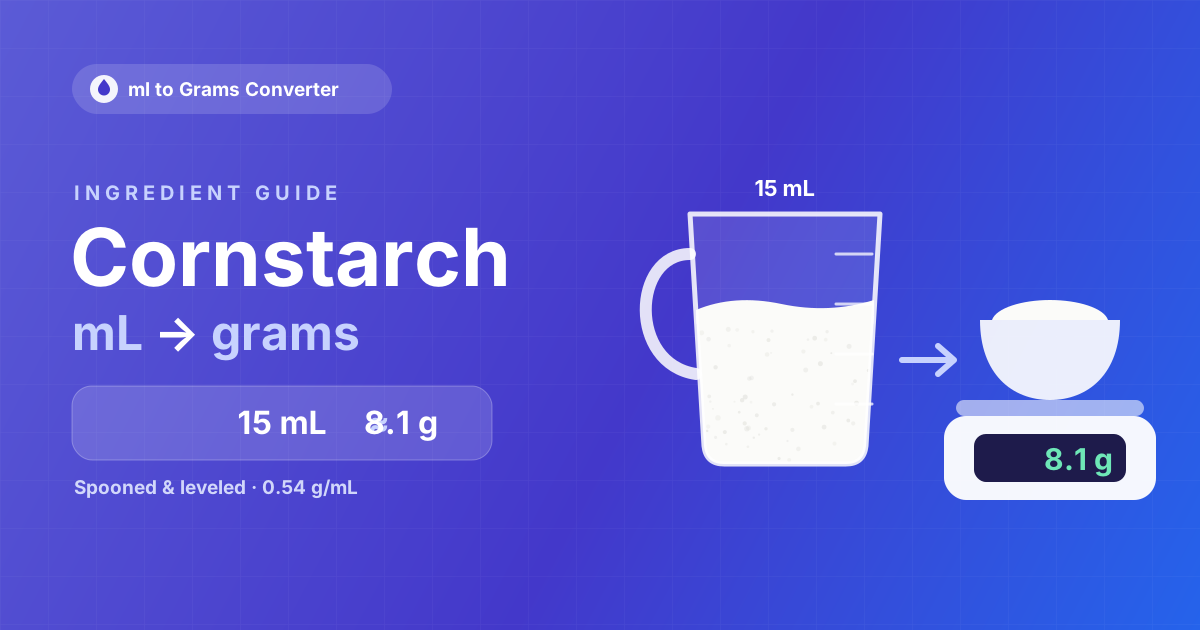
Cornstarch weighs about 0.54 g/mL when it is spooned into the measure and leveled, so 1 tablespoon (15 mL) comes to about 8.1 g and 100 mL comes to about 54 g. Put simply, a measure of cornstarch weighs a little over half as many grams as it holds in mL. That is the same density the Cornstarch option in our converter uses, and it agrees with USDA data and the two biggest brand labels.
The chart below covers the amounts most recipes use. Further down you will find spoon and cup weights, grams to mL, and the reason one tablespoon can weigh anywhere from about 7 to 10 g depending on how you fill it.
Cornstarch mL to grams chart
Every value assumes cornstarch that has been stirred loose, spooned into the measure and leveled, at 0.54 g/mL.
| Volume (mL) | Cornstarch (g) |
|---|---|
| 2.5 mL | 1.4 g |
| 5 mL | 2.7 g |
| 7.5 mL | 4.1 g |
| 10 mL | 5.4 g |
| 15 mL | 8.1 g |
| 20 mL | 10.8 g |
| 25 mL | 13.5 g |
| 30 mL | 16.2 g |
| 45 mL | 24 g |
| 50 mL | 27 g |
| 60 mL | 32 g |
| 75 mL | 41 g |
| 80 mL | 43 g |
| 100 mL | 54 g |
| 120 mL | 65 g |
| 125 mL | 68 g |
| 150 mL | 81 g |
| 200 mL | 108 g |
| 240 mL | 130 g |
| 250 mL | 135 g |
Weights are rounded to one decimal place below 20 g and to whole grams from 20 g up, which is as fine as any home kitchen needs.
What the 0.54 g/mL figure assumes
The density describes cornstarch in its loose, everyday state: powder that has been stirred in the box, spooned into a measuring spoon or cup, and leveled with a straight edge. Nobody has tapped the measure on the counter or pressed the powder down. If you scoop straight from a settled box, expect your spoon to hold more than the chart says. If you sift first, expect it to hold a little less.
This is also the exact value behind the Cornstarch setting in the site’s calculator, so the chart, the examples in this article and the converter all give matching answers.
Teaspoons, tablespoons and cups of cornstarch
Most cooking uses cornstarch a spoonful at a time, so the small measures are the ones worth memorizing. Spoon sizes here are metric (a 5 mL teaspoon and a 15 mL tablespoon), and the cup is the 240 mL US cup used across this site.
| Measure | Cornstarch (g) |
|---|---|
| 1/4 teaspoon (1.25 mL) | 0.7 g |
| 1/2 teaspoon (2.5 mL) | 1.4 g |
| 1 teaspoon (5 mL) | 2.7 g |
| 1/2 tablespoon (7.5 mL) | 4.1 g |
| 2 teaspoons (10 mL) | 5.4 g |
| 1 tablespoon (15 mL) | 8.1 g |
| 2 tablespoons (30 mL) | 16.2 g |
| 1/4 cup (60 mL) | 32 g |
| 1/3 cup (80 mL) | 43 g |
| 1/2 cup (120 mL) | 65 g |
| 1 US cup (240 mL) | 130 g |
Three numbers cover almost every savory recipe: a teaspoon is about 2.7 g, a tablespoon about 8.1 g, and two tablespoons about 16.2 g. Below a teaspoon, the weights are too small for a scale that reads in whole grams to show accurately, so a level measuring spoon is the better tool there.
Why one tablespoon can weigh 7 g or 10 g
Cornstarch is an extremely fine powder. Left alone in a box, it settles and compacts. Dragged through with a spoon, it packs into the bowl of the spoon. Stirred or sifted, it traps air and fluffs up. All three states can fill the same 15 mL tablespoon, and each one puts a different amount of starch in it.
That is why published figures for a single tablespoon run from about 7 g at the light end to about 10 g at the firm end. Neither end is wrong. They describe different ways of filling a spoon. The spooned-and-leveled method sits in the middle of that range, and it is the one that is easiest to repeat from one day to the next.
For a tablespoon or two in a gravy, a spread of a gram or two makes little visible difference. For a half cup in a baking recipe, the same proportional error adds up to several grams, and that is where a scale earns its place on the counter.
What references and labels say
Here is how the main sources compare. The numbers are exactly as each source publishes them.
| Source | Measure | Weight |
|---|---|---|
| USDA FoodData Central | 1 cup | 128 g |
| Argo and Bob’s Red Mill labels | 1 tablespoon | 8 g |
| Clabber Girl label | 1 tablespoon | 10 g |
| King Arthur Baking | 1/4 cup | 28 g |
USDA’s cup figure and the Argo and Bob’s Red Mill tablespoon both work out to the same 0.54 g/mL, which is why this site uses it. You can look up the USDA entry yourself in USDA FoodData Central. Clabber Girl’s 10 g tablespoon reflects a much firmer fill. King Arthur’s quarter cup works out to about 0.47 g/mL, which fits a very light, airy spoon-in.
Some online calculators use 0.507 g/mL, taken from an FAO database, and at least one uses a figure as high as 0.63. USDA and the major brand labels agree on 0.54, so that is the best single number for everyday use.
The practical lesson: when a recipe prints both a volume and a weight, follow the weight. It tells you how the recipe writer actually measured, whichever method they used.
Cornstarch, cornflour, corn flour and cornmeal
The naming trips up a lot of cooks. In the UK and Australia, the fine white starch sold in the US as cornstarch is called cornflour. Same product, different label. If a British recipe asks for cornflour, this chart applies.
In the US, “corn flour” means something else: finely ground whole corn, a different product from the pure starch. Cornmeal is different again. Do not substitute any of them for cornstarch by volume, and do not use the numbers on this page for them.
The mix-up usually happens with recipes that cross borders. A British or Australian recipe that asks for cornflour wants the fine white starch covered here, while an American recipe that asks for corn flour wants ground corn. Read the ingredient in context before you reach for the box.
How to convert cornstarch mL to grams
The conversion is a single multiplication:
grams = mL × 0.54
So 30 mL × 0.54 g/mL = 16.2 g. Going the other way, divide by the same number: mL = grams ÷ 0.54.
Keep in mind that mL measures volume and grams measure mass. The two only line up one for one when an ingredient’s density is about 1 g/mL, as it is for water. Cornstarch is far lighter than that, so 100 mL of it is nowhere near 100 g.
For a volume that is not in the chart, enter your exact amount and select Cornstarch in the mL to Grams Converter. It uses the same 0.54 g/mL, so its answer will match this page. Other powders need their own density: all-purpose flour, for example, has its own figure in the flour mL to grams chart, and cornstarch numbers should not be reused for it.
Worked examples
A fruit pie filling that calls for 2 tablespoons. Two tablespoons is 30 mL. 30 mL × 0.54 g/mL = 16.2 g. If your scale only shows whole grams, set it to the nearest one and you are well within the normal range for a spooned measure.
A pan sauce thickened with 1 tablespoon. One tablespoon is 15 mL. 15 mL × 0.54 g/mL = 8.1 g. That matches the 8 g printed on the Argo and Bob’s Red Mill labels, so if you are reading the nutrition panel as a guide, you are measuring the same way they do.
A baking recipe that uses 1/2 cup. Half a US cup is 120 mL. 120 mL × 0.54 g/mL = 64.8 g, or about 65 g. This is the size of measure where packing matters most. A firmly scooped half cup will hold noticeably more than 65 g, so if the recipe was written by weight, weigh it.
A metric recipe listing 45 mL. 45 mL × 0.54 g/mL = 24.3 g, which rounds to about 24 g. If the same recipe calls the ingredient cornflour and comes from the UK or Australia, it means cornstarch, and this number applies unchanged.
Grams to mL for cornstarch
Recipes written by weight are easy to follow with a scale. Without one, divide the grams by 0.54 to get the volume, then measure it with spoons or a small jug.
| Weight (g) | Cornstarch (mL) |
|---|---|
| 5 g | 9.3 mL |
| 8 g | 14.8 mL |
| 10 g | 18.5 mL |
| 15 g | 28 mL |
| 20 g | 37 mL |
| 25 g | 46 mL |
| 30 g | 56 mL |
| 40 g | 74 mL |
| 50 g | 93 mL |
| 100 g | 185 mL |
| 200 g | 370 mL |
A few conversions come up often:
8 g ÷ 0.54 g/mL = 14.81 mL. An 8 g serving is essentially one level 15 mL tablespoon, which is why brand labels use it.25 g ÷ 0.54 g/mL = 46.3 mL, or about 46 mL. That is just over the 45 mL line in the chart above.100 g ÷ 0.54 g/mL = 185.19 mL, or about 185 mL. Well short of a full 240 mL US cup, even though 100 g sounds like a lot.
Reverse conversions have the same packing caveat as forward ones. The volumes assume you spoon and level; press the powder in and you will overshoot the weight.
Scaling cornstarch when you halve or multiply a recipe
Scaling is where spoon measures get awkward. Halve a recipe that uses 1 tablespoon and you need 1/2 tablespoon, about 4.1 g. Make one and a half batches of a sauce that uses 1 tablespoon and you need 1 1/2 tablespoons (22.5 mL), about 12.2 g. Neither amount is a single spoon in most measuring sets, and adding two or three partial spoons stacks up the small errors from each one.
Converting to grams first makes the arithmetic simple. A pie filling that uses 3 tablespoons (45 mL) needs about 24 g; tripling the recipe means 90 mL × 0.54 g/mL = 48.6 g, so weigh about 49 g rather than counting out nine separate tablespoons. For a party-sized batch of gravy, this is also the quickest way to measure: set the bowl on the scale, tare it, and spoon in cornstarch until you reach the target.
Keep the thickening ratio in mind when you scale. Cornstarch should rise in step with the liquid it is thickening, so if you double the liquid, double the cornstarch weight too.
Storage affects the next measurement as well. Cornstarch that has picked up moisture forms small, hard lumps, and those lumps sit in a spoon differently from loose powder. Keep the box closed and dry, and break up any lumps before you spoon and level.
Thickening with cornstarch: the short version
In sauces, gravies, puddings and fruit fillings, cornstarch is there to thicken. The one rule that saves the most trouble: mix it with a little cold liquid first to make a smooth slurry, then stir that into the hot liquid. Dry cornstarch dropped straight into something hot tends to form lumps that are hard to break up.
A common starting point is about 1 tablespoon of cornstarch to thicken 1 cup of liquid to a light sauce. By weight, that tablespoon is about 8.1 g. Recipes vary a lot beyond that, depending on how thick the finished dish should be, so treat it as a starting place rather than a fixed ratio.
If the liquid is milk, as in a custard or pudding, you can weigh that too. The milk mL to grams guide has the numbers.
Tips for measuring cornstarch accurately
- Loosen the box first. Give the powder a stir with a spoon before measuring. Settled cornstarch is denser than the chart assumes.
- Spoon it in, then level it. Fill the measure with a second spoon and sweep off the excess with the back of a knife. Do not tap the measure or press the powder down.
- Avoid scooping with the measuring spoon itself. Pushing the spoon through the box packs the powder and is the main reason people end up with 10 g tablespoons.
- Weigh anything from about 1/4 cup up. At that size, the difference between a light and a firm fill is several grams. Place the bowl on the scale, press tare, and spoon cornstarch in until you reach the weight.
- Use spoons for tiny amounts. Under a teaspoon, a level measuring spoon is more consistent than a kitchen scale that reads in whole grams.
- Check your spoon size. The tables use a 15 mL tablespoon and a 5 mL teaspoon. Use a proper measuring set rather than cutlery, which varies widely.
- Trust the recipe’s grams. If a recipe gives both cups and grams, the grams show how the author filled the cup.
The same spoon-and-level method works for other fine powders, including leaveners. For teaspoon-scale weights of those, see baking powder and baking soda mL to grams.
Frequently asked questions
How many grams is 1 tablespoon of cornstarch?
A level tablespoon of cornstarch weighs about 8.1 g when spooned in and leveled. The Argo and Bob’s Red Mill labels list 8 g, while a packed or heaped spoon can reach about 10 g.
How many grams is 100 mL of cornstarch?
At 0.54 g/mL, 100 mL of cornstarch is about 54 g. That assumes the powder was spooned into the measure and leveled rather than packed.
Is cornflour the same as cornstarch?
In the UK and Australia, yes: cornflour is the name for the fine white starch sold as cornstarch in the US. In the US, corn flour is finely ground whole corn, a different product that should not be swapped for cornstarch.
How many mL is 10 g of cornstarch?
Ten grams of cornstarch is about 18.5 mL, because 10 g divided by 0.54 g/mL gives 18.52 mL. That is a little more than one level tablespoon.
Why do other charts give different weights for cornstarch?
Different sources measure differently and use different densities, from about 0.47 g/mL for a very light fill to 0.63 g/mL at the high end. USDA and the main brand labels agree on 0.54 g/mL, which is the figure used here and in the converter.